Industry-Verified Manufacturing Data (2026)

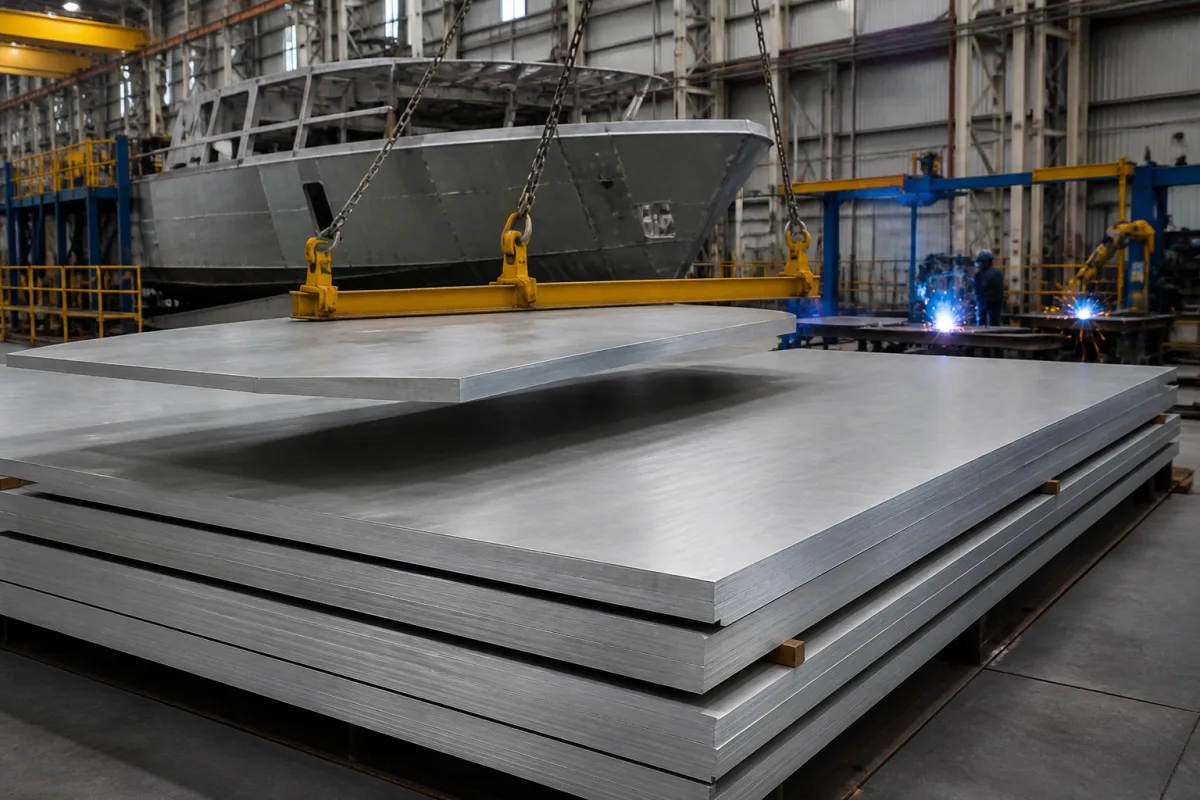
Marine-Grade Aluminum Alloy Plate

Based on aggregated insights from multiple verified factory profiles within the CNFX directory, the standard Marine-Grade Aluminum Alloy Plate used in the Other Transport Equipment Manufacturing sector typically supports operational capacities ranging from standard industrial configurations to heavy-duty production requirements.

Technical Definition & Core Assembly

A canonical Marine-Grade Aluminum Alloy Plate is characterized by the integration of Aluminum Matrix and Alloying Elements. In industrial production environments, manufacturers listed on CNFX commonly emphasize Aluminum construction to support stable, high-cycle operation across diverse manufacturing scenarios.

High-strength aluminum alloy plate specifically engineered for marine vessel construction

Product Specifications

Technical details and manufacturing context for Marine-Grade Aluminum Alloy Plate

Definition
Marine-grade aluminum alloy plate is a semi-finished industrial material produced through controlled rolling and heat treatment processes to achieve optimal mechanical properties for shipbuilding applications. This material offers an excellent strength-to-weight ratio, superior corrosion resistance in saltwater environments, and good weldability for structural fabrication. It is specifically formulated to withstand the dynamic stresses and harsh marine conditions encountered by vessels throughout their operational lifespan. The alloy composition is carefully balanced to provide durability while maintaining formability during hull and superstructure manufacturing.
Working Principle
The aluminum alloy achieves its marine-grade properties through precise metallurgical composition and controlled thermomechanical processing, creating a microstructure that balances strength, ductility, and corrosion resistance.
Common Materials
Aluminum, Magnesium, Manganese, Silicon
Technical Parameters
  • Standard plate thickness range (mm) Customizable
  • Minimum yield strength requirement (MPa) Customizable
Components / BOM
  • Aluminum Matrix
    Primary metallic base providing structural integrity
    Material: Pure aluminum with alloying elements
  • Alloying Elements
    Enhance mechanical properties and corrosion resistance
    Material: Magnesium, manganese, silicon compounds
  • Surface Treatment Optional
    Optional protective coating for enhanced durability
    Material: Chemical conversion coating or anodizing
Engineering Reasoning
0-150 MPa tensile stress, -40°C to 80°C temperature, 0-3.5% NaCl concentration in seawater
Corrosion fatigue crack propagation at stress intensity factor threshold ΔK_th = 5.8 MPa√m in 3.5% NaCl solution
Design Rationale: Pitting corrosion initiation at chloride ion concentration >0.5% NaCl, followed by stress corrosion cracking at sustained tensile stress >30% of yield strength (σ_y = 345 MPa)
Risk Mitigation (FMEA)
Trigger Galvanic coupling with copper-based alloys (E_cu = +0.34V vs SHE) creating 0.8V potential difference
Mode: Accelerated pitting corrosion at rate >0.5 mm/year in seawater
Strategy: Dielectric isolation using neoprene gaskets (thickness ≥3 mm) and cathodic protection with zinc anodes (consumption rate 7.8 kg/A-year)
Trigger Cyclic wave loading at frequency 0.1-0.3 Hz exceeding fatigue limit σ_f = 110 MPa for 10^7 cycles
Mode: Intergranular crack propagation from corrosion pits (aspect ratio >3:1)
Strategy: Shot peening to induce compressive residual stress of -200 MPa to depth 0.3 mm, reducing stress intensity factor by 40%

Industry Taxonomies & Aliases

Commonly used trade names and technical identifiers for Marine-Grade Aluminum Alloy Plate.

Industrial Ecosystem & Supply Chain DNA

Complementary Systems
Downstream Applications
Specialized Tooling

Application Fit & Sizing Matrix

Operational Limits
pressure: Up to 100 MPa (static), 50 MPa (dynamic)
other spec: Seawater exposure rating: ISO 12944 C5-M, Corrosion allowance: 2 mm minimum
temperature: -50°C to 150°C
Media Compatibility
✓ Seawater immersion ✓ Marine atmospheric conditions ✓ Brine solutions
Unsuitable: Concentrated acidic environments (pH < 4)
Sizing Data Required
  • Maximum design load (kN/m²)
  • Required corrosion allowance (mm)
  • Vessel structural span (m)

Reliability & Engineering Risk Analysis

Failure Mode & Root Cause
Galvanic corrosion
Cause: Contact with dissimilar metals in seawater, creating electrochemical cells that accelerate aluminum dissolution, especially at joints or fasteners.
Stress corrosion cracking (SCC)
Cause: Combination of tensile stress (from fabrication, welding, or service loads) and corrosive marine environment, particularly in chloride-rich seawater, leading to crack propagation.
Maintenance Indicators
  • White powdery deposits (aluminum oxide) or localized pitting on the surface, indicating active corrosion.
  • Audible cracking or popping sounds under load, suggesting stress corrosion cracking or fatigue failure initiation.
Engineering Tips
  • Apply protective coatings (e.g., anodizing or marine-grade paint systems) and use galvanic isolation (e.g., insulating gaskets or sacrificial anodes) to prevent galvanic corrosion.
  • Implement regular non-destructive testing (NDT) such as ultrasonic or dye penetrant inspection to detect early-stage cracks, especially in high-stress areas like welds and fastener holes.

Compliance & Manufacturing Standards

Reference Standards
ASTM B928/B928M - Standard Specification for High Magnesium Aluminum-Alloy Sheet and Plate for Marine Service ISO 6362-2 - Wrought aluminum and aluminum alloys - Extruded rods/bars, tubes and profiles - Part 2: Mechanical properties EN 485-2 - Aluminum and aluminum alloys - Sheet, strip and plate - Part 2: Mechanical properties
Manufacturing Precision
  • Thickness: +/- 0.1 mm for plates up to 6 mm thick
  • Flatness: 0.2 mm per 100 mm of length
Quality Inspection
  • Salt Spray Test (ASTM B117) - Corrosion resistance verification
  • Ultrasonic Testing (ASTM E2375) - Internal defect detection

Factories Producing Marine-Grade Aluminum Alloy Plate

Verified manufacturers with capability to produce this product in China

✓ 95% Supplier Capability Match Found

S Sourcing Manager from Brazil Feb 05, 2026
★★★★★
"As a professional in the Other Transport Equipment Manufacturing sector, I confirm this Marine-Grade Aluminum Alloy Plate meets all ISO standards."
Technical Specifications Verified
P Procurement Specialist from Canada Feb 02, 2026
★★★★☆
"Standard OEM quality for Other Transport Equipment Manufacturing applications. The Marine-Grade Aluminum Alloy Plate arrived with full certification. (Delivery took slightly longer than expected, but technical support was excellent.)"
Technical Specifications Verified
T Technical Director from United States Jan 30, 2026
★★★★★
"Great transparency on the Marine-Grade Aluminum Alloy Plate components. Essential for our Other Transport Equipment Manufacturing supply chain."
Technical Specifications Verified
Verification Protocol

“Feedback is collected from verified sourcing managers during RFQ (Request for Quote) and factory evaluation processes on CNFX. These reports represent historical performance data and technical audit summaries from our B2B manufacturing network.”

7 sourcing managers are analyzing this specification now. Last inquiry for Marine-Grade Aluminum Alloy Plate from India (51m ago).

Supply Chain Commonly Integrated Components

Main Bending Roller

The primary cylindrical component that applies bending force to marine hull plates during the forming process.

Explore Specs →
Plate Support Table

A structural component of a Marine Hull Plate Bending Roller that provides stable support and alignment for steel plates during the bending process.

Explore Specs →
Plate Conveyor System

A mechanical system designed to transport steel plates through the shot blasting process in marine hull manufacturing.

Explore Specs →
Dust Collector

A filtration system that captures and removes abrasive dust and debris generated during shot blasting operations.

Explore Specs →

Frequently Asked Questions

What makes this aluminum alloy plate suitable for marine applications?

This marine-grade aluminum alloy plate is specifically engineered with aluminum, magnesium, manganese, and silicon to provide exceptional corrosion resistance against saltwater, high strength-to-weight ratio, and durability required for shipbuilding and marine vessel construction.

What are the key specifications for this marine aluminum plate?

Key specifications include tensile strength (MPa), yield strength (MPa), elongation (%), thickness (mm), width (mm), and length (mm). These parameters ensure structural integrity and performance in demanding marine environments.

How does the surface treatment enhance this aluminum plate's performance?

The surface treatment provides additional protection against corrosion, improves paint adhesion, and enhances the plate's longevity in harsh marine conditions, making it ideal for hulls, decks, and structural components in shipbuilding.

Can I contact factories directly on CNFX?

CNFX is an open directory, not a transaction platform. Each factory profile provides direct contact information and production details to help you initiate direct inquiries with Chinese suppliers.

Get Quote for Marine-Grade Aluminum Alloy Plate

Request technical pricing, lead times, or customized specifications for Marine-Grade Aluminum Alloy Plate directly from verified manufacturing units.

Your business information is encrypted and only shared with verified Marine-Grade Aluminum Alloy Plate suppliers.

Thank you! Your message has been sent. We'll respond within 1–3 business days.

Need to Manufacture Marine-Grade Aluminum Alloy Plate?

Connect with verified factories specializing in this product category

Add Your Factory Contact Us
Previous Product
Marine Riser System
Next Product
Mast Base