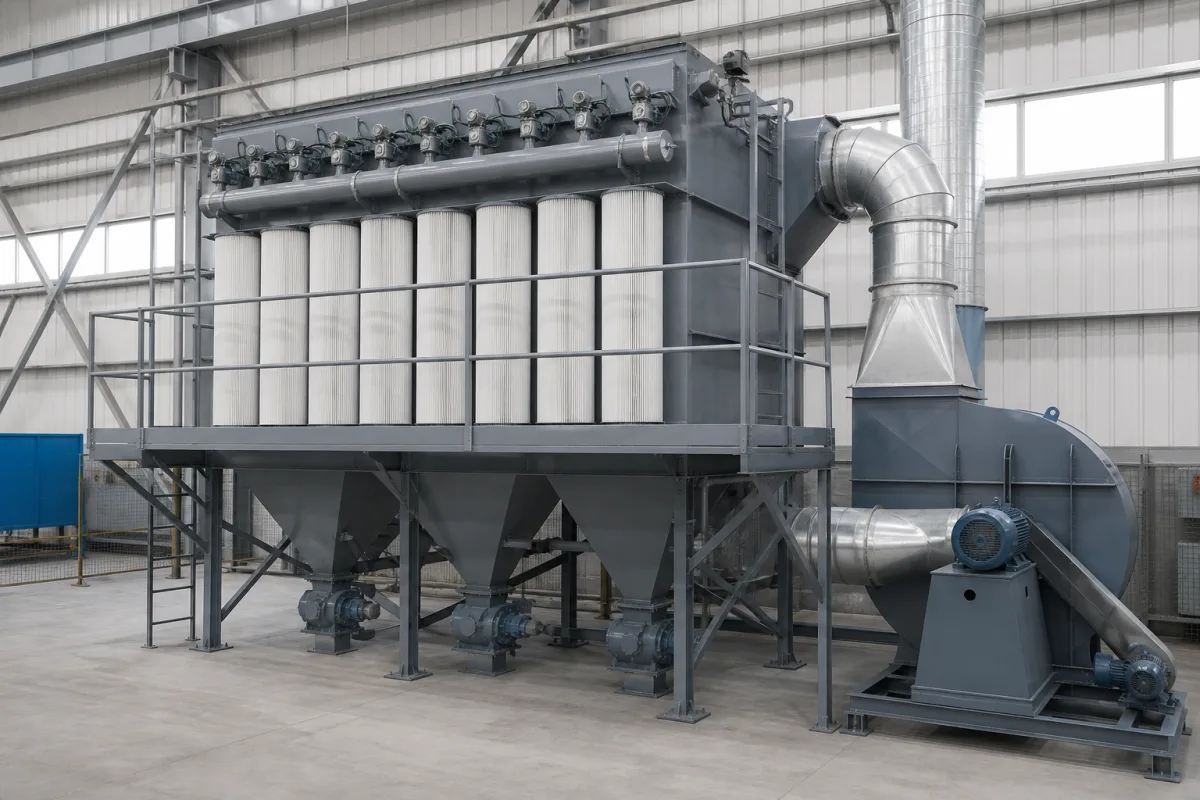
Air pollution control · The dust decides the filter
A dust collector separates particles from an air or gas stream before it is discharged or returned to the building. The right design depends on the dust's particle size, loading, temperature, moisture and whether it can burn. Describe the dust and the airflow first; the filter type, size and safety features follow.
Industrial dust collectors: cyclones, pulse-jet bag filters (baghouses), cartridge collectors, and oil-mist and fume collectors for process and workshop extraction. Wet scrubbers and electrostatic precipitators are separate technologies.
CNFX editorial research · Sources checked October 12, 2026 · 5 sources
Choose the collector type from the dust and airflow
The US EPA's technology fact sheets describe pulse-jet fabric filters (baghouses) and cartridge collectors; suppliers also offer cyclones and mist collectors. Each suits a different combination of particle size, loading, temperature and airflow.
Type
What the sources say
Ask for
Cyclone
Mechanical separator for coarser particles; used as a collector or a pre-cleaner, for example on shot-blasting machines. [4] EPA: "when much of the pollutant loading consists of relatively large particles, mechanical collectors such as cyclones may be used to reduce the load on the fabric filter". [1]
Cut size and efficiency curve for your particle size distribution.
Pulse-jet baghouse
EPA: "typical new equipment design efficiencies are between 99 and 99.9%"; felt bags cleaned by compressed-air pulses allow higher air-to-cloth ratios and smaller units than other fabric filters. [1]
Bag fabric, air-to-cloth ratio, cleaning control and compartmentation.
Cartridge collector
Pleated paper or non-woven cartridges in factory-built units for lower airflows; EPA: "typical new equipment design efficiencies are between 99.99 and 99.999+%". [2]
Media type, temperature limit and the dust's tendency to bridge pleats.
Oil-mist and fume collectors
Separate products for machining mist and welding fume. [5]
Media for oil or fume, and drainage.
EPA describes fabric filters as constant-outlet rather than constant-efficiency devices: outlet particle concentration "is nearly constant, whereas the overall efficiency is more likely to vary with particulate loading". Specify the outlet concentration you need, not just an efficiency percentage. [1]
02
Size the filter by air-to-cloth ratio and pressure drop
EPA explains that baghouse size is set by the air-to-cloth ratio, the airflow divided by cloth area, chosen from the dust loading, dust characteristics and cleaning method; high loading needs a lower ratio to avoid excessive pressure drop. [1]
EPA states that "typical inlet concentrations to baghouses are 1 to 23 grams per cubic meter" and that "medium pressure drop is required, typically in the range of 100 to 250 mm of water column"; well-designed and operated baghouses have been shown capable of reducing emissions below 0.05 g/m³ and, "in a number of cases", to 0.002–0.011 g/m³. Standard fabric filters work in pressure or vacuum service within about ±640 mm water column. [1]
As a calculation example only, 20,000 m³/h of air at an air-to-cloth ratio of 1.2 m/min needs 20,000 ÷ 60 ÷ 1.2 ≈ 278 m² of filter area. The right ratio depends on the dust and cleaning system; ask the supplier for the ratio used and its basis.
EPA notes a pulse-jet weakness at high gas velocity: dust knocked off one bag can be drawn straight onto the next instead of falling to the hopper. Compartments that can be isolated for cleaning prevent this. [1]
03
Respect temperature, moisture and dust behaviour
EPA lists synthetic fabrics such as nylon, acrylic and polyester as useful only at relatively low temperatures of 95 to 150 °C, and fibreglass, PTFE or Nomex for hotter gas; and says "typically, gas temperatures up to about 260/C (500/F), with surges to about 290/C (550/F) can be accommodated routinely, with the appropriate fabric material". Paper cartridges are limited to about 95 °C. [1][2]
Cooling with spray or dilution air protects the fabric but raises humidity, so the gas must stay above the dew point of any condensable; EPA advises insulating and possibly heating the collector and ducts where condensation can occur. Hygroscopic, sticky or tarry dust can cake or plug the fabric. [1]
Give the supplier the gas temperature range, moisture, any acid or alkaline components, and how the dust behaves when damp.
04
Treat combustible dust as an explosion hazard
OSHA warns that any combustible material in finely divided form can become explosible when suspended in air, including food, grain, plastics, wood, paper, rubber, pharmaceuticals, coal and metals such as aluminium and magnesium. It cites the US Chemical Safety Board's count of 281 combustible-dust incidents from 1980 to 2005, with 119 deaths and 718 injuries. [3]
EPA notes that "concentrations of some dusts in the collector, approximately 50 g/m3 (22 gr/ft3), may represent a fire or explosion hazard if a spark or flame is accidentally admitted", and that fabrics can burn when readily oxidisable dust is collected. [1]
If your dust can burn, test its explosibility and specify explosion protection for the collector and ducts, spark detection or arresting where sparks can enter, grounding of the filter media and a safe discharge. Ask which national rules and standards the design follows; those standards were not read for this page.
05
Filters, pulse cleaning, housing, hopper, fan, ducts, pre-separator and protection
Specifications come from the design of the collector you order.
Part
Role
Fix in the order
Filter bags or cartridges
Capture the dust; media sets temperature and chemical limits. [1][2]
Venting or suppression, isolation, spark arresting and grounding.
06
Airflow, outlet target, pressure drop and temperature for the quotation
Airflow, dust and gas data come from your process. EPA ranges fill the middle column where the fact sheets give them; they are fact-sheet figures, not guarantees for one unit.
Fabric filters behave as constant-outlet devices; EPA "typical new equipment design efficiencies": 99–99.9% for baghouses, 99.99–99.999+% for cartridges. [1][2]
Guaranteed outlet concentration and test method.
Pressure (pressure drop)
EPA warns that too heavy a dust cake gives "an excessive pressure drop"; ask the supplier for design and maximum values. [1]
Clean and operating pressure drop.
Operating temperature (°C)
Limited by media: up to about 95 °C for paper cartridges; for baghouses EPA says "typically, gas temperatures up to about 260/C (500/F)" can be handled with the appropriate fabric. [2][1]
Hopper and discharge must handle the collected dust.
Discharge capacity and method.
Weight and dimensions
Needed for structure and layout.
Mass, footprint and access space.
07
Send the dust and airflow data together
Paste it into your enquiry below or into an email to a maker, then replace every bracket.
Dust: [material; particle size distribution; loading g/m³; sticky, abrasive or hygroscopic; combustible test results]
Gas: [airflow at actual conditions; temperature range; moisture; acid or alkaline components]
Sources: [number and type of extraction points; hood design; duct layout]
Target: [outlet concentration; recirculation to the building or discharge]
Collector: [cyclone, pulse-jet baghouse, cartridge or mist collector; pre-separator]
Filter: [media; air-to-cloth ratio; pressure drop; cleaning control]
Safety: [explosion protection; spark arresting; grounding; fire detection]
Discharge: [hopper; rotary valve or screw; bagging or conveying]
Utilities: [compressed air; power supply; noise limits]
Documents: [sizing calculation; media data sheet; performance guarantee; maintenance plan]
12 companies list this product among what they make. Company figures are quoted from each
company's own website; every card states where the relationship came from.
Qingdao Puhua Heavy Industrial Machinery Co., Ltd.
Manufacturing site to be confirmed for the order
Lists cyclone dust collectors and dust extractors for its shot-blasting machines.
Explore company information and manufacturing capabilities, then discuss the scope of your project with a relevant supplier.
Share this page
Compiled and source-reviewed by the CNFX editorial team.
Each manufacturer above links to the page on that company's own website where the product is listed, with the date we checked it. How we source and review
· Page last updated 13 October 2026
Buyer questions
Baghouse or cartridge collector?
EPA describes cartridge collectors as factory-built units for lower airflows with paper media limited to about 95 °C, and pulse-jet baghouses as able to handle larger flows and higher loadings; for baghouses it says "typically, gas temperatures up to about 260/C (500/F)" can be accommodated with the appropriate fabric. [2][1]
What sets the size of a baghouse?
The air-to-cloth ratio: airflow divided by filter area. EPA notes it depends on dust loading, dust characteristics and cleaning method, and that high loadings need a lower ratio. [1]
Can a dust collector explode?
Yes, with combustible dust. OSHA lists explosible dust types, and EPA notes that dust in a collector at "approximately 50 g/m3" may be a fire or explosion hazard if a spark or flame is admitted. [3][1]
Sources and what still needs a direct check
Sources checked 2026-10-12. EPA fact sheets and OSHA's topic page are government sources for general principles; their figures are fact-sheet ranges, not design limits for a specific unit. Supplier pages describe their own offers. NFPA and other explosion-protection standards were not read for this page.