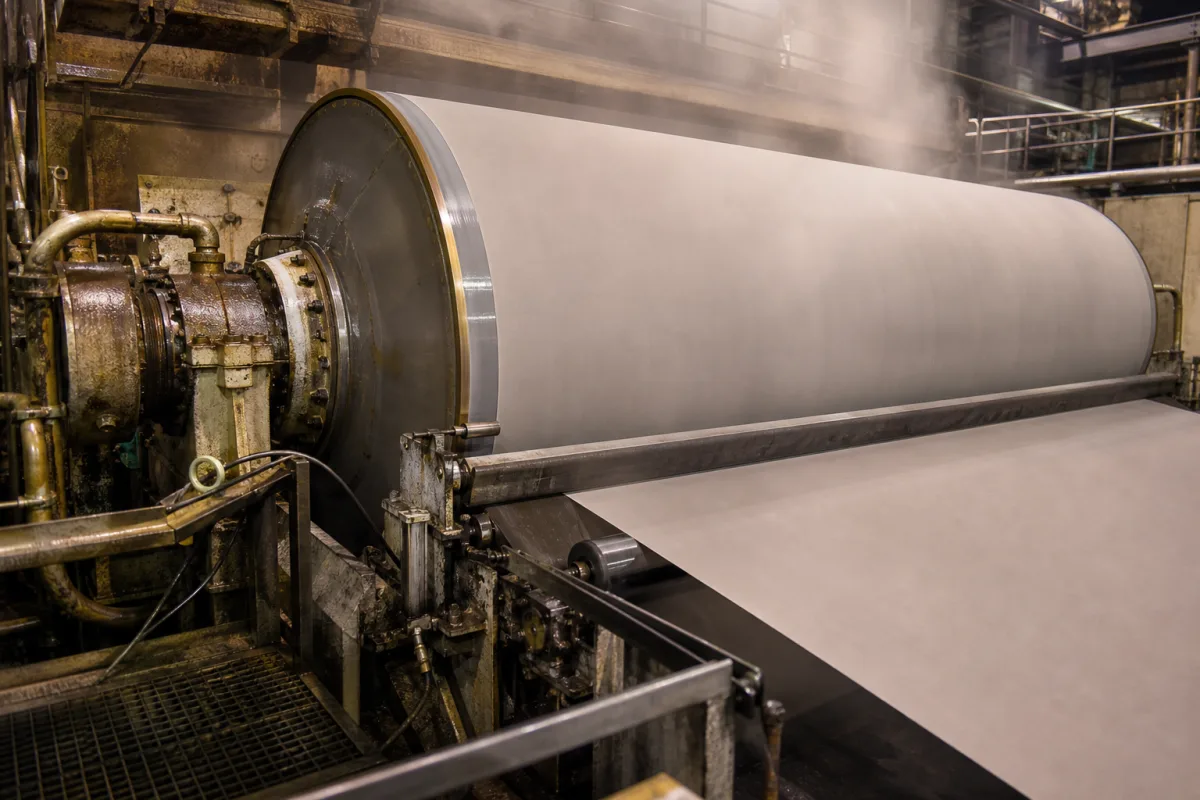
Paper machine dryers · Condensate rimming and siphons, dryer bars, steam pressure, cast-iron pressure vessel inspection, thermal stress
A paper machine drying cylinder, or dryer can, is a hollow cast-iron or steel cylinder heated inside by steam, over which the wet paper web is wrapped to evaporate water; condensate is removed through a siphon and rotary joint. Ask three things first: how condensate is drained at your machine speed and whether dryer bars are fitted, what steam pressure and code the shell is designed and stamped for, and how the shell will be inspected in service.
Steam-heated drying cylinders for paper and board machines, including standard dryer cans and Yankee dryers, with heads, journals, siphons and dryer bars. Rotary joints sold alone, dryer felts, hoods and drum dryers for other materials are outside this page.
CNFX editorial research · Sources checked October 12, 2026 · 4 sources
A Johnson Corporation patent on dryer bars describes condensate inside a dryer moving from ponding and cascading at low speed to 'rimming' at high speed, when it follows the shell around its whole periphery. At high speed the rimming layer is very stagnant and forms an insulating barrier between the steam and the shell; siphons are designed to minimise the condensate left in the dryer, and axial dryer bars were developed to make the rimming layer turbulent, raising and evening out heat transfer. [1]
The same patent notes that bar cross-section is chosen from the number of rows, the rimming condensate expected, cost, rigidity and installation handling, and that bar assemblies must accommodate differential thermal expansion between bars and shell. It describes modern paper machines up to 400 inches wide running at speeds approaching 6,000 feet per minute. [1]
A Beloit patent on dryers with stationary siphons and spoiler bars explains that the siphon-to-shell clearance leaves a condensate layer that impedes heat transfer, that bars allow a thicker layer without that penalty, and that stationary siphons need relatively low differential pressure. It cites steam pressures ranging to about 160 psig and also names a figure of about 125 psig. [2] Editorial calculation: 6,000 ft/min is about 1,830 m/min, and 125 psig about 0.86 MPa; agree siphon type, clearance and differential pressure with the supplier for your speed range.
Give the supplier the machine speed range, paper grade and basis weight, cylinder diameter and face width, steam pressure and temperature, design code and stamp required, siphon type (rotating or stationary), dryer bars, rotary joint, drive, surface finish and hardness, and inspection and documentation requirements.
02
Design, inspect and heat the shell as a pressure vessel
A National Board Bulletin article reports that in April 1989 four dryer cans on a paper machine built about 1914 failed; the root cause was a torsional fatigue crack initiating on the outside surface of one can, and a similar 5-inch crack penetrating three-quarters of another shell was found. The cracks lay outside the "high stress areas" associated with the heads, so the author recommended 100% wet fluorescent magnetic particle inspection of the shell outside surface, at least for old machines. [3]
A second National Board article, on Yankee dryers, describes its example Yankee as a gray cast-iron cylinder about 6 m in diameter and 7.75 m wide, weighing about 180 t, heated by 1.1 MPa (160 psi) steam and run at 1,900 m/min, and cites ASME Code Section VIII, Division 2, and SA-278 gray cast iron in connection with the shell. It calls for controlled heating at start-up (cracks have followed steam or impingement heat without rotation), annual internal and external inspection, thickness measurement after grinding to set the allowable steam pressure and press load, and rules out fusion welding as a repair for cast iron. [4]
Editorial calculation: at 1,900 m/min a 6 m diameter Yankee turns at about 1,900 ÷ (π × 6) ≈ 101 rpm. Ask the supplier for the design pressure, code stamp, material and inspection plan for the shell. [4]
03
Dryer cans sold alongside paper machine castings
Listings include paper machine drying cylinders among paper machine castings and components.
04
Where steam enters, condensate leaves and drive torque reaches the shell
Yankee figures from the National Board, and the dryer-can values still to obtain
The diameter, face width and weight rows quote the one Yankee described in the National Board article; for a standard dryer can those are values the supplier must give.
Field
What it means and published values
Ask the supplier for
Diameter (mm)
About 6 m for the Yankee in the National Board article. [4]
Diameter.
Face width (mm)
About 7.75 m for the Yankee in the National Board article. [4]
Face width.
Shell thickness (mm)
Sets allowable pressure; re-measure after grinding. [4]
Explore company information and manufacturing capabilities, then discuss the scope of your project with a relevant supplier.
Share this page
Compiled and source-reviewed by the CNFX editorial team.
Each manufacturer above links to the page on that company's own website where the product is listed, with the date we checked it. How we source and review
· Page last updated 13 October 2026
Buyer questions
What is condensate rimming in a dryer?
At high speed condensate follows the shell all the way round as a stagnant layer that insulates the shell; dryer bars make it turbulent, per a Johnson patent. [1]
Why do dryer cans need full-surface inspection?
A National Board investigation found a torsional fatigue crack outside the high-stress head areas and recommended 100% magnetic particle inspection of the shell OD, at least for old machines. [3]
Can a cast-iron Yankee be repaired by welding?
No. The National Board article states fusion welding is not appropriate or allowable for cast iron, as heat input causes cracking. [4]
Sources and what still needs a direct check
Sources checked 2026-10-12. Johnson Corporation (now Kadant Johnson) and Beloit patents describe their own dryer designs; the National Board articles are from its Bulletin and represent their authors. Design codes and TAPPI inspection guidance were not read for this page.