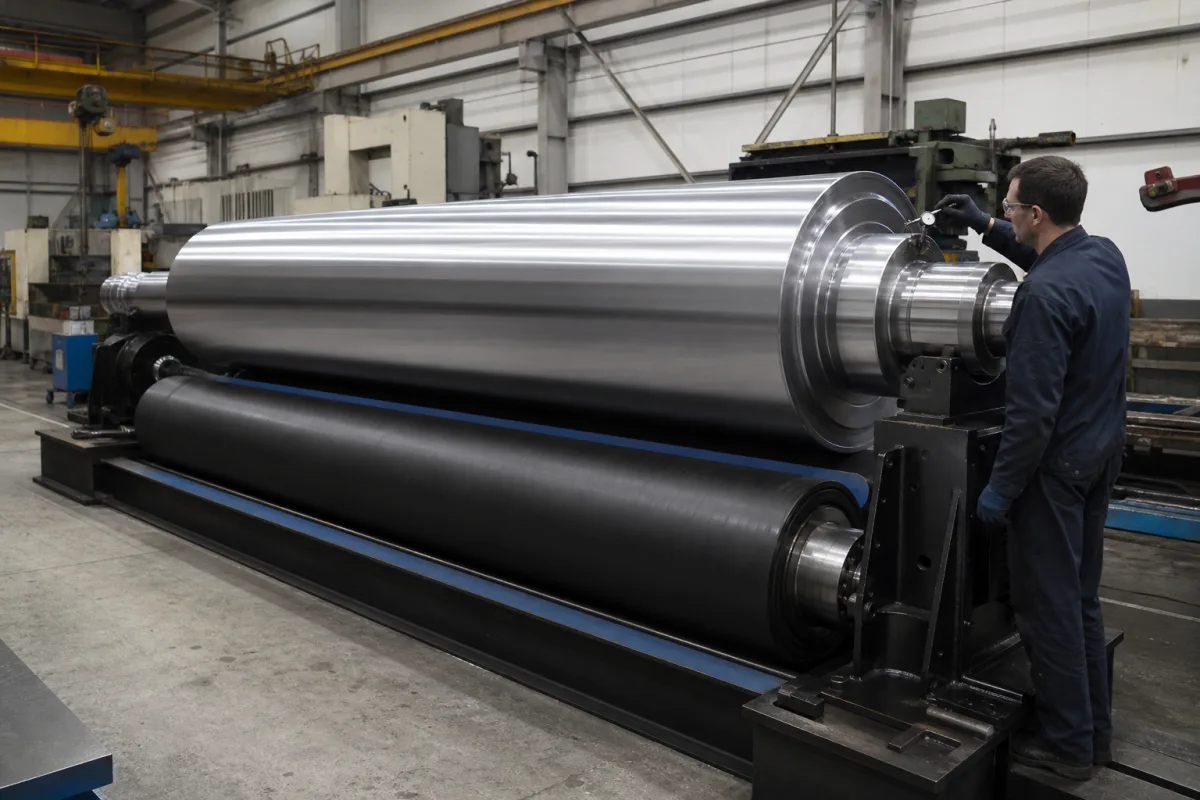
Press roll (individual covered roll for a paper machine press nip: shell, journals, surface pattern and rubber or polyurethane cover)
Single press rolls for paper machine nips · plain, blind-drilled, grooved and suction shells, rubber and polyurethane covers, P&J hardness, regrinding and cover debonding
A press roll is one of the rolls that form a nip in the press section of a paper machine: a cast iron, steel or stainless shell on forged journals and bearings, with a rubber or polyurethane cover that is plain, blind-drilled, grooved or perforated for suction. Ask three things first: which shell type and size the position needs, which cover material, hardness and surface pattern it runs, and how the cover will be reground, repaired or replaced.
Individual press rolls and their covers for paper, board and tissue machine press nips: plain, blind-drilled, grooved and suction press rolls, replacement shells and recovering. The complete press section (nip layout, shoe presses, felts and felt conditioning) is covered on the Paper machine press section page; dryer cylinders, calender rolls and winder drums are outside this page.
CNFX editorial research · Sources checked October 12, 2026 · 4 sources
Shandong Daxing describes its blind-drilled "Jumbo Press Roll" for corrugated paper, cardboard and other heavy grades with a diameter range of φ1000-1600 mm, maximum face length 14,000 mm, shell of gray cast iron or steel, surface "Blind Hole, Blind + Through Hole; Smooth or Groove", PU or rubber coating, journals of forged 42CrMo, cast steel or nodular iron, and flanged connection. To protect the rubber cover from the heat of high nip load, it adds a water inlet at the operating-side journal so that water circulates through the spoke body. [1]
For its suction press roll Daxing lists shells of SS304, SS316, SS316L or duplex stainless steel, a suction box of SS304, diameters of 400-1200 mm, face lengths of 2000-9000 mm, speed up to 2000 m/min, PU or rubber covering, an internal spray for flushing the perforations, a temperature sensor for the internal bearing and vibration sensors for all bearings. [2]
Editorial calculation: roll speed in min⁻¹ is web speed ÷ (π × diameter). A 1,200 mm suction press roll at 1,000 m/min turns at 1,000 ÷ (3.1416 × 1.2) ≈ 265 min⁻¹; a 1,000 mm roll at the same speed turns at about 318 min⁻¹. Use your machine speed and roll diameter for bearing and balancing checks; the speed is an assumed example.
Give the roll maker the machine and press position (1st, 2nd or 3rd nip; suction, plain or blind-drilled), web speed and nip load, shell material, diameter and face length, journal drawing and bearing type, cover material, hardness and thickness, surface pattern (holes, grooves), crown if any, cooling, balancing and runout requirements, sensors, and whether the roll is new or a recover of your shell.
02
Choose the cover material, hardness and maintenance plan
A Stowe Woodward patent on roll covers states that soft rubber compounds "between about 30 and 300 on the Pusey and Jones (P&J) scale" have good dynamic properties under nip conditions, that polyurethane covers have good abrasion resistance, release and toughness "particularly in the hardness range of 4 to 70 P&J", and that softer PU "(P&J of about 70 to 200)" has poorer chemical resistance than rubber. It describes covers built from a base layer bonded to the metal core and a topstock layer, and notes that "repair, regrinding or replacement of a cover" costs considerably less than replacing the whole roll. [4]
Valmet, writing about tissue machines, says press roll covers there must be "evenly hard" and much softer than on printing paper or board machines, and that wear or hardness change leads to short grinding intervals; it reports that its polyurethane covers "do not harden in use like most traditional rubber covers" and that their grinding intervals "can even be twice as long". It also notes that "most polyurethane coatings are applied using a different P&J value" than rubber because the material responds differently to the P&J measurement, not because it acts differently in the nip. [3]
Valmet links internal water cooling of press rolls to water entering the cover and causing "sudden debonding", and says its press roll polyurethane generates a fraction of the nip heat so that internal cooling is not needed. [3] Compare this with the water-cooled spoke body Daxing offers for rubber-covered jumbo press rolls. [1]
03
Daxing press roll specifications and other Chinese roll makers
Shandong Daxing publishes specifications for blind-drilled and suction press rolls. Shandong Xinhe and Qinyang Aotian list press or suction press rolls among paper machine parts, and Huatao lists press rolls among parts it manufactures for paper machine renovation. Ask each for the shell material, cover material and hardness, surface pattern, journal and bearing details, and balancing and runout data.
04
Shell, journals, cover layers, drilling and suction box
The cover is built in layers on the metal core: a base layer that bonds to the shell and a topstock that meets the felt.
Part
Role
Fix in the order
Shell
Carries nip load; cast iron, steel or stainless. [1][2]
Diameter, face length, cover P&J and speed for a press roll
Daxing's two published rolls set the size range here: 1000 to 1600 mm blind-drilled rolls up to 14,000 mm face and 400 to 1200 mm suction rolls up to 2000 m/min.
Field
What it means and published values
Ask the supplier for
Roll diameter (mm)
Example: 1000-1600 mm blind-drilled; 400-1200 mm suction. [1][2]
Diameter over cover.
Face length (mm)
Example: up to 14,000 mm; 2000-9000 mm suction. [1][2]
Face and total length.
Shell material
Gray cast iron, steel; stainless or duplex for suction. [1][2]
Shandong Daxing publishes press roll specifications; Shandong Xinhe, Qinyang Aotian and Huatao list press or suction press rolls among paper machine parts.
Shandong Daxing Machinery Co.,ltd
Manufacturing site to be confirmed for the order
Publishes specifications for blind-drilled jumbo press rolls and suction press rolls with PU or rubber covers.
Explore company information and manufacturing capabilities, then discuss the scope of your project with a relevant supplier.
Share this page
Compiled and source-reviewed by the CNFX editorial team.
Each manufacturer above links to the page on that company's own website where the product is listed, with the date we checked it. How we source and review
· Page last updated 13 October 2026
Buyer questions
How is a press roll different from the press section?
This page covers a single roll and its cover; the nip layout, shoe presses and felts of the whole section are on the Paper machine press section page. [1][2]
What P&J hardness do press roll covers have?
A Stowe Woodward patent gives about 30-300 P&J for soft rubber and 4-70 P&J for the range where PU performs well; Valmet notes PU and rubber respond differently to the P&J test. [4][3]
Why do covers debond?
Valmet links internal water cooling to water entering the cover and causing sudden debonding. [3]
Is regrinding cheaper than a new roll?
The Stowe Woodward patent says repair, regrinding or replacement of a cover costs considerably less than replacing the whole roll. [4]
Sources and what still needs a direct check
Sources checked 2026-10-12. Shandong Daxing publishes its press roll specifications; Valmet describes tissue press roll covers; a Stowe Woodward patent describes rubber and polyurethane roll covers.