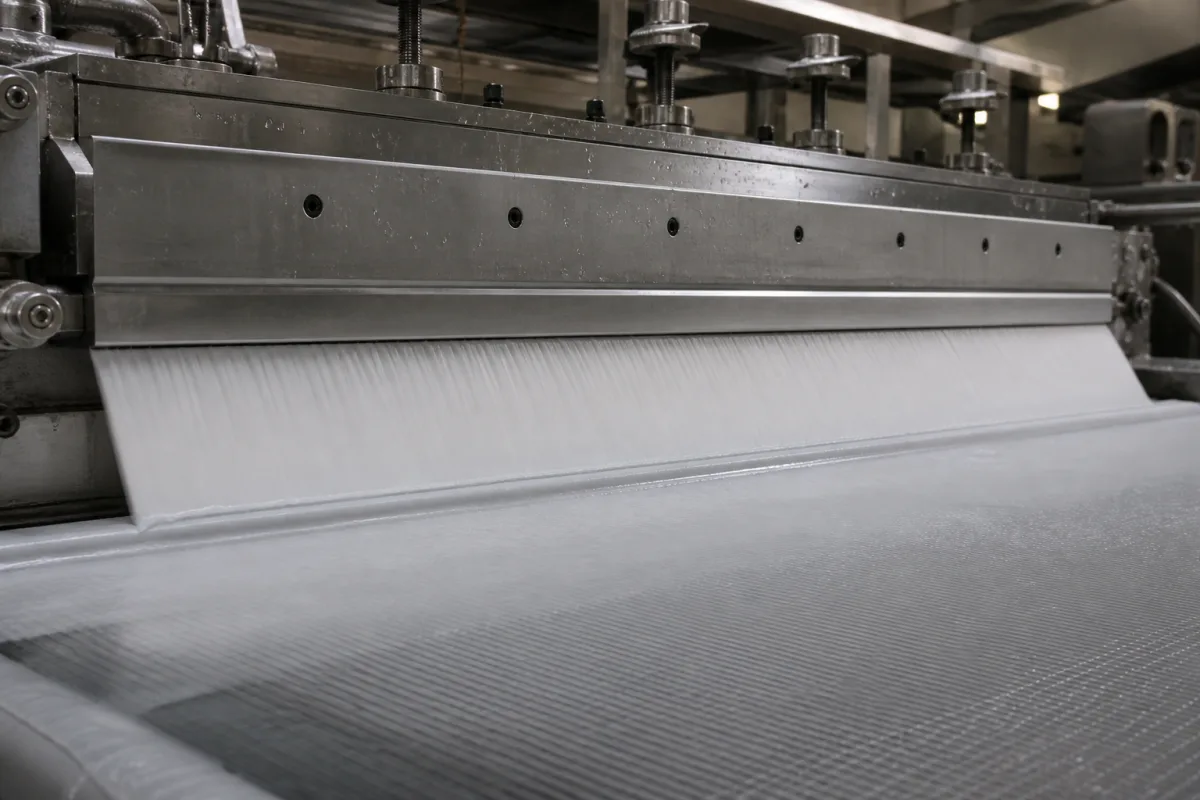
Headbox slice lip and its profile actuators: the flexible lip bar, spindle rods and actuators that bend it
The flexible stainless or titanium bar at the outlet of a headbox, pulled and pushed by a row of spindle rods at 45 mm or wider zone spacing so that its edge sets the slice opening — and with it the cross-machine basis weight — to fractions of a micrometre
Stock leaves a conventional headbox through a narrow slot between a rigid forming board below and the slice lip above. The lip is a long, deliberately flexible bar: rods attached along its length push or pull its lower edge by a few micrometres at a time, opening the slot a little where the sheet is light and closing it where it is heavy. Buying a slice lip therefore means buying three things that must match — the bar itself, the rods and clamps that hold it, and the actuators that move it — plus a way of knowing where the edge actually is.
Slice lips of paper and board machine headboxes and the hardware that profiles them: the flexible lip or profiling bar, spindle (slice) rods and clamping assemblies, manual and motorised slice actuators, their force, stroke, resolution and spacing, bend limits and position measurement. The headbox as a whole — hydraulic and air-cushion types, flow from inlet to jet, jet-to-wire speed and dilution profiling — is covered on the Paper machine headbox page; forming-section suction boxes on their own page.
CNFX editorial research · Sources checked October 12, 2026 · 3 sources
A deformable bar on a row of slice rods: what sets the opening and how closely it can be bent
Measurex's 1989 European patent application describes the arrangement: the slurry discharges through the space between a deformable slice lip and a rigid forming board at the bottom of the headbox, both spanning the machine; the basis weight depends in part on the height of that opening; the lower edge of the lip is moved by slice rods attached near the opening and spaced at fixed intervals across the machine, each adjustable so that different segments of the lip are displaced by different amounts. [3] Earlier designs used manually operated screw jacks on the rods, or electric heating coils inside them that changed the rod length with temperature. [3]
Honeywell supplies the lip and rods as part of a system: its AutoSlice 9142 models combine actuators, 316 stainless spindle rods, SuperFlex clamping assemblies and a SuperFlex slice lip in 316 stainless steel (9142-10/-11) or titanium (9142-20/-21); the 9141 models fit other makers' slice lips. [1] The minimum actuator zone spacing is 45 mm with the narrower CDW45L actuator and 60 mm with the CDW60L. [1]
Editorial calculation: across a 6 m wide slice, 60 mm spacing allows up to 100 actuator zones and 45 mm up to about 133; the spacing that is usable also depends on how sharply the lip may be bent between neighbouring rods, which Honeywell enforces with bend limits (next section).
Valmet positions its IQ Slice Profiler for basis weight or fibre orientation profiles, and suggests that where its IQ Dilution system controls the dry weight profile, the slice is used for fibre orientation control. [2] Editorial note: whether the lip is to correct weight or orientation decides how fine a zone spacing is worth paying for; agree this with the headbox and control-system suppliers before ordering.
Give the lip supplier the headbox make and width, lip material, the existing rod spacing and clamp design, and whether actuators will be reused or replaced.
02
Actuator figures: 4 or 14.5 kN, 13 mm stroke, 0.2 µm steps and bend limits between neighbours
Honeywell's AutoSlice data sheet gives two actuators with the same stroke and resolution but different force and width; it lists them in this form: [1]
Both use a 24 V DC stepper motor with a steel harmonic gear. Bend-limit protection is implemented in each actuator from the positions of its neighbours, the actuator spacing and the lip design; an electronic clutch limits motor torque and therefore force on the lip; a hand wheel with a slip mechanism gives manual backup without over-stressing. [1] Valmet's actuators use a closed-loop stepping motor and self-locking micro-adjusters whose gear resists deflection from adjacent positions. [2]
Editorial calculation: at 5–60 µm/s, a 25 µm correction takes about 0.4 to 5 s; the full 13 mm stroke at 60 µm/s takes about 3.6 minutes.
Ask for force, stroke, resolution, response rate and zone width of the actuator, how bend limits are calculated for your lip, and what happens to the lip on loss of power.
03
Knowing where the lip edge is: LVDT feedback on the actuator, or force measured on the rod
Measurex set out the measurement problem in 1989: an LVDT fixed between the lower edge of the lip and the headbox frame sits close to the slurry, where particles and moisture can jam and corrode its sliding parts; an accuracy of 0.001 inch is needed in papermaking, so a high-resolution and costly LVDT is required, with a short life in a paper mill. [3]
Its alternative was to infer displacement from force: according to the application, “the typical force exerted by the slice rod” on the lip is on the order of 500 kg for a lip movement on the order of 1/1000 inch, measured with an annular force transducer around the rod. [3] Honeywell's current actuators place the LVDT on the actuator output shaft instead, positively connected for true output position feedback. [1]
Editorial calculation: 0.001 inch is 25.4 µm, about 127 times the 0.2 µm resolution Honeywell quotes for its actuators. Note that an LVDT on the actuator shaft reports the rod end, not the lip edge, so lip stiffness and clamp play sit between the two readings.
04
What to send for a slice lip or slice actuator system
Paste it into your enquiry below or into an email to a maker, then replace every bracket.
Headbox: [make, type, slice width, grades and speed]
Lip: [material 316 SS or titanium; thickness; clamp design; new or reuse]
Rods: [spacing; material; attachment]
Actuators: [number; force; stroke; resolution; response rate; housing]
Control: [QCS interface; bend-limit settings; manual backup]
Use: [basis weight or fibre orientation; dilution system present or not]
Explore company information and manufacturing capabilities, then discuss the scope of your project with a relevant supplier.
Share this page
Compiled and source-reviewed by the CNFX editorial team.
Each manufacturer above links to the page on that company's own website where the product is listed, with the date we checked it. How we source and review
· Page last updated 13 October 2026
Buyer questions
What does the slice lip do?
Its lower edge and the forming board form the headbox outlet; slice rods bend the lip locally so the opening, and the basis weight, can be trimmed across the machine. [3]
How closely are slice actuators spaced?
Honeywell's AutoSlice actuators need at least 45 mm (CDW45L) or 60 mm (CDW60L) between zones. [1]
How finely can the lip be moved?
Honeywell gives 0.2 µm setpoint and feedback resolution over a 13 mm stroke at 5–60 µm/s. [1]
What is the slice lip made of?
Honeywell's SuperFlex lip is offered in 316 stainless steel or titanium, with 316 stainless spindle rods. [1]
Sources and what still needs a direct check
Sources checked 2026-10-12. Lip, rod and actuator specifications come from Honeywell's AutoSlice product information note PN-10-36 (2010); actuator design and use for fibre orientation from Valmet's IQ Slice Profiler page; the lip and rod arrangement, older adjusters, force and displacement figures and LVDT limits from Measurex's European patent application EP 0 346 174.