Industry-Verified Manufacturing Data (2026)

Top Crowned Roll

Based on aggregated insights from multiple verified factory profiles within the CNFX directory, the standard Top Crowned Roll used in the Paper Manufacturing sector typically supports operational capacities ranging from standard industrial configurations to heavy-duty production requirements.

Technical Definition & Core Assembly

A canonical Top Crowned Roll is characterized by the integration of Roller Shell and Shaft. In industrial production environments, manufacturers listed on CNFX commonly emphasize Hardened Alloy Steel construction to support stable, high-cycle operation across diverse manufacturing scenarios.

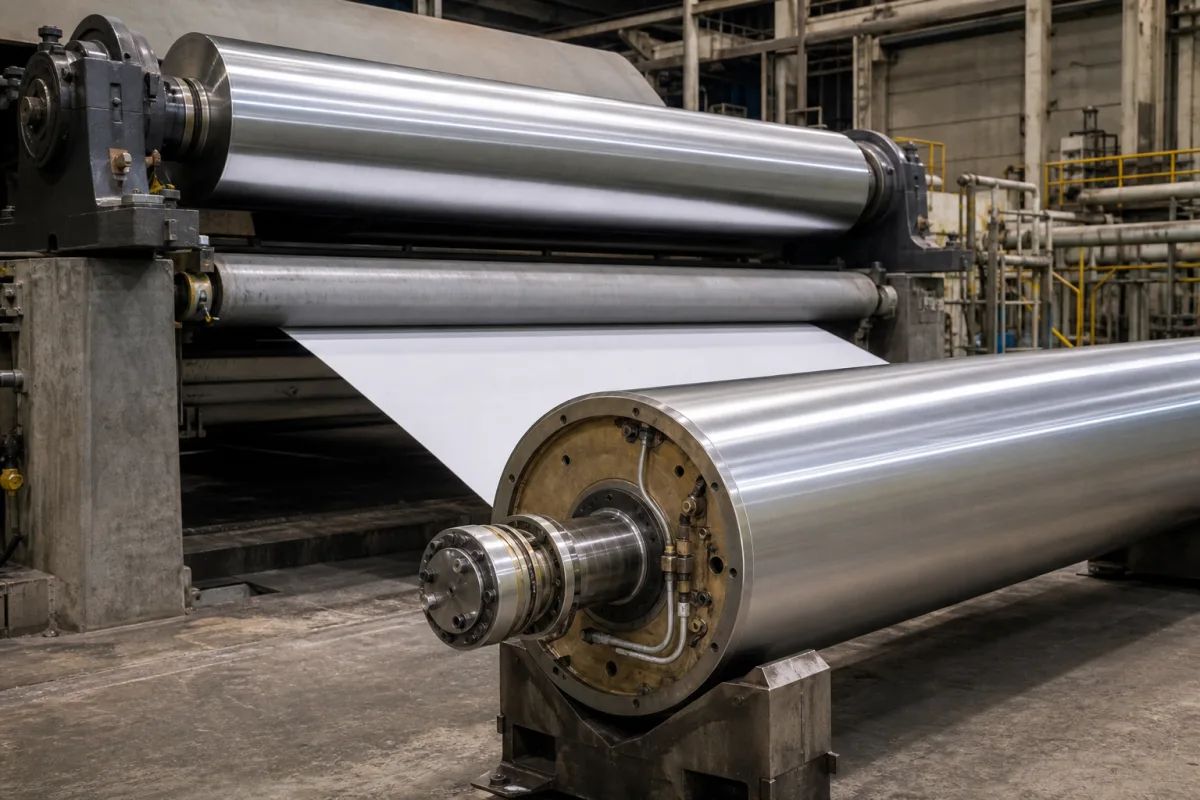
A cylindrical roller with a convex profile along its length, designed to compensate for deflection under load in industrial systems.
Product Specifications

Technical details and manufacturing context for Top Crowned Roll

Definition
The Top Crowned Roll is a precision-engineered cylindrical component featuring a convex curvature along its longitudinal axis. Within Industrial Systems, it serves as a critical load-bearing and material-handling element, typically installed in the upper position of roller assemblies. Its primary function is to maintain uniform pressure distribution and prevent material slippage or tracking issues by compensating for the natural deflection that occurs when the roller is subjected to operational loads, ensuring consistent performance across the entire working width.
Working Principle
The Top Crowned Roll operates on the principle of pre-compensation for elastic deformation. When installed under tension or load within an Industrial System (such as in conveyors, web handling equipment, or processing lines), the central portion of a straight roller would deflect downward. The intentionally machined convex crown (highest point at the center, tapering toward the ends) ensures that under operational load, the roller deforms into a near-straight or optimally curved profile. This maintains uniform linear contact pressure with the material (web, sheet, or product) being transported or processed, preventing edge tension variations, wrinkling, or misalignment.
Common Materials
Hardened Alloy Steel, Chrome-Plated Steel
Technical Parameters
  • Crown Height - The maximum deviation from a straight line across the roller's length, defining the convex profile. (mm) Customizable
Components / BOM
  • Roller Shell
    Provides the convex cylindrical surface for material contact and load bearing.
    Material: Hardened alloy steel, often chrome-plated for wear resistance.
  • Shaft
    Central structural element for mounting and transmitting torque/support.
    Material: High-strength steel, precision-ground.
  • Bearings
    Enable smooth rotation of the roller around the fixed or rotating shaft.
    Material: Steel with ceramic or polymer elements.
Engineering Reasoning
0.1-2.5 MPa contact pressure, 50-150°C operating temperature, 100-500 RPM rotational speed
Yield strength exceedance at 350 MPa (AISI 52100 steel), Hertzian contact stress > 1.5 GPa, surface roughness degradation beyond Ra 0.8 μm
Design Rationale: Plastic deformation from Hertzian contact stress exceeding material yield strength, leading to permanent crown profile loss and subsequent bearing surface misalignment
Risk Mitigation (FMEA)
Trigger Hertzian contact stress exceeding 1.5 GPa due to excessive radial load
Mode: Plastic deformation of crown profile exceeding 0.05 mm deviation from nominal convexity
Strategy: Finite element analysis optimization of crown radius (typically 0.001-0.003 mm/mm) to maintain maximum contact stress below 1.2 GPa
Trigger Thermal expansion mismatch (Δα=12×10⁻⁶/°C) between roller (steel) and housing (aluminum)
Mode: Binding and seizure at operating temperatures above 120°C
Strategy: Precision clearance design using thermal expansion coefficient differential calculation: Δd = d₀ × Δα × ΔT, maintaining 0.02-0.05 mm operational clearance

Industry Taxonomies & Aliases

Commonly used trade names and technical identifiers for Top Crowned Roll.

Applied To / Applications

This component is essential for the following industrial systems and equipment:

Industrial Ecosystem & Supply Chain DNA

Complementary Systems
Downstream Applications
Specialized Tooling

Application Fit & Sizing Matrix

Operational Limits
pressure: Up to 50 MPa contact pressure
other spec: Max deflection compensation: 0.5-2.0 mm per meter length
temperature: -40°C to 150°C
Media Compatibility
✓ Paper/pulp processing lines ✓ Steel rolling mills ✓ Textile manufacturing conveyors
Unsuitable: High-precision semiconductor wafer handling (requires flat surface)
Sizing Data Required
  • Roller length and span between supports
  • Maximum expected load per unit length
  • Required crown height based on material stiffness

Reliability & Engineering Risk Analysis

Failure Mode & Root Cause
Surface fatigue spalling
Cause: Cyclic Hertzian contact stresses from rolling under load, often exacerbated by improper crown profile, misalignment, or overloading, leading to subsurface crack initiation and propagation to the surface.
Crown profile degradation
Cause: Uneven wear across the roll face due to localized high pressure from material tracking issues, thermal expansion mismatches, or improper initial crowning, resulting in loss of controlled material spread and potential edge defects.
Maintenance Indicators
  • Visible flaking or pitting on the roll surface, especially in the crown area, indicating advanced fatigue failure.
  • Abnormal vibration or audible knocking during operation, suggesting uneven wear, imbalance, or bearing issues affecting crown integrity.
Engineering Tips
  • Implement regular crown profile measurements using laser profilometry to detect wear trends and schedule re-crowning before loss of functionality.
  • Optimize alignment and tension control in the mill stand to ensure even load distribution across the crown, reducing localized stress concentrations.

Compliance & Manufacturing Standards

Reference Standards
ISO 286-2:2010 - Limits and fits for cylindrical parts ANSI B4.1-1967 (R2009) - Preferred Limits and Fits for Cylindrical Parts DIN 7184-1:2016 - Tolerances for linear and angular dimensions
Manufacturing Precision
  • Bore diameter: +/-0.02mm
  • Crown profile flatness: 0.1mm per 100mm length
Quality Inspection
  • Dye Penetrant Test for surface defects
  • Coordinate Measuring Machine (CMM) dimensional verification

Factories Producing Top Crowned Roll

Verified manufacturers with capability to produce this product in China

✓ 95% Supplier Capability Match Found

P Procurement Specialist from Brazil Feb 08, 2026
★★★★★
"The Top Crowned Roll we sourced perfectly fits our Paper Manufacturing production line requirements."
Technical Specifications Verified
T Technical Director from Canada Feb 05, 2026
★★★★★
"Found 11+ suppliers for Top Crowned Roll on CNFX, but this spec remains the most cost-effective."
Technical Specifications Verified
P Project Engineer from United States Feb 02, 2026
★★★★★
"The technical documentation for this Top Crowned Roll is very thorough, especially regarding technical reliability."
Technical Specifications Verified
Verification Protocol

“Feedback is collected from verified sourcing managers during RFQ (Request for Quote) and factory evaluation processes on CNFX. These reports represent historical performance data and technical audit summaries from our B2B manufacturing network.”

14 sourcing managers are analyzing this specification now. Last inquiry for Top Crowned Roll from USA (48m ago).

Supply Chain Commonly Integrated Components

Spray Manifold

A distribution component in a felt conditioning shower system that evenly disperses water or conditioning agents across the felt surface.

Explore Specs →
Spray Nozzles

Precision components that atomize and distribute water or conditioning agents onto felt surfaces in paper manufacturing processes.

Explore Specs →

Frequently Asked Questions

What is the purpose of the convex profile on a Top Crowned Roll?

The convex profile compensates for deflection under load in industrial paper manufacturing systems, ensuring uniform pressure distribution and consistent paper quality across the entire roller width.

What materials are used in Top Crowned Rolls and why?

Top Crowned Rolls are made from hardened alloy steel for structural strength and chrome-plated steel surfaces for corrosion resistance, wear durability, and smooth operation in demanding paper manufacturing environments.

How does the BOM (Bearings, Roller Shell, Shaft) affect performance?

The bearing system ensures smooth rotation with minimal friction, the roller shell provides the precise convex profile for deflection compensation, and the shaft delivers structural integrity and torque transmission for reliable operation in paper machines.

Can I contact factories directly on CNFX?

CNFX is an open directory, not a transaction platform. Each factory profile provides direct contact information and production details to help you initiate direct inquiries with Chinese suppliers.

Get Quote for Top Crowned Roll

Request technical pricing, lead times, or customized specifications for Top Crowned Roll directly from verified manufacturing units.

Your business information is encrypted and only shared with verified Top Crowned Roll suppliers.

Thank you! Your message has been sent. We'll respond within 1–3 business days.

Need to Manufacture Top Crowned Roll?

Connect with verified factories specializing in this product category

Add Your Factory Contact Us
Previous Product
Suction Box
Last Product