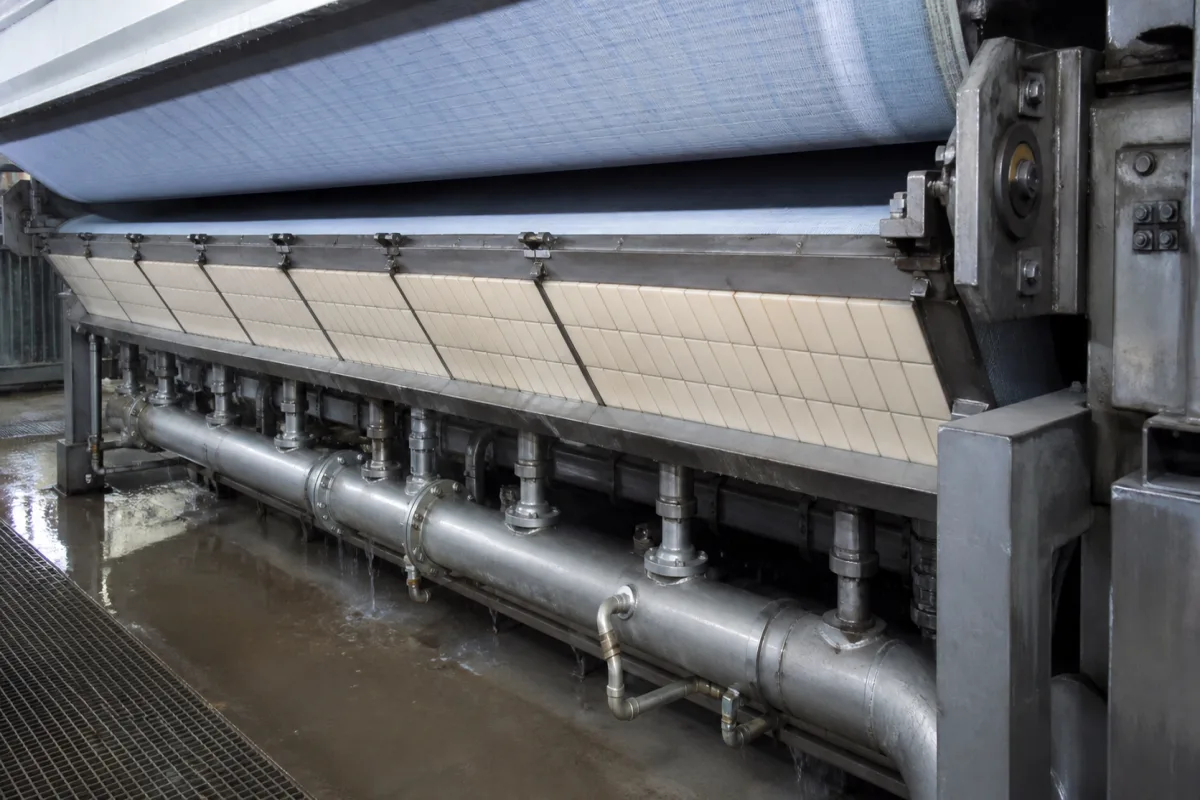
Forming-section vacuum suction box for paper machines
Paper machine forming section · vacuum suction boxes under the forming fabric, vacuum steps, dwell time, ceramic covers
A forming-section vacuum suction box is a sealed box under the forming fabric of a paper machine, with a slotted cover over which the fabric runs; a vacuum pump draws water and air down through the sheet and fabric. Ask three things first: what vacuum level and dwell time each box needs for your grade and speed, how many boxes there are and in what order, and what the cover and slots are made of.
Vacuum suction boxes (low-vacuum, high-vacuum and multi-slit boxes) on the forming table or twin-wire former of paper and board machines, with their covers, slots, housings and vacuum connections. Felt suction boxes and Uhle boxes that condition press felts are covered on the Paper machine press section page. Vacuum pumps, suction rolls and couch rolls sold alone are outside this page.
CNFX editorial research · Sources checked October 12, 2026 · 7 sources
In a laboratory study at Karlstad University, published in BioResources, Björn Sjöstrand dewatered 20 g/m² tissue sheets on a forming fabric at -10, -20 and -30 kPa, and then in succession through all three levels, to imitate three suction boxes with rising vacuum. He reports that progressively higher vacuum levels improved both outgoing dryness and vacuum pump energy, and that for 20 g/m² sheets with 5 ms at each level the triple setup was particularly efficient. [1]
A follow-up study by Öman and Sjöstrand on 86 °SR grease-proof paper simulated a four-step box at 10, 20, 30 and 40 kPa. For 50 g/m² paper the four steps reached 11.7% dryness, against roughly 10% after 40 ms at a constant 20 kPa, and the authors report a 14% increase in dryness over a single box at equal energy, measured as air drawn through the sheet. For 100 g/m² paper the four-step run reached about 10.3%. [2]
The same study warns that a multi-slit box applied too early in the forming section should be avoided, to limit wire wear and protect formation, and that the highly refined pulp clogged the fabric: almost 50% of the air pulled through the 100 g/m² sheet passed at the 10 kPa step. [2] Editorial note: ask the box supplier for the vacuum setting of each box in the sequence and how it is controlled, not one figure for the whole table.
Give the supplier the grade and basis weight, freeness, machine speed and width, forming fabric, existing box layout, vacuum available per box, target dryness after the forming section, and the cover and slot pattern you use now.
02
Set dwell time from slot length and speed
Sjöstrand measured dwell times of 0, 1, 2.5, 5, 10 and 20 ms, designed to capture the dewatering of a suction box with a total dwell time of 20 ms, and found that dryness rose quickly at first and then reached a plateau, where the pumps keep drawing air through the sheet and fabric for little further gain in dryness. [1]
For grease-proof paper, Öman and Sjöstrand report that dryness rose readily between 0 and 10 ms and that the 10 and 20 kPa steps plateaued after about 10 ms each, so a longer dwell there would waste energy; at 40 kPa no plateau appeared within the times tested. [2] Editorial calculation: dwell time equals open slot length divided by fabric speed, so at 600 m/min (10 m/s) a 10 ms dwell needs 100 mm of open slot in the machine direction, and a 20 ms dwell needs 200 mm.
Rewetting after the box also counts: Sjöstrand cites laboratory rewetting of 3 to 6% in dryness for 50 and 100 g/m² sheets and pilot-scale rewetting of 0 to 4% for 20 and 100 g/m² sheets, and his study used a forming fabric of 0.645 mm caliper, 380 cfm air permeance and 59% void volume. [1]
03
Choose the cover, slots and housing
Qinyang Aotian describes its vacuum suction box as a traditional dewatering element of the paper machine, with 2 to 11 fitted, located at the rear of the fourdrinier table between the vacuum couch roll and the wet suction box. [3]
Aotian lists ceramic panels in 95% and 99% alumina and in zirconia on an ultra-high-molecular-weight polyethylene and glass-fibre substrate, in a stainless steel housing, with single, double and triple slit covers and a seat that can be installed rotated through 360 degrees. [4][5]
Huatao lists high-vacuum boxes with adjusting blocks at both ends of the panel to set the suction opening, lubricated with clean water to reduce friction on the wire, and offers dewatering elements in aluminium oxide, zirconium oxide or silicon nitride ceramic. [6] Huadong Paper Machinery states that it relieves residual stress in dewatering-element housings, with minimal welding seams, so that they keep their flatness in use. [7]
04
Cover material, slot pattern, open area and flatness to request from box makers
Ask each supplier for the cover material, slot pattern, open area, housing material and flatness tolerance, and for the vacuum and speed range the box is designed for.
3 companies list this product among what they make. Company figures are quoted from each
company's own website; every card states where the relationship came from.
Qinyang Aotian Machinery Manufacturing Co., Ltd.
Manufacturing site to be confirmed for the order
Lists vacuum suction boxes, suction boxes and dewatering boards with alumina or zirconia ceramic covers for the wire part.
Explore company information and manufacturing capabilities, then discuss the scope of your project with a relevant supplier.
Share this page
Compiled and source-reviewed by the CNFX editorial team.
Each manufacturer above links to the page on that company's own website where the product is listed, with the date we checked it. How we source and review
· Page last updated 13 October 2026
Buyer questions
Why step the vacuum between boxes?
Laboratory work at Karlstad University found that progressively higher vacuum levels improved dryness and reduced pump energy compared with one level. [1]
How much does a multi-step box add?
For 50 g/m² grease-proof paper, a four-step 10–40 kPa box reached 11.7% dryness against roughly 10% at a constant 20 kPa. [2]
How many vacuum suction boxes does a machine have?
Qinyang Aotian states 2 to 11 on the fourdrinier table, between the couch roll and the wet suction box. [3]
Sources and what still needs a direct check
Sources checked 2026-10-12. The two laboratory studies are peer-reviewed BioResources articles from Karlstad University; Qinyang Aotian, Huatao and Huadong are equipment makers describing their own products. Laboratory figures depend on the pulp, basis weight and fabric used.