Pharmaceutical processing · Cycle, instrumentation, sterilisation and leak rate
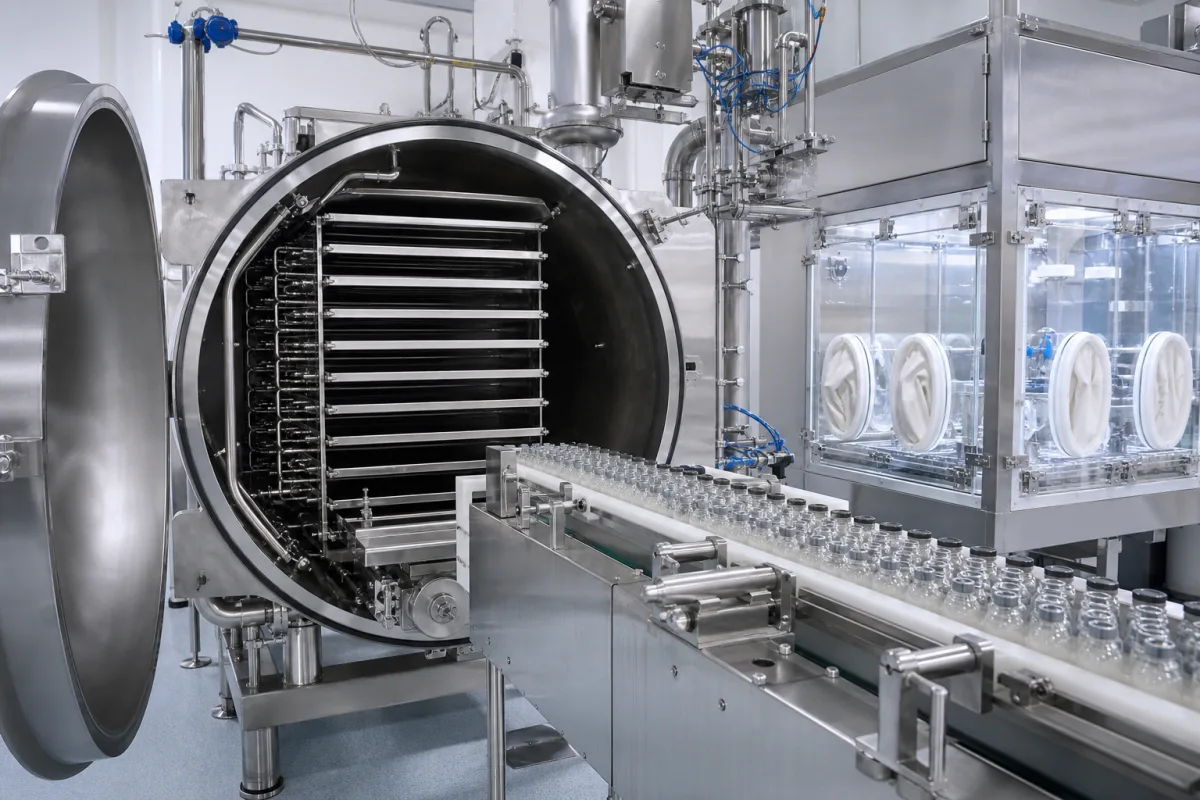
A lyophilizer freezes the product, removes ice by sublimation under vacuum, then removes bound water by desorption. For injectables, the equipment must also record the process, be sterilisable including its gas lines, hold vacuum without leaks, and stopper the vials before the chamber is opened.
Laboratory, pilot and production freeze dryers for pharmaceutical and biological products, with shelf temperature control, vacuum, condenser and vial stoppering. Food and home freeze dryers are outside this page.
CNFX editorial research · Sources checked October 12, 2026 · 4 sources
FDA's Guide to Inspections of Lyophilization of Parenterals describes freeze-drying as three interdependent steps: freezing, primary drying (sublimation) and secondary drying (desorption). Partially stoppered vials are frozen on cooled shelves, vacuum is applied and the shelves are heated to sublime the ice, and the vials are then fully stoppered, in FDA's words "usually by hydraulic or screw rod stoppering mechanisms installed in the lyophilizers". [1]
The guide notes that the rate and manner of freezing affect quality: slow freezing forms larger ice crystals that leave larger voids for vapour to escape, but can increase concentration shifts and may change the drug's physical form. During primary drying the product should be held at least 4–5 °C below its eutectic point. [1]
Give the supplier your product's critical temperature (eutectic or collapse), fill volume and vial format, batch size and the cycle you have developed. Shelf area, condenser capacity and refrigeration follow from these.
02
Specify the instrumentation and records
FDA expects the lyophilizer to control and record shelf temperature, product temperature, condenser temperature, chamber pressure and condenser pressure, with manufacturing directions that set time, temperature and pressure limits for each cycle. FDA calls product temperature monitoring "particularly important for those cycles for which there are atypical operating procedures, such as power failures or equipment breakdown". [1]
The guide adds that long cycles strain machinery, so failures during a cycle are not unusual; there should be documented corrective actions and an evaluation of effects such as partial or complete meltback. Shelf fluid leaking into the chamber or a break in sterility would be cause to reject the batch. [1]
03
Check how the chamber and gas lines are sterilised
FDA calls the sterilization of the lyophilizer "one of the more frequently encountered problems noted during inspections": some older units cannot tolerate steam under pressure and can only be wiped with a chemical agent, while inert-gas and sterile-air lines for backfill or vacuum break may be inaccessible to such treatment. It states: "Generally, lyophilizers should be sterilized after each cycle because of the potential for contamination of the shelf support rods." [1]
Where shelves are collapsed for loading, the hydraulic ram enters from a non-sterile area; controls have included wiping the ram, testing it for microbial contamination and hydraulic fluid residues. Loading and transport of partially stoppered vials need laminar flow or barrier protection. [1]
04
Plan the leak test
FDA explains that leakage can come from the atmosphere, the shelf heat-transfer fluid, the condenser refrigerant and oil vapour back-streaming from the vacuum pump. The leak rate should be monitored periodically, for example after sterilisation at the start of the cycle or before stoppering, with the pressure rise accepted at validation used as the production limit. Some designs add a tortuous path or oil trap between pump and chamber. [1]
Ask the supplier for the leak-rate test method and acceptance value, and how shelf-fluid and refrigerant leaks would be detected.
05
Match loading, sterilisation and leak-test design to EU GMP Annex 1
The European Commission's revised EU GMP Annex 1 (C(2022) 5938, Brussels, 22.8.2022) treats lyophilization as "a critical process step" whose activities are extensions of aseptic processing. It came into operation on 25 August 2023, except point 8.123 on lyophilizer loading and sterilisation frequency, which applied from 25 August 2024. Under 8.123, lyophilizers that are manually loaded or unloaded "with no barrier technology separation should be sterilised before each load"; for automated or closed-barrier loading the frequency must be justified in the contamination control strategy (CCS). [4]
Annex 1 changes the purchase specification as well as the procedures. A lyophilizer that will be loaded by hand without barrier technology has to be sterilised before every load [4], and FDA notes that some older units cannot tolerate steam under pressure [1]. Ask the supplier how its loading system (conveyor, transfer cart or isolator) keeps partially stoppered vials under grade A, and whether the chamber is designed for sterilisation between loads.
Point 8.124 requires the maximum permitted air leakage to be specified and checked at the start of every cycle [4], in line with FDA's guidance to monitor leak rate against the value accepted at validation [1]. Ask for the chamber leak-rate test method, the acceptance value the supplier guarantees, and how the vent filter is sterilised and integrity tested in place. Laboao and Gaokang list production freeze dryers with stoppering [2][3]; ask which of these Annex 1 features each offers.
Editorial calculation: point 8.123 applied two years after publication (25 August 2024), one year later than the rest of Annex 1 (25 August 2023). [4]
Annex 1 point
Requirement (summarised from the text)
8.122
Validate sterilisation of lyophilizer and trays, vial support rings; challenge hold time in APS; re-sterilise after maintenance or cleaning
8.123
Minimise operator intervention; manual loading without barriers: sterilise before each load; automated or closed-barrier: justify frequency in CCS (from 25 August 2024)
8.124
Sterilise the integrity filter before each use; its integrity test is part of batch release; specify maximum air leakage and check it at the start of every cycle
8.125
Check trays regularly for distortion or damage
8.126
Specify the loading pattern; transfer partially closed containers under grade A; keep unsealed containers under grade A, separated from operators
Text is from EU GMP Annex 1 (C(2022) 5938), extracted from the PDF; national inspectorates apply it with the rest of EU GMP.
06
Benchtop, pilot and 10–500 kg production freeze dryers with stoppering
The listed makers split between laboratory benchtop and vertical units and production pharmaceutical dryers with in-chamber stoppering. [2][3]
Laboao lists pharmaceutical freeze dryers from 10 kg to 500 kg capacity, including rubber-stopper models, alongside lab and pilot units; Gaokang lists a small pharmaceutical freeze dryer in 304 stainless steel (316 optional) with −55 °C or −80 °C options; Souz, Ancourage, Drawell and AELab list laboratory freeze dryers. Ask whether a unit is designed for steam sterilisation and GMP documentation. [2][3]
07
Shelves, condenser, vacuum pump, stoppering ram and vent filters
Part
Role
Fix in the order
Chamber and shelves
Hold vials; shelves heat and cool through circulating fluid. [1]
Shelf area, spacing, material, finish.
Condenser
Traps sublimed vapour; its temperature is recorded. [1]
Capacity, temperature, internal or external.
Vacuum system
Sets chamber pressure; risk of oil back-streaming. [1]
Record shelf, product, condenser temperatures and pressures. [1]
PLC/HMI, data integrity, alarms.
08
Shelf and condenser temperatures, shelf area and SIP for a lyophilizer order
FDA's guide sets what must be controlled and recorded (shelf, product and condenser temperatures, chamber pressure) but gives no equipment ratings, so every numeric row needs the supplier's figure for your batch. [1]
Field
What it means and published values
Ask the supplier for
Shelf temperature range (°C)
Freezing and drying; product held below eutectic. [1]
12 companies list this product among what they make. Company figures are quoted from each
company's own website; every card states where the relationship came from.
LABOAO
Manufacturing site to be confirmed for the order
Lists pharmaceutical freeze dryers from 10 to 500 kg, plus laboratory and pilot freeze dryers.
Explore company information and manufacturing capabilities, then discuss the scope of your project with a relevant supplier.
Share this page
Compiled and source-reviewed by the CNFX editorial team.
Each manufacturer above links to the page on that company's own website where the product is listed, with the date we checked it. How we source and review
· Page last updated 13 October 2026
Buyer questions
What are the stages of pharmaceutical freeze drying?
Freezing, primary drying by sublimation under vacuum, and secondary drying by desorption, followed by stoppering in the chamber. [1]
How cold should the product be during primary drying?
FDA's guide states it is desirable to hold the product at least 4–5 °C below its eutectic point. [1]
Why test lyophilizer leak rate?
Leaks from air, shelf fluid, refrigerant or pump oil vapour can contaminate the product; FDA expects periodic leak-rate checks against a validated pressure-rise limit. [1]
How often must a pharmaceutical freeze dryer be sterilised in the EU?
EU GMP Annex 1 (point 8.123, applying from 25 August 2024) requires lyophilizers loaded or unloaded manually without barrier technology to be sterilised before each load; for automated or closed-barrier loading the frequency must be justified in the contamination control strategy. [4]
Sources and what still needs a direct check
Sources checked 2026-10-12. FDA's Guide to Inspections of Lyophilization of Parenterals (1993) is a reference for FDA investigators, not binding guidance, but it remains on FDA's website and sets out what inspectors look for. Supplier pages describe their own offers.