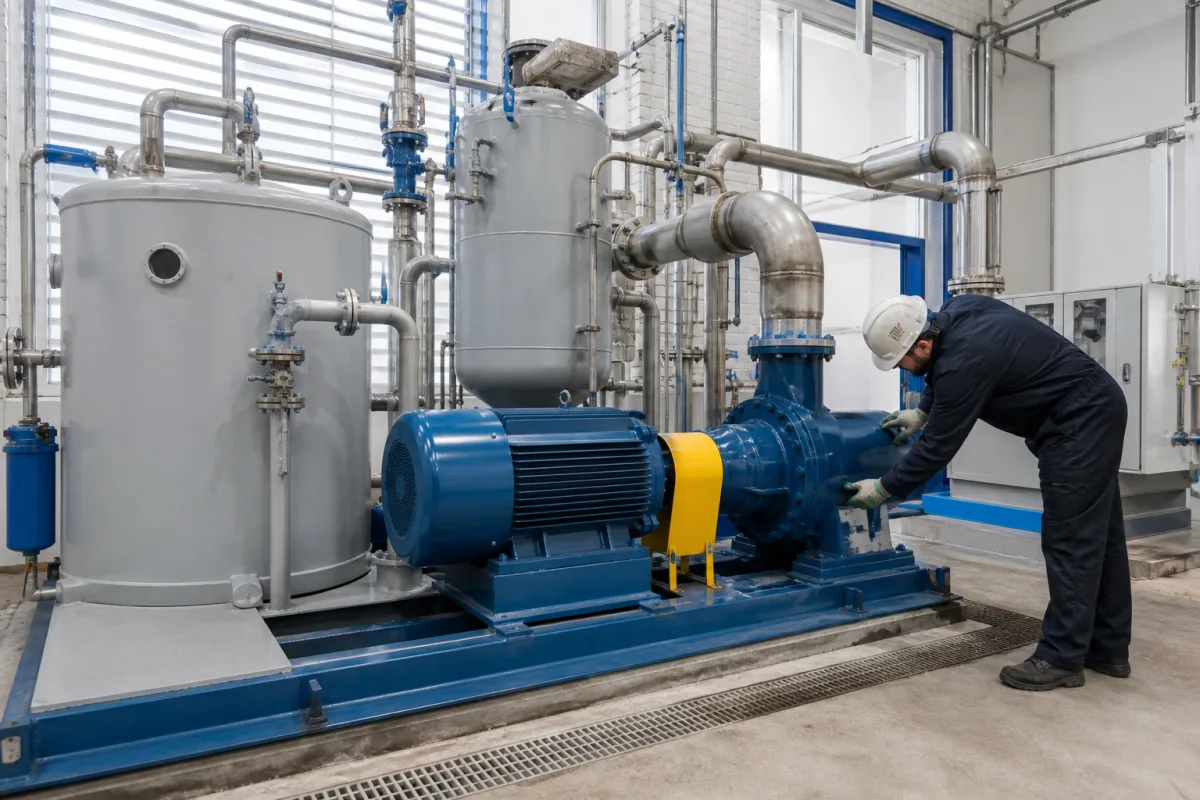
Closed-loop liquid ring vacuum system with a non-water ring liquid (oil- or solvent-sealed, with Roots booster) for vapour recovery
Liquid ring vacuum systems sealed with oil, solvent or another process liquid · ring-liquid vapour pressure, chilled closed loop, Roots boosters, vapour recovery
In a non-water-sealed liquid ring system the pump's ring is formed by a liquid chosen to match the gas being pumped — a mineral oil, a solvent, or a product such as biodiesel — circulated in a closed loop through a separator, a heat exchanger and back to the pump, with Roots boosters ahead of it where a lower working pressure is needed. The ring liquid's vapour pressure at the loop temperature sets how deep the pump can go, and condensed process vapour stays in a recoverable liquid instead of contaminating seal water. Ask three things first: which ring liquid is compatible with your vapours and what its vapour pressure is at the coolant temperature you have, how the loop is cooled and kept topped up or bled, and whether boosters are needed to reach your working pressure.
Closed-loop liquid ring vacuum systems sealed with oil, solvent or another process-compatible liquid, with their separator, ring-liquid cooler, circulation pump and Roots boosters, used for solvent and vapour recovery on dryers, distillation columns and reactors. Water-sealed packages with once-through, partial-recirculation or total-recovery water loops, Roots sets on rotary vane or dry screw pumps and tank-mounted units are covered on the Packaged vacuum pump system (skid unit with separator, heat exchanger and booster stage) page; choosing a single vacuum pump type is covered on the Vacuum pump page. High-vacuum stations and hospital vacuum plant are outside this page.
CNFX editorial research · Sources checked October 12, 2026 · 5 sources
Choose the ring liquid by its vapour pressure at the cooled loop temperature
Busch, writing in CPP, explains that the achievable vacuum of a liquid ring pump depends on the vapour pressure of the operating fluid, which is why the pumps work only in the rough-vacuum range. The fluid can be water or a liquid compatible with the gas or vapour pumped: ethylene glycol, mineral oils, organic solvents, or other liquids that are already part of the process. [1]
In a closed circuit, Busch describes the separated fluid passing through a heat exchanger before it re-enters the pump, so it stays at a constant temperature and only small amounts of fresh fluid are needed; the fluid absorbs the heat of compression and the pump runs close to isothermal. [1] Editorial note: with a non-water ring liquid it is the closed circuit that keeps the liquid, and the vapour condensed into it, inside the plant instead of going to drain.
Editorial calculation from NIST's Antoine parameters [4][5] (water: A 5.40221, B 1838.675, C −31.737, valid 273–303 K; toluene: A 4.14157, B 1377.578, C −50.507, valid 273–323 K; P in bar, T in K): water's vapour pressure is 10.0 mbar at 7 °C, 17.0 mbar at 15 °C and 31.7 mbar at 25 °C; toluene's is 13.9, 22.1 and 37.9 mbar at the same temperatures. So a toluene ring at 15 °C (22.1 mbar) has about the vapour pressure of a water ring at 19 °C: a toluene-sealed loop has to run roughly 4 K colder than a water-sealed one to hold the same limit. [5][4]
Editorial note: compare the ring liquid's vapour pressure at the loop temperature with the suction pressure you need; Busch's 33 hPa two-stage ultimate is already of the same order as these values, which is why the coolant temperature, not the pump size, decides how close to it a non-water loop can work. [1][5][4]
Give the supplier the vapour composition and flow, the ring liquid you propose and its vapour pressure curve, the coolant and its supply temperature, and how the recovered liquid will be bled from the loop.
02
Add a Roots booster: water ring 267 Pa against oil ring 80 Pa behind the same booster
Shandong Boke's JZJ2B Roots–liquid ring systems pair ZJP Roots pumps with 2BV or 2BE1 liquid ring backing pumps, and its table gives two ultimate pressures for the same set: 267 Pa as a water ring vacuum system and 80 Pa as an oil ring vacuum system. The 70 L/s JZJ2B70-2 (ZJP-70 on a 2BV5110) lists a maximum inlet pressure of 6,000 Pa and 5.5 kW total power. [2]
Editorial calculation: the oil ring brings the set's ultimate down by a factor of 267 ÷ 80 ≈ 3.3 with the same booster — the effect of a lower-vapour-pressure ring liquid in the backing pump carried through the booster stage. 70 L/s × 3.6 = 252 m³/h. [2]
A larger example of a booster train on a non-water ring: a Wintek vapour-recovery system listed by Phoenix Equipment uses two rotary-lobe vacuum boosters in series, followed by an intercooler and a two-stage liquid ring vacuum pump, and operates at about 4.7–5.2 torr absolute, with a booster liquid-injection system on the skid. [3] Editorial calculation: 5 torr × 133.3 Pa/torr ≈ 667 Pa. [3]
Boke also offers flow parts in stainless steel, duplex stainless steel or titanium alloys and protective coatings for corrosive duties, with mechanical or packing seals chosen to the operating conditions. [2] Editorial note: ask at what inlet pressure each booster is switched on and how it is protected above the listed maximum inlet pressure.
03
A biodiesel-sealed vapour-recovery skid on a distillation column, line by line
The Wintek system is a single published unit, but its listing gives the design data a buyer of a non-water-sealed system has to supply or check. [3]
Duty: designed for a biodiesel distillation column; 5,600 ACFM design capacity and 4,792 ACFM operating capacity; inlet flow 280 lb/h with a listed composition of 76% nitrogen, 23% methanol and 1% water vapour, at 60 °C. Ring liquid: biodiesel, circulated in a closed-loop recovery system through a plate heat exchanger by a circulation pump. Cooling medium: 45 °F water with 40% glycol. Skid: two Tuthill rotary-lobe boosters, intercooler, a Dekker DV0751B-DA3 two-stage liquid ring pump with a 75 HP motor, separator tank, instrumentation, valves and skid-mounted piping; 3-phase 60 Hz 460 V. [3]
Editorial calculation: 5,600 ACFM × 1.699 = about 9,510 m³/h and 4,792 ACFM about 8,140 m³/h at suction conditions; 280 lb/h is about 127 kg/h; 45 °F is about 7.2 °C. Using the product the column already makes as the ring liquid means methanol condensing in the loop ends up in a stream the plant can handle, rather than in seal water. [3]
Editorial note: the listing does not say how the methanol that condenses into the biodiesel ring is removed from the loop; ask any supplier how the ring liquid's composition, and with it its vapour pressure, is held steady over a campaign.
04
Ring-liquid loop, chilled exchanger, circulation pump, boosters and intercooler
Part
Role with a non-water ring liquid
Fix in the order
Liquid ring pump
Single or two-stage; limit set by ring-liquid vapour pressure. [1]
Stages, materials, seals.
Ring liquid
Oil, solvent or process liquid compatible with the vapours. [1][3]
Liquid and vapour-pressure curve.
Separator tank
Splits gas from ring liquid in the closed loop. [1][3]
Volume, level control, bleed.
Plate heat exchanger and coolant
Holds loop temperature; 45 °F water/40% glycol on the Wintek skid. [3]
Duty and coolant temperature.
Circulation pump
Moves ring liquid through the exchanger and back. [3]
Flow and head.
Roots boosters and intercooler
Lower the working pressure; two in series with an intercooler on the Wintek skid. [3][2]
Sizes and switch-on pressure.
Flow-part materials
Stainless, duplex or titanium for corrosive duty. [2]
Materials and seal type.
05
Ring liquid, loop temperature, ultimate pressure and booster data for the quotation
Field
Published or calculated value
Ask the supplier for
Ring liquid vapour pressure (mbar)
Water 10.0, toluene 13.9 at 7 °C (editorial calculation from NIST). [4][5]
Find oil- and solvent-sealed liquid ring vacuum system manufacturers
3 companies list this product among what they make. Company figures are quoted from each
company's own website; every card states where the relationship came from.
Souz Vacuum
Manufacturing site to be confirmed for the order
Lists JZPS Roots–liquid ring vacuum systems with ultimate pressures for both a liquid ring unit and an oil ring unit.
Lists a closed-circulation vacuum system of liquid ring pump, gas–liquid separator, heat exchanger, instruments and valves on one base plate, and Roots–liquid ring systems.
Explore company information and manufacturing capabilities, then discuss the scope of your project with a relevant supplier.
Share this page
Compiled and source-reviewed by the CNFX editorial team.
Each manufacturer above links to the page on that company's own website where the product is listed, with the date we checked it. How we source and review
· Page last updated 13 October 2026
Buyer questions
Why does an oil ring reach a lower pressure than a water ring?
The vacuum limit follows the ring liquid's vapour pressure (Busch); Boke lists 267 Pa with a water ring and 80 Pa with an oil ring behind the same Roots booster. [1][2]
Can a solvent be the ring liquid?
Busch lists organic solvents and liquids already in the process among the operating fluids used, provided they are compatible with the gas pumped. [1]
What does a published non-water-sealed system look like?
A Wintek skid for a biodiesel column uses biodiesel as the ring liquid in a closed loop, two rotary-lobe boosters and an intercooler, at about 4.7–5.2 torr. [3]
Sources and what still needs a direct check
Sources checked 2026-10-12. Busch (in CPP) explains the ring-liquid limit; NIST's Antoine parameters give the vapour pressures; Boke publishes water-ring and oil-ring figures for one booster set; a Phoenix Equipment listing describes a Wintek biodiesel-sealed system.