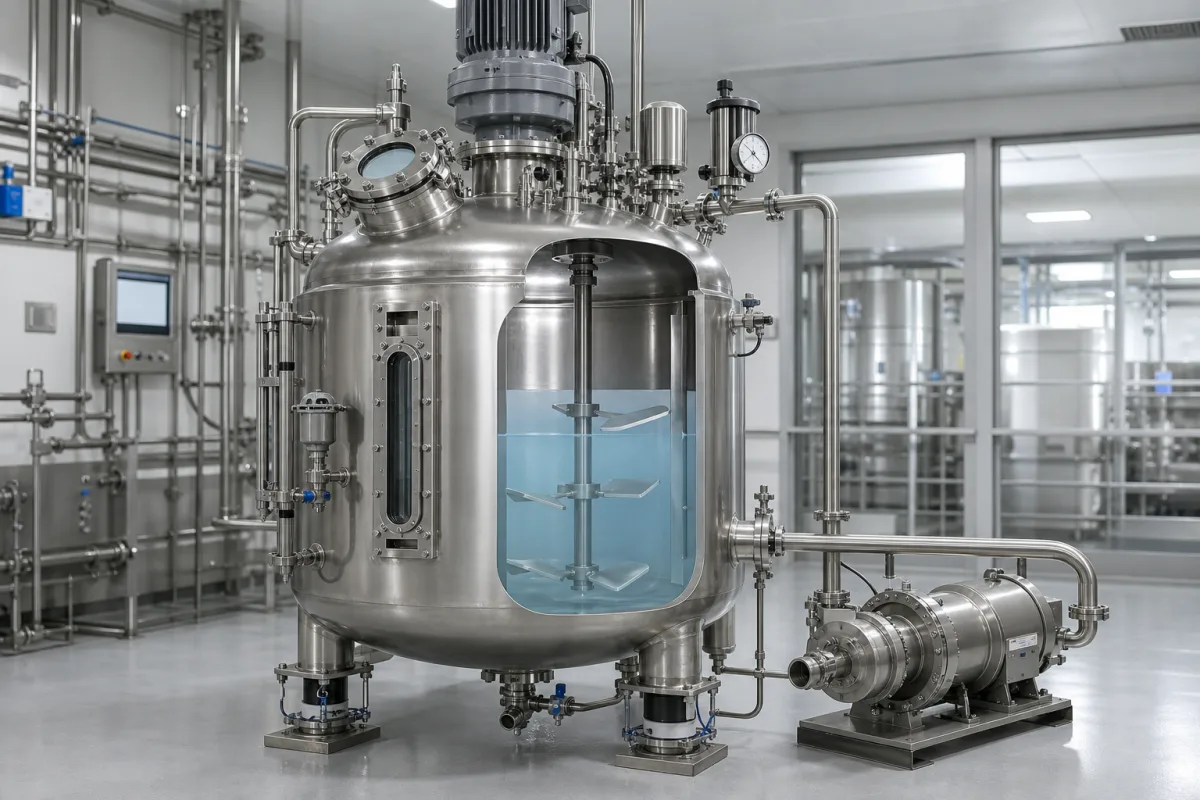
Agitated tanks for liquids · Baffles and vortexing, impeller type and power number, motor power from P = Ne ρ n³ d⁵, materials and finish
A mixing vessel is a tank, such as a stainless steel one, fitted with an agitator — motor, gearbox, shaft and one or more impellers — and, where needed, baffles, a jacket and instruments, used to blend liquids, dissolve solids or keep particles in suspension. Ask three things first: what liquid volume, viscosity and duty (blending, dissolving, suspending) the vessel must handle, whether it has baffles and which impeller type it uses, since together they set power and flow, and what pressure, temperature, material and finish the vessel and seals need.
Agitated mixing tanks and vessels for low- and medium-viscosity liquids and slurries, including baffles, impellers and drives. Static mixers, powder blenders, high-shear homogenisers as separate machines and unagitated storage tanks are outside this page.
CNFX editorial research · Sources checked October 12, 2026 · 4 sources
Major-Godlewska and Karcz (Chemical Papers, 2017) state that low-viscosity liquids are agitated in standard practice in vessels with a high-speed impeller and four planar baffles of width 0.1 D running the full liquid height, the standard geometry having liquid height equal to vessel diameter. In their 0.6 m vessel filled with water to H = D, with up-pumping six-blade turbines measured between Re 3 × 10⁴ and 2 × 10⁵, the mean power number with standard baffles was 4.45 for a 90° (flat) blade, 2.77 for 60°, 1.48 for 45° and 0.67 for 30°. [1]
Without baffles the same impellers gave power numbers of 0.88 (90°), 0.83 (60°), 0.61 (45°) and 0.39 (30°), and shortening the baffles reduced power number; the effect of blade angle was strongest with standard baffles, where power number fell about five-fold from 90° to 30°. The paper also cites a free-surface vortex reaching a 45° pitched-blade turbine in an unbaffled vessel at a critical speed in other work. [1]
A second laboratory geometry, from the Autonomous Metropolitan University in Mexico, uses the same baffle rule: a jacketed stainless vessel of internal diameter T = 132 mm with a dished bottom, four removable baffles each about as tall as the tank diameter and 1/10 of it wide, cut from 3.2 mm stainless plate, and a standard six-blade Rushton turbine of 50.8 mm diameter. The ratios were C/T = 0.3848 for off-bottom clearance, Z/T = 1 for liquid height and D/T = 0.3848 for impeller diameter; with impeller speed varied between 25 and 1,100 rpm in two glucose solutions, the rig covered static, laminar, transition and turbulent flow up to Re = 42,955. The authors note that baffles are added to improve mixing efficiency above the transitional regime. [4]
Editorial note: baffles convert swirl into top-to-bottom flow and raise the power an impeller draws; an unbaffled vessel draws less power for the same speed. Ask the supplier which impeller, how many baffles and what liquid level the agitator was sized for, and whether it is up- or down-pumping.
Give the supplier the working volume and range of fill levels, liquid properties (density, viscosity, temperature), duty (blending, dissolving, solids suspension, heat transfer), solids content and particle size, batch time, pressure or vacuum, temperature and jacket needs, materials and surface finish, cleaning method, hazardous-area rating, and instruments and nozzles.
02
Size the agitator power from the power number
The paper defines the power number as Ne = P / (n³ d⁵ ρ), with P the power, n the impeller speed, d the impeller diameter and ρ the liquid density, and measured power from shaft torque as P = 2π n M. [1]
Editorial calculation: rearranging, P = Ne ρ n³ d⁵. For water (1,000 kg/m³), a 0.5 m impeller at 2 rev/s (120 rpm) draws about 1.48 × 1,000 × 8 × 0.031 ≈ 370 W with a 45° pitched-blade turbine in a baffled vessel, about 150 W unbaffled, and about 1.1 kW with a flat-blade turbine in a baffled vessel. Because power rises with the fifth power of diameter and the cube of speed, a 20% larger impeller at the same speed needs about 2.5 times the power. [1] Add drive losses and margin for start-up and higher-viscosity batches.
Chunke describes mixing tanks as containers to blend two or more components and builds them in 304, 316 or 316L stainless steel for ease of cleaning and smooth surfaces, with thickness, diameter, height and nozzle positions customised. [2]
Hydrofoil impellers aim to move more liquid for less power. US patent 4,468,130 (General Signal Corp., inventor Ronald J. Weetman) uses three blades 120° apart, each a constant-thickness plate with a rounded leading edge, cambered about 8% at the tip falling to 0% at the base, and twisted so the tip chord angle is 12–32° and the hub chord angle about 16° greater. It describes a downward-pumping impeller in a baffled tank with the tank diameter about three times the impeller diameter (D/T about 1/3), and measures efficiency as Q/P, axial flow per unit power. [3]
Editorial calculation: for a tank 1.5 m across, D/T of 1/3 gives an impeller of about 0.5 m, the size used in the power example above. [3]
03
Water-treatment tanks, reactor-side vessels and vacuum cosmetic tanks
Listings include stainless liquid mixing tanks for water treatment and process plants, mixing vessels alongside reactors and powder mixers, and normal-pressure and vacuum mixing tanks for cosmetics and food; ask each for impeller type and power, baffles, finish and pressure rating.
04
Which part holds the batch and which one sets the power draw
Matching volume, speed and impeller geometry to the batch
Power number, baffle size and the D/T and C/T ratios come from published test vessels and one patent; seal, design pressure and design temperature have no reference here and are for the supplier to state.
Chunke lists 304/316 stainless mixing tanks for water treatment; Konmix lists mixing vessels and movable tanks beside its reactors and powder mixers; Wuxi Yikai lists normal-pressure and vacuum mixing tanks among its homogenising mixers.
Guangzhou Chunke Environmental
Manufacturing site to be confirmed for the order
Lists 304/316 stainless liquid mixing tanks and storage tanks for water treatment and process use.
Explore company information and manufacturing capabilities, then discuss the scope of your project with a relevant supplier.
Share this page
Compiled and source-reviewed by the CNFX editorial team.
Each manufacturer above links to the page on that company's own website where the product is listed, with the date we checked it. How we source and review
· Page last updated 13 October 2026
Buyer questions
Do mixing tanks need baffles?
In Major-Godlewska and Karcz's tests, four standard baffles raised a 45° pitched-blade turbine's power number from 0.61 to 1.48, converting swirl into mixing. [1]
How do I estimate agitator power?
Using P = Ne ρ n³ d⁵ with a published power number; a 0.5 m 45° PBT at 120 rpm in water draws about 370 W baffled (editorial calculation). [1]
What material are mixing tanks made of?
Chunke builds its mixing tanks in 304, 316 or 316L stainless steel for easy cleaning. [2]
What is a hydrofoil impeller?
US patent 4,468,130 describes a three-blade impeller of cambered, twisted plates (tip chord angle 12–32°) designed to maximise axial flow per unit power in a baffled tank with D/T about 1/3. [3]
Sources and what still needs a direct check
Sources checked 2026-10-12. Major-Godlewska and Karcz report measured power numbers for one test geometry, and Magos-Rivera, Avilés-Cruz and Ramírez-Muñoz describe a second baffled Rushton-turbine vessel; Chunke describes its own tanks. Power numbers depend on impeller and vessel geometry.