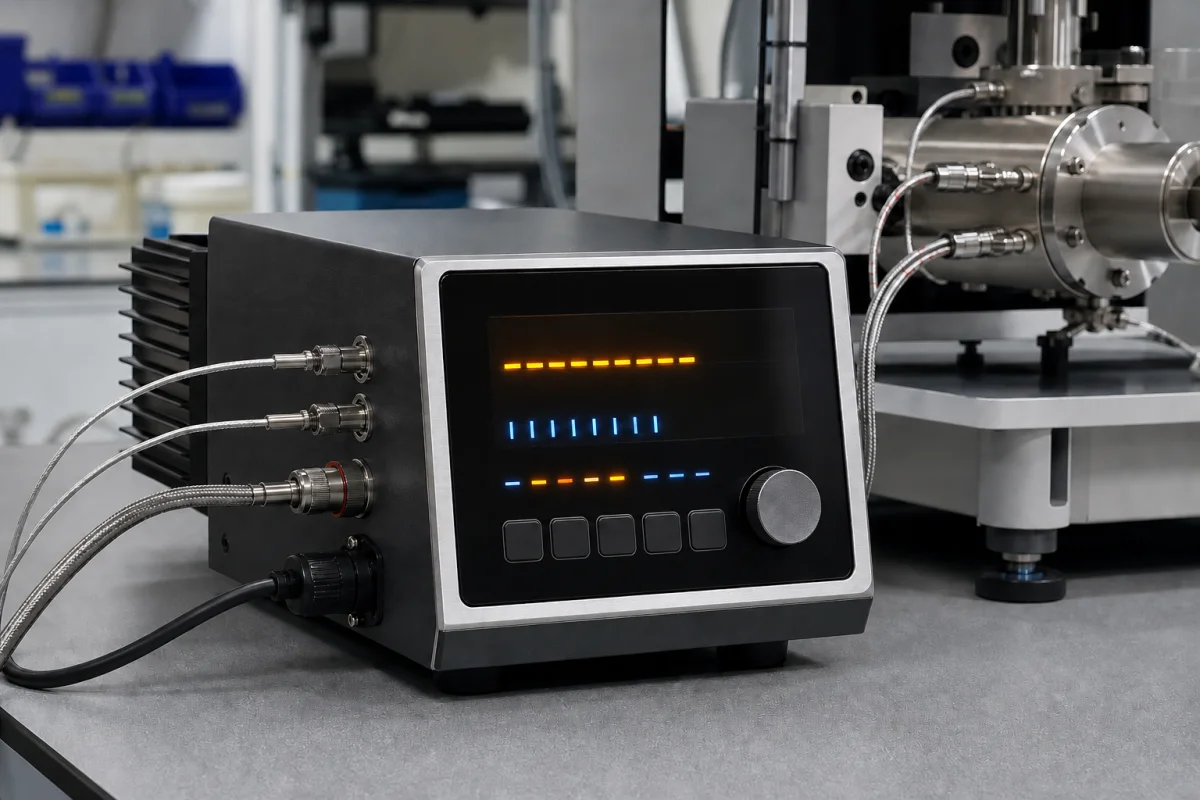
Digital barrel temperature controller for melt flow index testers
Melt flow tester barrel control · multi-zone PID on platinum RTDs, accuracy over the 0–75 mm above the die, recovery after loading
A melt flow index tester (extrusion plastometer) extrudes molten polymer through a die under a set load and reports melt mass-flow rate (MFR) or melt volume-flow rate (MVR), and the result moves with barrel temperature. The digital temperature controller in it is not a general-purpose panel controller: it reads one or more platinum resistance sensors in the barrel wall, drives the barrel heater zones with PID, and has to hold the melt within a few tenths of a kelvin along the part of the bore where the measurement is taken, and return to that band within minutes after cold granules are loaded. Specify it by where and how its accuracy is stated, not by display resolution.
Digital temperature control systems built into, or retrofitted to, melt flow index testers (extrusion plastometers) to ISO 1133-1/-2 and ASTM D1238: the multi-zone PID controller, platinum RTD sensors, barrel heater zones and the temperature verification they are specified by. General-purpose panel and DIN-rail temperature controllers for ovens, extruders and process heaters are covered on the Temperature controller page. Load, piston displacement, test methods and automation of the whole instrument belong to the Melt flow index tester (extrusion plastometer) page, which treats the tester as a purchase; this page stays with its barrel heating and control. Circulating temperature control units are covered on the Circulating temperature control unit (TCU) for reactor jackets and moulds page and the Temperature control unit (TCU) for jacketed and flow reactors page.
CNFX editorial research · Sources checked October 12, 2026 · 4 sources
Where along the bore, and over what time, the barrel accuracy is stated
Makers state barrel temperature performance in different terms, and the terms decide whether two figures can be compared. ZwickRoell specifies the Mflow by the zone that matters to the test: [2]
ZwickRoell explains why the spatial and temporal figures matter: ISO 1133-2 is the part of the standard for materials sensitive to time- or temperature-dependent history or humidity, such as PBT, PET and PA, and plastometers used for it must meet specific conditions for spatial and temporal temperature distribution in the barrel. [3]
Editorial note: a display resolution of 0.01 or 0.1 K says nothing about how far the melt is from set point. Ask for the stated accuracy as a spatial value over a named length above the die and a temporal value over a named time, and for the verification method used with a reference thermometer.
Gradient ≤±0.3 °C within 0–75 mm above the die [4]
Give the supplier the standards and parts to be met (ISO 1133-1, ISO 1133-2, ASTM D1238 procedure), test temperatures, polymers (including moisture-sensitive ones), whether the controller is for a new tester or a retrofit, sensor type and number, heater zones, supply voltage, and calibration certificate requirements.
02
Three heater zones on three platinum RTDs, and recovery after loading
Tinius Olsen redesigned the MP1200 furnace around a three-zone band heater, with a three-zone PID controller and three platinum RTDs, to hold ±0.1 °C from set point along the testing area of the bore and meet the requirements of ISO 1133-2. [1]
Qualitest describes the same idea for the QualiFi 5000: a dual PID algorithm drives a heater and sensor rated for continuous use from 50 to 450 °C, and multi-stage independent zone control holds a gradient below ±0.1 °C along the barrel wall and within ±0.3 °C over 0–75 mm above the die. Temperature recovers within 2 minutes after the material is loaded. [4]
Editorial calculation: the Tinius Olsen ±0.1 °C band is a 0.2 °C total spread; the Qualitest ±0.3 °C gradient over 75 mm is a 0.6 °C total spread, three times wider, though the two are stated over different lengths and cannot be ranked from these figures alone.
The controller also feeds the timing of the test. ZwickRoell lists time resolution of 0.002 s with an error limit of ±0.01 s for Method B, and piston travel resolution of 0.003 mm with an error limit of ±0.02 mm to ISO 1133; Tinius Olsen gives timer accuracy of 0.001 s. [2][1]
03
Barrel material and the fluoropolymer and PVC exception
ZwickRoell's Mflow uses a 9.55 mm bore barrel in a wear-resistant version for fluorine-free plastics, and an acid- and wear-resistant version for fluoropolymers such as PTFE and PFA, which release hydrofluoric acid, and for PVC, which can release hydrochloric acid. [2]
Editorial note: when the barrel is changed for an acid-resistant one, repeat the temperature verification over the 0–75 mm above the die before reporting results.
04
Send the test method and the verification you need
Paste it into your enquiry below or into an email to a maker, then replace every bracket.
Standards: [ISO 1133-1 / ISO 1133-2 / ASTM D1238 procedure]
Temperatures: [test temperatures; maximum]
Accuracy: [spatial over mm above die; temporal over time]
Zones and sensors: [heater zones; Pt RTD count]
Recovery: [time to band after loading]
Polymers: [including PET, PBT, PA, PTFE, PVC]
Scope: [new tester or controller retrofit]
Documents: [calibration certificate; reference thermometer]
1 company lists this product among what they make. Company figures are quoted from each
company's own website; every card states where the relationship came from.
Xiamen Maxwell Automation Limited
Manufacturing site to be confirmed for the order
Lists PID temperature controllers with thermocouple and RTD inputs, including the CH102 with relay and SSR-drive output and touch-button PID controllers with universal input.
Explore company information and manufacturing capabilities, then discuss the scope of your project with a relevant supplier.
Share this page
Compiled and source-reviewed by the CNFX editorial team.
Each manufacturer above links to the page on that company's own website where the product is listed, with the date we checked it. How we source and review
· Page last updated 13 October 2026
Buyer questions
How accurate must a melt flow tester barrel temperature be?
Makers state it differently: ZwickRoell gives under 0.3 K within 0–75 mm above the die, Tinius Olsen ±0.1 °C along the bore, Qualitest ≤0.2 °C indication error. [2][1][4]
Why three heater zones?
Tinius Olsen uses a three-zone band heater with three platinum RTDs and a three-zone PID controller to hold ±0.1 °C along the bore for ISO 1133-2. [1]
What does ISO 1133-2 add?
Per ZwickRoell, it covers materials sensitive to time-temperature history or humidity, such as PET, PBT and PA, with spatial and temporal temperature conditions in the barrel. [3]
Sources and what still needs a direct check
Sources checked 2026-10-12. Tinius Olsen, ZwickRoell and Qualitest make melt flow testers; the figures are their own specifications (Tinius Olsen bulletin 131-D, 2012; ZwickRoell product information; Qualitest product page). ISO 1133 and ASTM D1238 themselves set the requirements.