Industry-Verified Manufacturing Data (2026)

Extruder Barrel

Based on aggregated insights from multiple verified factory profiles within the CNFX directory, the standard Extruder Barrel used in the Rubber and Plastic Product Manufacturing sector typically supports operational capacities ranging from standard industrial configurations to heavy-duty production requirements.

Technical Definition & Core Assembly

A canonical Extruder Barrel is characterized by the integration of Barrel Liner and Heating Bands. In industrial production environments, manufacturers listed on CNFX commonly emphasize Nitrided Steel construction to support stable, high-cycle operation across diverse manufacturing scenarios.

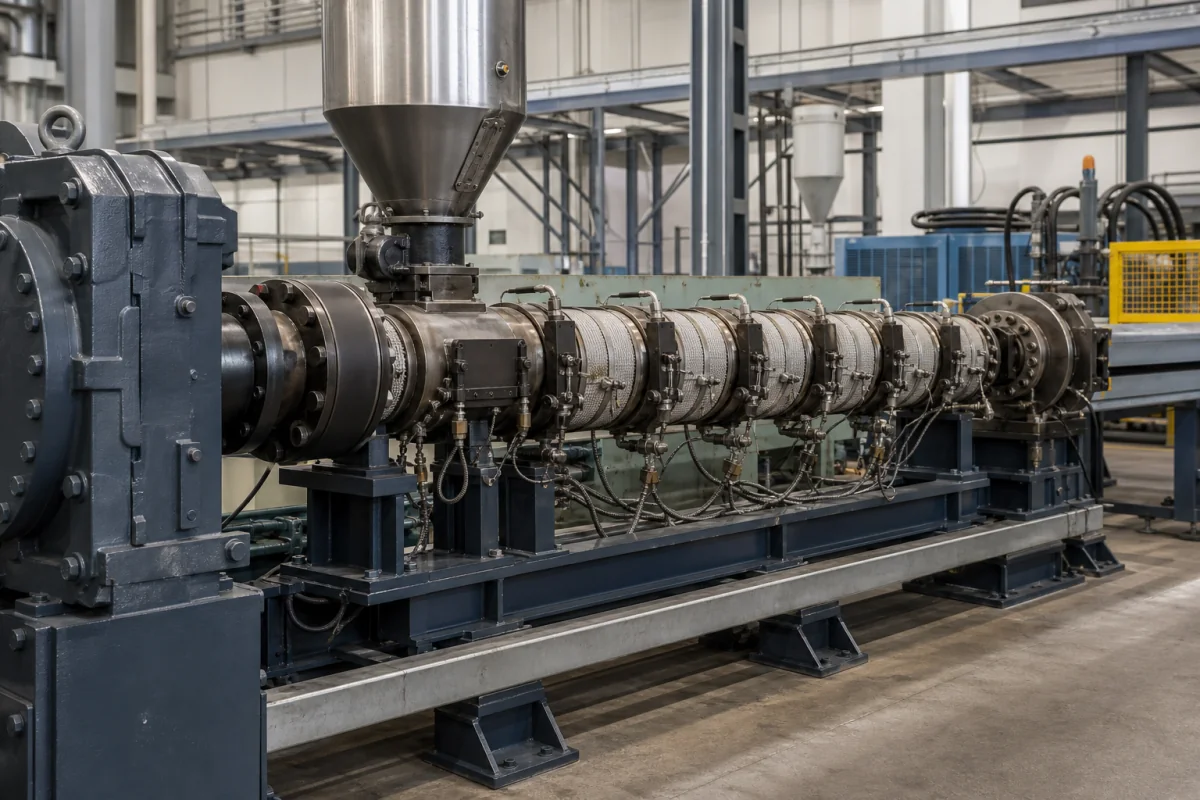
The cylindrical housing that contains the screws and provides the processing environment for polymer compounding.
Product Specifications

Technical details and manufacturing context for Extruder Barrel

Definition
In a twin-screw polymer compounding extruder, the extruder barrel is the main structural component that houses the intermeshing screws. It provides the enclosed processing chamber where raw polymer materials, additives, and fillers are conveyed, melted, mixed, and pressurized before being forced through the die. The barrel typically consists of multiple modular sections that can be configured for different processing requirements.
Working Principle
The barrel works in conjunction with the rotating screws to process polymer materials. As the screws rotate within the barrel, they convey material forward while generating shear and pressure. The barrel's internal surface provides the counter-surface against which the material is worked, and its heating/cooling systems control the thermal profile throughout the compounding process.
Common Materials
Nitrided Steel, Bimetallic Alloy (e.g., Xaloy, Reiloy)
Technical Parameters
  • Inner diameter of the barrel, which determines the screw size and processing capacity (mm) Standard Spec
Components / BOM
  • Barrel Liner
    Wear-resistant inner surface that contacts the polymer material
    Material: Bimetallic alloy or hardened steel
  • Heating Bands
    Provide controlled heating to maintain processing temperature
    Material: Stainless steel with ceramic or mica insulation
  • Cooling Channels
    Circulate cooling fluid to remove excess heat from the barrel
    Material: Steel
  • Feed Throat
    Entry point for raw materials into the barrel
    Material: Hardened steel
  • Venting Port
    Allows removal of volatiles and gases during processing
    Material: Stainless steel
Engineering Reasoning
10-100 MPa internal pressure, 150-350°C barrel temperature
Yield strength exceeded at 250 MPa internal pressure or 400°C barrel temperature
Design Rationale: Thermal fatigue from cyclic heating/cooling causing microcrack initiation at stress concentrations
Risk Mitigation (FMEA)
Trigger Polymer degradation causing acidic byproducts
Mode: Corrosion pitting on internal barrel surface
Strategy: Nitrided surface treatment with 0.3mm case depth
Trigger Screw deflection exceeding 0.1mm radial clearance
Mode: Metal-to-metal contact causing scoring
Strategy: Barrel bore straightness tolerance of 0.02mm/m with induction hardening to 55 HRC

Industry Taxonomies & Aliases

Commonly used trade names and technical identifiers for Extruder Barrel.

Industrial Ecosystem & Supply Chain DNA

Complementary Systems
Downstream Applications
Specialized Tooling

Application Fit & Sizing Matrix

Operational Limits
pressure: Up to 300 bar (30 MPa) maximum internal pressure
flow rate: 10-10,000 kg/hr (depending on screw diameter and L/D ratio)
temperature: 50-400°C (depending on barrel material and heating/cooling system)
slurry concentration: Not applicable - designed for polymer melts, not slurries
Media Compatibility
✓ Polyethylene (PE) compounds ✓ Polypropylene (PP) blends ✓ Engineering thermoplastics (e.g., PC, ABS, Nylon)
Unsuitable: Highly abrasive materials with mineral fillers >40% without specialized liner
Sizing Data Required
  • Required throughput (kg/hr)
  • Screw diameter and L/D ratio needed
  • Material viscosity and shear sensitivity

Reliability & Engineering Risk Analysis

Failure Mode & Root Cause
Barrel Liner Wear
Cause: Abrasive degradation from high-friction polymer processing, compounded by metal-to-metal contact from screw misalignment or insufficient material feed, leading to reduced wall thickness and compromised thermal uniformity.
Thermal Fatigue Cracking
Cause: Cyclic heating and cooling stresses from frequent startups/shutdowns or inconsistent temperature control, exacerbated by material degradation deposits causing localized hot spots and thermal expansion mismatches.
Maintenance Indicators
  • Audible metallic grinding or scraping noises during operation indicating screw-barrel contact
  • Visual discoloration or burn marks on barrel exterior signaling overheating or material degradation
Engineering Tips
  • Implement routine infrared thermography scans to detect and correct thermal gradients before they cause barrel distortion or cracking
  • Establish strict material feed protocols with upstream filtration to prevent abrasive contaminants and maintain consistent screw-barrel clearance through precision alignment checks

Compliance & Manufacturing Standards

Reference Standards
ISO 9001:2015 - Quality management systems ASTM A276/A276M-17 - Standard Specification for Stainless Steel Bars and Shapes CE Marking - Directive 2006/42/EC on machinery safety
Manufacturing Precision
  • Bore diameter: +/-0.02mm
  • Surface flatness: 0.1mm per meter length
Quality Inspection
  • Dimensional verification with CMM (Coordinate Measuring Machine)
  • Ultrasonic testing for internal defects

Factories Producing Extruder Barrel

Verified manufacturers with capability to produce this product in China

✓ 97% Supplier Capability Match Found

S Sourcing Manager from Canada Feb 25, 2026
★★★★★
"Impressive build quality. Especially the technical reliability is very stable during long-term operation."
Technical Specifications Verified
P Procurement Specialist from United States Feb 22, 2026
★★★★☆
"As a professional in the Rubber and Plastic Product Manufacturing sector, I confirm this Extruder Barrel meets all ISO standards. (Delivery took slightly longer than expected, but technical support was excellent.)"
Technical Specifications Verified
T Technical Director from United Arab Emirates Feb 19, 2026
★★★★★
"Standard OEM quality for Rubber and Plastic Product Manufacturing applications. The Extruder Barrel arrived with full certification."
Technical Specifications Verified
Verification Protocol

“Feedback is collected from verified sourcing managers during RFQ (Request for Quote) and factory evaluation processes on CNFX. These reports represent historical performance data and technical audit summaries from our B2B manufacturing network.”

12 sourcing managers are analyzing this specification now. Last inquiry for Extruder Barrel from India (1h ago).

Supply Chain Compatible Machinery & Devices

Industrial Conveyor Belt

A continuous loop of material used to transport goods in industrial settings.

Explore Specs →
Modular Injection Molded Plastic Pallet

Interlocking plastic pallet system for logistics and storage.

Explore Specs →
Multi-Layer Co-Extruded Barrier Film

Plastic film with multiple layers for superior barrier properties.

Explore Specs →
High-Precision Silicone Gasket

Custom-molded silicone seal for industrial equipment.

Explore Specs →

Frequently Asked Questions

What are the advantages of bimetallic alloy extruder barrels over nitrided steel?

Bimetallic alloy barrels (like Xaloy or Reiloy) offer superior wear resistance and corrosion protection for abrasive or corrosive polymers, extending service life compared to standard nitrided steel barrels.

How do cooling channels in an extruder barrel improve processing?

Cooling channels allow precise temperature control along the barrel length, preventing polymer degradation, improving melt consistency, and enabling processing of heat-sensitive materials.

When should an extruder barrel be replaced or relined?

Replace or reline the barrel when excessive wear causes increased clearance between screws and barrel liner, leading to reduced output, poor mixing, or inconsistent product quality.

Can I contact factories directly on CNFX?

CNFX is an open directory, not a transaction platform. Each factory profile provides direct contact information and production details to help you initiate direct inquiries with Chinese suppliers.

Get Quote for Extruder Barrel

Request technical pricing, lead times, or customized specifications for Extruder Barrel directly from verified manufacturing units.

Your business information is encrypted and only shared with verified Extruder Barrel suppliers.

Thank you! Your message has been sent. We'll respond within 1–3 business days.

Need to Manufacture Extruder Barrel?

Connect with verified factories specializing in this product category

Add Your Factory Contact Us
Previous Product
Ejection System
Next Product
Fume Extraction Hood