Industry-Verified Manufacturing Data (2026)

Heated Transfer Lines

Based on aggregated insights from multiple verified factory profiles within the CNFX directory, the standard Heated Transfer Lines used in the Rubber and Plastic Product Manufacturing sector typically supports operational capacities ranging from standard industrial configurations to heavy-duty production requirements.

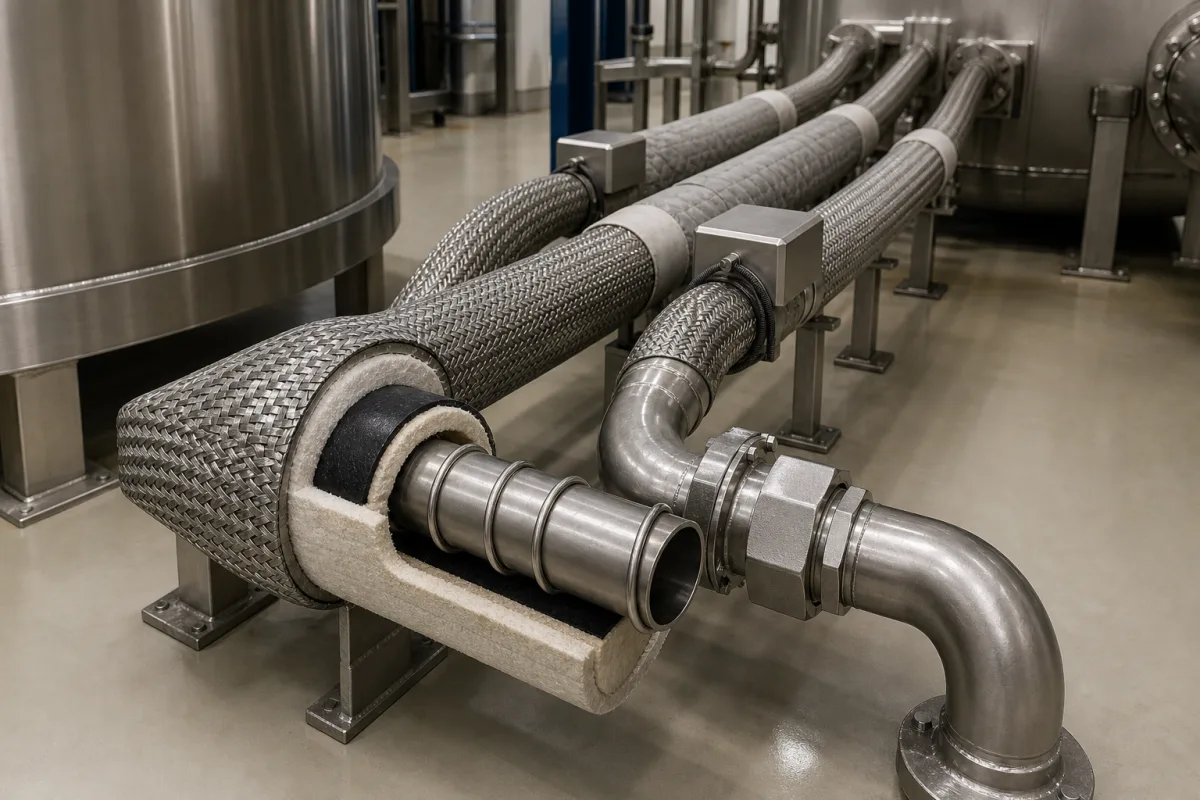
Technical Definition & Core Assembly

A canonical Heated Transfer Lines is characterized by the integration of Heating Jacket and Temperature Sensors. In industrial production environments, manufacturers listed on CNFX commonly emphasize Stainless steel 316L construction to support stable, high-cycle operation across diverse manufacturing scenarios.

Temperature-controlled piping system for transporting viscous resins

Product Specifications

Technical details and manufacturing context for Heated Transfer Lines

Definition
Specialized heated conduits within resin storage and metering systems that maintain precise temperature control to ensure consistent viscosity and flow characteristics of thermosetting or thermoplastic resins during transfer from storage vessels to processing equipment.
Working Principle
Utilizes integrated heating elements (electric, steam, or thermal fluid) along the pipeline to maintain resin temperature above its minimum processing threshold, preventing premature curing or solidification during transfer while ensuring uniform material properties.
Common Materials
Stainless steel 316L, Carbon steel with internal coating, PTFE-lined steel
Technical Parameters
  • Standard diameters range from 25mm to 150mm depending on resin viscosity and flow requirements (mm) Customizable
Components / BOM
  • Heating Jacket
    Provides uniform heat distribution along pipeline length
    Material: Stainless steel with insulation
  • Temperature Sensors
    Monitor and regulate temperature at multiple points along the line
    Material: Stainless steel housing with thermocouple elements
  • Insulation Layer
    Minimizes heat loss and maintains energy efficiency
    Material: Mineral wool or ceramic fiber
Engineering Reasoning
0.5-3.0 MPa at 50-120°C with viscosity range 500-5000 cP
Material yield strength threshold: 275 MPa for 316L stainless steel at 150°C, or thermal gradient exceeding 15°C/cm causing differential expansion stress >200 MPa
Design Rationale: Thermal fatigue from cyclic heating (ΔT>80°C) causing crack initiation at stress concentrations exceeding Paris' law threshold (ΔK>6 MPa√m), coupled with viscous drag pressure drop exceeding laminar flow limit (Re>2300)
Risk Mitigation (FMEA)
Trigger PID controller integral windup causing sustained 150°C overshoot
Mode: 316L stainless steel annealing at 850°C, reducing yield strength from 290 MPa to 170 MPa
Strategy: Cascade control with outer loop flow rate feedback and anti-windup compensation using Clamping method with 10% safety margin
Trigger Two-phase flow formation at 0.7 MPa due to dissolved gas release (Henry's constant k_H=3.4×10⁻⁴ mol/L·bar)
Mode: Cavitation erosion at vapor bubble collapse generating localized 1.5 GPa shock waves
Strategy: Degassing unit maintaining dissolved oxygen <2 ppm with upstream pressure maintained >1.2×vapor pressure at operating temperature

Industry Taxonomies & Aliases

Commonly used trade names and technical identifiers for Heated Transfer Lines.

Applied To / Applications

This component is essential for the following industrial systems and equipment:

Industrial Ecosystem & Supply Chain DNA

Complementary Systems
Downstream Applications
Specialized Tooling

Application Fit & Sizing Matrix

Operational Limits
pressure: Up to 10 bar (150 psi) standard, higher on request
flow rate: 0.1 to 100 L/min depending on line diameter
temperature: Typically 40°C to 250°C (customizable up to 400°C)
slurry concentration: Up to 60% solids by weight (depends on particle size and viscosity)
Media Compatibility
✓ Epoxy resins ✓ Polyurethane systems ✓ Hot melt adhesives
Unsuitable: Highly corrosive acids or solvents requiring specialized metallurgy
Sizing Data Required
  • Required flow rate (L/min)
  • Material viscosity at operating temperature (cP)
  • Total heated length and ambient temperature

Reliability & Engineering Risk Analysis

Failure Mode & Root Cause
Thermal fatigue cracking
Cause: Cyclic heating and cooling causing expansion/contraction stresses, especially at welds, bends, or supports, leading to crack initiation and propagation.
Internal corrosion/erosion
Cause: Chemical attack from process fluids at elevated temperatures, combined with flow-induced erosion, thinning the pipe wall, particularly at elbows or velocity changes.
Maintenance Indicators
  • Visible steam or fluid leaks at joints, welds, or fittings, indicating seal failure or wall breach.
  • Unusual banging, knocking, or vibration noises during operation, suggesting water hammer, slug flow, or loose supports.
Engineering Tips
  • Implement a thermal cycling management program: control heating/cooling rates, use expansion loops/joints, and inspect high-stress areas (welds, supports) regularly with non-destructive testing (e.g., ultrasonic thickness testing).
  • Apply internal coatings or liners resistant to process chemicals, and monitor fluid chemistry/pH to minimize corrosive conditions; also, ensure proper insulation to maintain uniform temperatures and reduce thermal gradients.

Compliance & Manufacturing Standards

Reference Standards
ISO 9001:2015 - Quality Management Systems ASME B31.3 - Process Piping PED 2014/68/EU - Pressure Equipment Directive
Manufacturing Precision
  • Bore Diameter: +/-0.05mm
  • Flatness of Flange Faces: 0.1mm per 300mm
Quality Inspection
  • Hydrostatic Pressure Test
  • Radiographic Testing (RT) of Welds

Factories Producing Heated Transfer Lines

Verified manufacturers with capability to produce this product in China

✓ 96% Supplier Capability Match Found

S Sourcing Manager from Australia Feb 17, 2026
★★★★★
"As a professional in the Rubber and Plastic Product Manufacturing sector, I confirm this Heated Transfer Lines meets all ISO standards."
Technical Specifications Verified
P Procurement Specialist from Singapore Feb 14, 2026
★★★★☆
"Standard OEM quality for Rubber and Plastic Product Manufacturing applications. The Heated Transfer Lines arrived with full certification. (Delivery took slightly longer than expected, but technical support was excellent.)"
Technical Specifications Verified
T Technical Director from Germany Feb 11, 2026
★★★★★
"Great transparency on the Heated Transfer Lines components. Essential for our Rubber and Plastic Product Manufacturing supply chain."
Technical Specifications Verified
Verification Protocol

“Feedback is collected from verified sourcing managers during RFQ (Request for Quote) and factory evaluation processes on CNFX. These reports represent historical performance data and technical audit summaries from our B2B manufacturing network.”

6 sourcing managers are analyzing this specification now. Last inquiry for Heated Transfer Lines from Germany (1h ago).

Supply Chain Compatible Machinery & Devices

Automotive Weatherstrip

Rubber sealing component for vehicle doors, windows, and trunks.

Explore Specs →
Industrial Conveyor Belt

A continuous loop of material used to transport goods in industrial settings.

Explore Specs →
Modular Injection Molded Plastic Pallet

Interlocking plastic pallet system for logistics and storage.

Explore Specs →
Multi-Layer Co-Extruded Barrier Film

Plastic film with multiple layers for superior barrier properties.

Explore Specs →

Frequently Asked Questions

What temperature range can these heated transfer lines maintain for viscous resins?

Our heated transfer lines maintain precise temperature control typically between 50°C to 300°C (122°F to 572°F), with custom configurations available for specific resin viscosity requirements in rubber and plastic manufacturing.

How does the PTFE-lined steel option compare to stainless steel 316L for chemical resistance?

PTFE-lined steel offers superior chemical resistance against corrosive resins and additives, while stainless steel 316L provides excellent general corrosion resistance and structural integrity. The choice depends on your specific resin chemistry and operating conditions.

What maintenance is required for the heating jacket and temperature sensors?

Heating jackets require periodic inspection for insulation integrity and electrical connections, while temperature sensors need calibration checks every 6-12 months. The insulation layer typically requires minimal maintenance unless physical damage occurs.

Can I contact factories directly on CNFX?

CNFX is an open directory, not a transaction platform. Each factory profile provides direct contact information and production details to help you initiate direct inquiries with Chinese suppliers.

Get Quote for Heated Transfer Lines

Request technical pricing, lead times, or customized specifications for Heated Transfer Lines directly from verified manufacturing units.

Your business information is encrypted and only shared with verified Heated Transfer Lines suppliers.

Thank you! Your message has been sent. We'll respond within 1–3 business days.

Need to Manufacture Heated Transfer Lines?

Connect with verified factories specializing in this product category

Add Your Factory Contact Us
Previous Product
Heated Platens
Next Product
Heater Bands