Industry-Verified Manufacturing Data (2026)

Heater Bands

Based on aggregated insights from multiple verified factory profiles within the CNFX directory, the standard Heater Bands used in the Rubber and Plastic Product Manufacturing sector typically supports operational capacities ranging from standard industrial configurations to heavy-duty production requirements.

Technical Definition & Core Assembly

A canonical Heater Bands is characterized by the integration of Resistance Element (Coil/Wire) and Metal Sheath/Casing. In industrial production environments, manufacturers listed on CNFX commonly emphasize Stainless Steel (Casing) construction to support stable, high-cycle operation across diverse manufacturing scenarios.

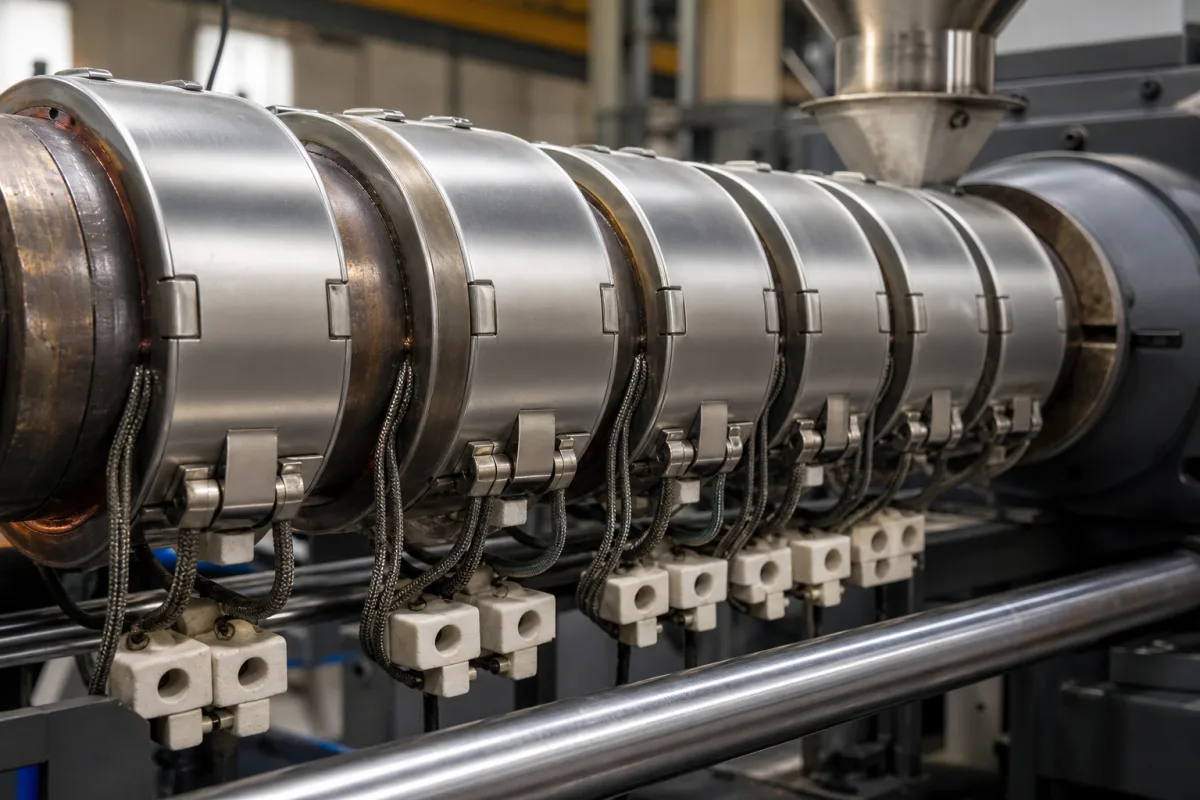
Electrical heating elements wrapped around the barrel of an injection molding machine to melt plastic pellets.
Product Specifications

Technical details and manufacturing context for Heater Bands

Definition
Heater bands are cylindrical electrical heating elements that encircle the barrel of an injection molding machine's injection unit. Their primary function is to provide precise, controlled heat to specific zones along the barrel, transforming solid plastic resin pellets into a molten, homogeneous state suitable for injection into a mold. They are critical for maintaining the correct temperature profile for the specific polymer being processed.
Working Principle
Heater bands convert electrical energy into thermal energy through resistance heating. When an electric current passes through the internal resistive element (typically a coil or ribbon), it generates heat. This heat is conducted through the band's casing (often stainless steel or Incoloy) and radiated/convected to the machine's barrel surface, raising the temperature of the plastic material inside.
Common Materials
Stainless Steel (Casing), Nickel-Chromium Alloy (Resistance Wire), Magnesium Oxide (Insulation)
Technical Parameters
  • Inner diameter and width of the band, which must match the barrel's outer diameter and zone length. (mm) Per Request
Components / BOM
  • Resistance Element (Coil/Wire)
    Generates heat when electrical current flows through it.
    Material: Nickel-Chromium Alloy (e.g., NiCr)
  • Metal Sheath/Casing
    Protects the internal elements, provides mechanical strength, and conducts heat to the barrel.
    Material: Stainless Steel or High-Temperature Alloy (e.g., Incoloy)
  • Insulation Material
    Electrically insulates the resistance element from the metal casing and improves heat transfer.
    Material: Magnesium Oxide (MgO) powder
  • Terminal/Lead Wires
    Provide the electrical connection points for power supply.
    Material: High-temperature insulated wire (e.g., fiberglass, silicone)
Engineering Reasoning
200-400°C barrel surface temperature, 120-480V AC input, 5-40A current
650°C element temperature (NiCr alloy recrystallization threshold), 550°C insulation breakdown (mica degradation point), 50V/mm dielectric strength limit
Design Rationale: Thermal fatigue from cyclic heating (20-400°C, 0.1-1Hz), NiCr oxidation at >600°C forming non-conductive Cr2O3, differential thermal expansion (17×10^-6/K NiCr vs 5×10^-6/K steel) causing sheath cracking
Risk Mitigation (FMEA)
Trigger PID controller overshoot exceeding 450°C setpoint
Mode: Polymer degradation forming carbonaceous deposits on band surface
Strategy: Cascade control with secondary thermocouple feedback loop, rate limiting to 10°C/min
Trigger Moisture ingress through 0.1mm sheath microcracks
Mode: Ground fault detection at <1MΩ insulation resistance
Strategy: Hermetic sealing with 316L stainless steel sheath, IP67 rating validation at 1m depth for 30min

Industry Taxonomies & Aliases

Commonly used trade names and technical identifiers for Heater Bands.

Applied To / Applications

This component is essential for the following industrial systems and equipment:

Industrial Ecosystem & Supply Chain DNA

Complementary Systems
Downstream Applications
Specialized Tooling

Application Fit & Sizing Matrix

Operational Limits
pressure: Ambient atmospheric pressure only (not pressure-rated)
other spec: Requires proper insulation and thermal management; not for direct immersion in fluids
temperature: Up to 450°C (842°F) continuous operation
Media Compatibility
✓ Polymer processing (plastics, resins) ✓ Thermal fluid heating systems ✓ Chemical process heating applications
Unsuitable: Explosive atmospheres or environments with flammable vapors
Sizing Data Required
  • Barrel diameter and length (heating surface area)
  • Required temperature profile and heating power (kW)
  • Process material melting point and thermal conductivity

Reliability & Engineering Risk Analysis

Failure Mode & Root Cause
Insulation breakdown
Cause: Thermal cycling causing expansion/contraction stress, moisture ingress, or physical damage leading to electrical short circuits or ground faults
Heating element burnout
Cause: Overheating due to poor thermal contact with process surface, voltage fluctuations, or localized hot spots from uneven clamping pressure
Maintenance Indicators
  • Visible discoloration, charring, or bubbling of insulation material indicating overheating
  • Audible buzzing, arcing sounds, or irregular heating patterns detected during operation
Engineering Tips
  • Ensure proper surface preparation and uniform clamping pressure during installation to maximize thermal contact and prevent hot spots
  • Implement regular infrared thermography inspections to detect abnormal temperature gradients and schedule preventive maintenance before failures occur

Compliance & Manufacturing Standards

Reference Standards
ISO 9001:2015 - Quality Management Systems ANSI/UL 499 - Electric Heating Appliances DIN 44875 - Electric Surface Heating Elements
Manufacturing Precision
  • Bore Diameter: +/-0.05mm
  • Flatness: 0.15mm per 300mm length
Quality Inspection
  • Insulation Resistance Test
  • Thermal Cycling Endurance Test

Factories Producing Heater Bands

Verified manufacturers with capability to produce this product in China

✓ 92% Supplier Capability Match Found

T Technical Director from United States Jan 10, 2026
★★★★★
"Testing the Heater Bands now; the technical reliability results are within 1% of the laboratory datasheet."
Technical Specifications Verified
P Project Engineer from United Arab Emirates Jan 07, 2026
★★★★☆
"Impressive build quality. Especially the technical reliability is very stable during long-term operation. (Delivery took slightly longer than expected, but technical support was excellent.)"
Technical Specifications Verified
S Sourcing Manager from Australia Jan 04, 2026
★★★★★
"As a professional in the Rubber and Plastic Product Manufacturing sector, I confirm this Heater Bands meets all ISO standards."
Technical Specifications Verified
Verification Protocol

“Feedback is collected from verified sourcing managers during RFQ (Request for Quote) and factory evaluation processes on CNFX. These reports represent historical performance data and technical audit summaries from our B2B manufacturing network.”

13 sourcing managers are analyzing this specification now. Last inquiry for Heater Bands from Poland (1h ago).

Supply Chain Compatible Machinery & Devices

Modular Injection Molded Plastic Pallet

Interlocking plastic pallet system for logistics and storage.

Explore Specs →
Multi-Layer Co-Extruded Barrier Film

Plastic film with multiple layers for superior barrier properties.

Explore Specs →
High-Precision Silicone Gasket

Custom-molded silicone seal for industrial equipment.

Explore Specs →
High-Density Polyethylene Storage Container

Industrial-grade plastic container for bulk material storage and transport.

Explore Specs →

Frequently Asked Questions

What are the main benefits of using stainless steel casing for heater bands?

Stainless steel casing provides excellent corrosion resistance, durability in high-temperature environments, and maintains structural integrity during repeated thermal cycling in rubber and plastic manufacturing processes.

How do nickel-chromium alloy resistance wires improve heater band performance?

Nickel-chromium alloy (typically Nichrome) offers high electrical resistance and oxidation resistance at elevated temperatures, ensuring consistent heating performance, longer lifespan, and efficient energy transfer for melting plastic pellets.

What maintenance is required for heater bands in plastic injection molding?

Regular inspection for wear/damage, cleaning of surfaces to ensure proper heat transfer, checking electrical connections and insulation integrity, and monitoring temperature consistency to prevent processing issues in plastic manufacturing.

Can I contact factories directly on CNFX?

CNFX is an open directory, not a transaction platform. Each factory profile provides direct contact information and production details to help you initiate direct inquiries with Chinese suppliers.

Get Quote for Heater Bands

Request technical pricing, lead times, or customized specifications for Heater Bands directly from verified manufacturing units.

Your business information is encrypted and only shared with verified Heater Bands suppliers.

Thank you! Your message has been sent. We'll respond within 1–3 business days.

Need to Manufacture Heater Bands?

Connect with verified factories specializing in this product category

Add Your Factory Contact Us
Previous Product
Heated Transfer Lines
Next Product
Heating Chamber