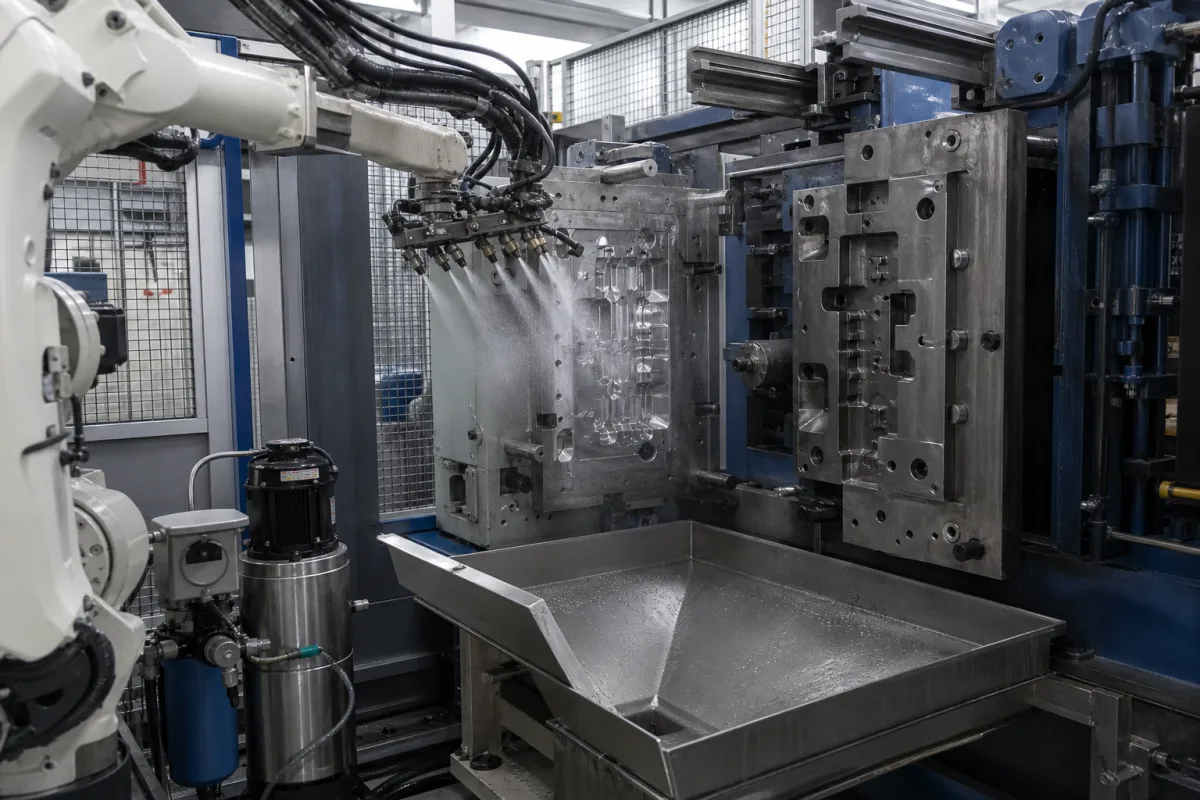
Automated mold spraying and cooling system (die spray system)
Die spray systems for high pressure die casting · Spraying die lubricant and anti-solder agents between shots, spray head and manipulator, booster pressure, blow-off of flash, and how spray parameters cool the die
An automated die spray system works between shots on a die casting machine: once the die opens and the casting is removed, a manipulator moves a spray head between the die halves, sprays release agent onto both halves, blows off debris, and withdraws before the die closes. The spray also takes heat out of the die. Ask three things first: which machine and die it must fit, what it must spray and how fast, and how much die cooling you expect from it.
Automatic spray units for die lubricant, anti-solder agents and blow-off air on high pressure die casting machines, including manipulators or robots, spray heads, valves, boosters and mixing units. Die temperature control units, release agent chemistry itself and spraying for gravity or sand casting are outside this page except where compared.
CNFX editorial research · Sources checked October 11, 2026 · 5 sources
Fit the manipulator, spray head and supply to the machine
US patent 6,830,200 (Mold spraying system, Honda Motor Co.) describes a system that sprays one or more materials onto each half of a die-cast mold while the mold is open between molding cycles. A manipulator arm moves the spray head between a raised position and a working position between the platens and the open mold halves; in the embodiment described, hydraulic traverse and lifting cylinders move the arm under control of a programmable logic controller. Nozzles on the spray head faces may be bent tubing shaped to reach particular areas such as the molding cavities. [1]
The patent explains that flash formed when molten metal enters the parting line can stay on the mold halves and cause defects or prevent the halves from mating, so high-pressure air from the spray head nozzles is directed at each mold half to remove it. In its example the head sprays an anti-solder material and a die lubricant and blows cleaning air, each through its own valve and supply line to a manifold on the machine, and a hydraulic booster raises the pressure of the anti-solder material and die lubricant so they reach the spray head at sufficient pressure despite line losses and the high spraying frequency of a short machine cycle. A pneumatic lock-out device engages the arm to prevent unwanted movement. [1]
Editorial note: give the supplier the die casting machine, platen opening and die size so it can confirm the head reaches all cavity areas, and the cycle time so it can show the spray, blow and retract fit in the open-die time.
Give the supplier the die casting machine model and platen dimensions, die open stroke, die size and cavity layout, machine cycle time and open-die time available for spraying, the materials to be sprayed (die lubricant, anti-solder, air), lubricant dilution and supply, robot or dedicated manipulator, nozzle layout, pressure and booster needs, PLC interface with the machine, lock-out and guarding, and overspray collection.
02
Plan how much heat the spray removes
A Chem-Trend and MAGMA paper on the effect of die lubricant spray on die thermal balance states that water-based die lubricants are commonplace in high pressure die casting and serve to release parts, lubricate moving die components, prevent solder formation and remove heat from the die. It describes the accepted model: heat flux rises with die surface temperature up to a burnout temperature, then falls as a vapour film forms, until the Leidenfrost temperature, which it gives as about 360°C. [2]
The study sprayed lubricant through an automatic spray gun onto an H-13 steel plate with thermocouples, varying initial plate temperature from 150°C to 400°C. Its conclusions: higher fluid pressure increases heat flux, particularly above 250°C, while air pressure had no effect over the range studied; the gun should be perpendicular to the die surface for maximum cooling; lubricant chemistry affects cooling above about 220°C; and dilution did not affect heat flux within the range studied. [2]
Editorial note: if the spray is expected to do part of the die cooling, ask the supplier which fluid pressure, spray angle and spray time it assumes, and confirm the die temperature range with your die thermal design.
03
Weigh open-die spraying against closed-die application
US patent 4,770,225 (Asmo Co., Ltd.; priority date 26 November 1985, granted 13 September 1988) sets out the drawbacks of spraying release agent from a head outside the mould while it is open: agent also lands on parting surfaces and the sliding surfaces of movable inserts, builds up there and holds aluminium tailings, so the closed mould keeps gaps that fill with metal as flash and the castings vary in dimension; agent that misses the die is lost and scatters into the surroundings. [3]
Its alternative injects the agent with the mould closed, through a port on the plunger sleeve between its ends, so the agent fills the cavity and coats only the surfaces that molten metal will contact; the surplus leaves through a vent channel opened and closed by a double-acting hydraulic piston-cylinder valve, and is recovered for reuse. The agent may be injected under pressure or drawn in by connecting the vent port to a vacuum tank, and the patent states it may be applied as a powder so it gives off no decomposition gas on contact with the metal. [3]
Editorial note: an open-die spray head of the kind in US 6,830,200 also blows flash off the die halves, which a closed-die system does not do; if a supplier offers internal or closed-die application, ask how it keeps the parting line clean and how surplus agent is recovered. [1][3]
04
Size the spray machine to the die casting machine
Die spray machine maker Wollin sizes its linear spraying machines by the locking force of the die casting machine they serve. Its ESM series uses AC servo drives on both axes with 2 m/s² acceleration, separate spraying, after-blowing and two high-pressure blow-off circuits that can be switched singly or combined, release agent supply at 2–8 bar, spray and after-blow air at 2–8 bar (4–8 bar on the ESM4) and high-pressure blow-off at 4–8 bar, with a separate concentrate line for micro-spraying. [4]
For smaller cells Wollin offers 1-axis PSM machines for die casting machines of 80–750 tonnes locking force, for example the PSM1F MST Vertikal 800 for 80–360 t and the PSM2F MST Vertikal 1300 for 560–750 t, and 2-axis PSM machines covering 80–5,500 t. [5] Editorial calculation: 10,000 kN is about 1,020 tonnes-force (10,000 ÷ 9.81), so the ESM2's upper limit sits above the 1-axis PSM range; and stepping from ESM2 to ESM4 multiplies spray-head weight by about 4.4 (45 to 200 kg) and air throughput by about 3.6 (700 to 2,500 Nm³/h), which sets the compressed-air supply the cell needs. [4] Give the spray supplier the machine's locking force, die opening stroke and platen size, and check the plant's air capacity against the listed throughput.
Wollin model
Die casting machine range (kN)
Vertical / horizontal stroke (mm)
Spray / after-blow circuits
Air throughput
Spray head weight
ESM2
1,600–10,000
800/1,000/1,300 / 800/1,000/1,200
4 / 4
700 Nm³/h
45 kg
ESM3
5,600–20,000
1,300/1,600/2,000 / 1,000–2,000
6 / 6
2,000 Nm³/h
100 kg
ESM4
20,000–62,000
2,000/2,500 / 2,000/2,500
8 / 8
2,500 Nm³/h
200 kg
05
Manipulator, spray head, valve manifold, booster, blow-off air, lock-out and PLC of a die spray unit
Coverage, cooling, positioning, agent use, pressures and locking force for a die spray quotation
Published values in this table come from the Honda and Asmo patents, the Chem-Trend and MAGMA study and Wollin's ESM and PSM ranges; where none states a value, the row says what to obtain from the supplier.
Field
What it means and published values
Ask the supplier for
Spray Coverage Rate (m²/min)
Die area covered per spray.
Value for your die.
Cooling Capacity (kW)
Heat removed by spray; depends on fluid pressure, angle and chemistry. [2]
Basis.
Positioning Accuracy (mm)
Repeatability of head position.
Value.
Mold Temperature Range (°C)
E.g. 150–400°C tested; Leidenfrost about 360°C. [2]
Range.
Agent Consumption (L/cycle)
Lubricant per shot; overspray from open-die spraying is lost to the surroundings. [3]
2 companies list this product among what they make. Company figures are quoted from each
company's own website; every card states where the relationship came from.
Bengbu Longhua Die Casting Machine Co., Ltd.
Manufacturing site to be confirmed for the order
Its website lists “Servo Robot Spray For Die Casting”.
Explore company information and manufacturing capabilities, then discuss the scope of your project with a relevant supplier.
Share this page
Compiled and source-reviewed by the CNFX editorial team.
Each manufacturer above links to the page on that company's own website where the product is listed, with the date we checked it. How we source and review
· Page last updated 13 October 2026
Buyer questions
What does an automated die spray system spray?
In US patent 6,830,200 the spray head applies die lubricant and anti-solder material and blows high-pressure air to remove flash from each mold half. [1]
Does die spray cool the die?
Yes; Chem-Trend and MAGMA list heat removal among die lubricant functions and found fluid pressure and spray angle affect cooling. [2]
Why does a die spray system need a booster?
The patent uses a booster so materials reach the spray head at sufficient pressure despite line losses and short machine cycles. [1]
Can release agent be applied with the die closed?
US patent 4,770,225 injects agent through the plunger sleeve into the closed cavity and recovers the surplus through a valved vent, so only metal-contact surfaces are coated. [3]
Sources and what still needs a direct check
Sources checked 2026-10-11. The two US patents (Asmo, 1988; Honda, 2004) describe their applicants' systems in their own terms; the technical paper is by a die lubricant maker and a casting simulation company and reports their own test results; Wollin's pages give its own spray machine data.