This page explains how Twin Screw Assembly is classified within Rubber and Plastic Product Manufacturing. Technical values and manufacturer relationships are research references; confirm the current specification and supplier evidence for each order.
The core rotating element in a twin-screw extruder that conveys, mixes, and processes polymer materials.
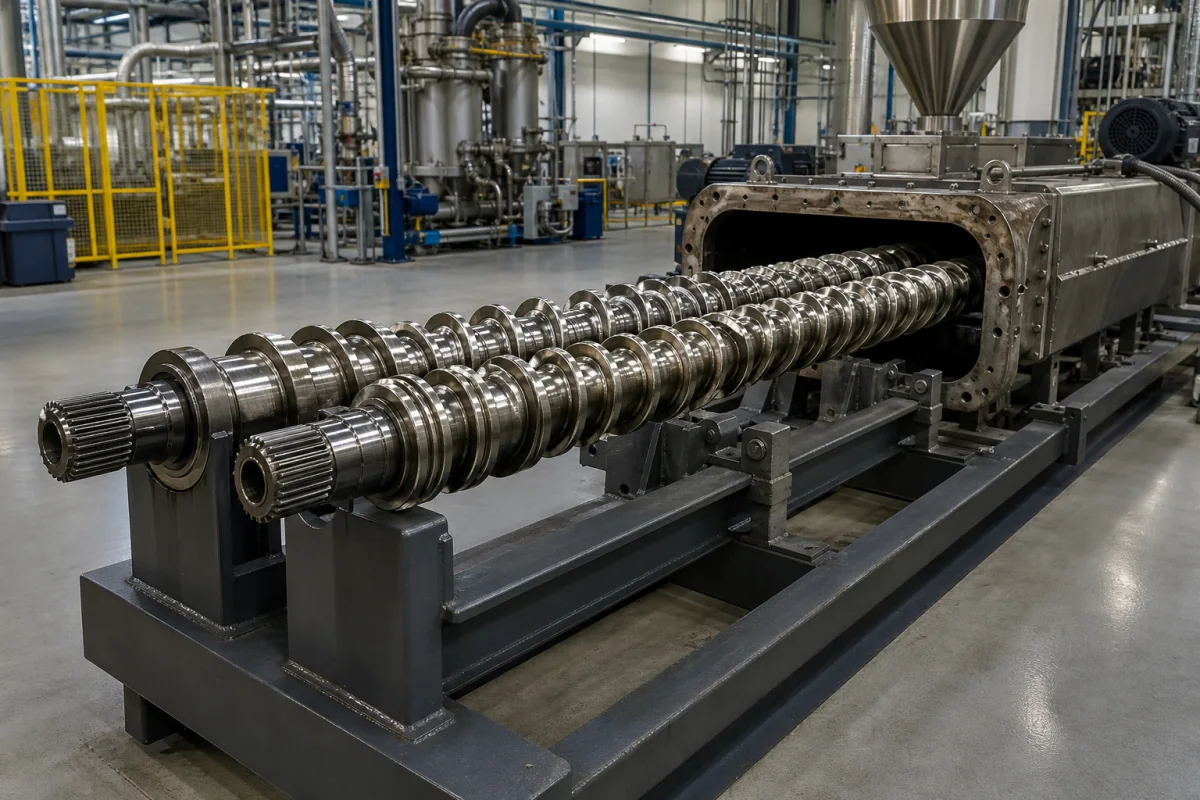
Technical details and manufacturing context for Twin Screw Assembly
| Parameter | Typical range | Notes & selection driver |
|---|---|---|
| Screw Diameter | 20–135 mm | Determines throughput and torque capacity |
| L/D Ratio | 20–60 | Higher ratio for better mixing and residence time |
| Screw Speed | 100–1200 rpm | Higher speed increases shear and throughput |
| Torque per Shaft | 50–5000 N·m | Critical for processing high-viscosity materials |
| Screw Material | 38CrMoAlA | Nitrided steel for wear resistanceGB/T 3077 |
| Surface Hardness | 58–62 HRC | Higher hardness improves wear life |
| Surface Roughness | Ra 0.4–0.8 μm | Smoother surface reduces material adhesion |
| Max Operating Temperature | 300–400 °C | Limited by material and cooling design |
| Max Operating Pressure | 10–30 MPa | Higher pressure requires stronger barrel and screw |
| Screw Weight | 5–500 kg | Affects handling and installation |
| Screw Length | 500–3000 mm | Determines process length and L/D ratio |
| Screw Pitch | 20–100 mm | Affects conveying and mixing efficiency |
Ranges are indicative industry figures for RFQ preparation, not a supplier commitment. Confirm every value and standard with the legal manufacturer before ordering.
| pressure: | Up to 500 bar (typical), 700 bar (max with reinforced design) |
| flow rate: | 10-10,000 kg/hr (depending on screw diameter and L/D ratio) |
| temperature: | +300°C to +400°C |
| slurry concentration: | Up to 70% solids by weight (with appropriate screw profile) |
Indicative industry ranges for design and RFQ preparation. Confirm the exact figures and applicable standard with the manufacturer before specifying.
Quoted from the published standard.
Manufacturer profiles associated with Twin Screw Assembly.
Manufacturer listings support early research and capability understanding. They are not certification, ranking, or transaction guarantees.
A practical evidence checklist for RFQ preparation and supplier evaluation.
CNFX does not score or rank suppliers. Buyers must verify all claims and documents with the legal manufacturer before ordering.
The typical screw diameter range is 20 to 135 mm, as listed in the directory. However, the exact diameter depends on the extruder model and the required throughput. Always verify with the equipment manufacturer for your specific application.
Common materials include nitrided steel (e.g., 38CrMoAlA per GB/T 3077) and bimetallic alloys such as Xaloy or Bimet. These materials provide wear resistance and durability. The choice depends on the processed materials and operating conditions.
The maximum operating temperature is typically 300 to 400 °C, as per the directory. However, this can vary based on the screw material and cooling design. Confirm the temperature limit with the manufacturer for your specific assembly.
Always refer to the technical datasheet provided by the legal manufacturer or supplier. Verify parameters such as screw diameter, L/D ratio, speed, torque, material grade, and operating limits. Do not rely solely on directory values, as they are reference ranges.
Editorial classification, named public sources where available, and source-reviewed manufacturer records.
Ask for use case, specification boundaries, supplier type, and RFQ preparation information for this product.
Compare manufacturer profiles with relevant product and process capability.