Industry-Verified Manufacturing Data (2026)

Vibration Platform

Based on aggregated insights from multiple verified factory profiles within the CNFX directory, the standard Vibration Platform used in the Rubber and Plastic Product Manufacturing sector typically supports operational capacities ranging from standard industrial configurations to heavy-duty production requirements.

Technical Definition & Core Assembly

A canonical Vibration Platform is characterized by the integration of Base Plate and Vibration Motor. In industrial production environments, manufacturers listed on CNFX commonly emphasize Steel construction to support stable, high-cycle operation across diverse manufacturing scenarios.

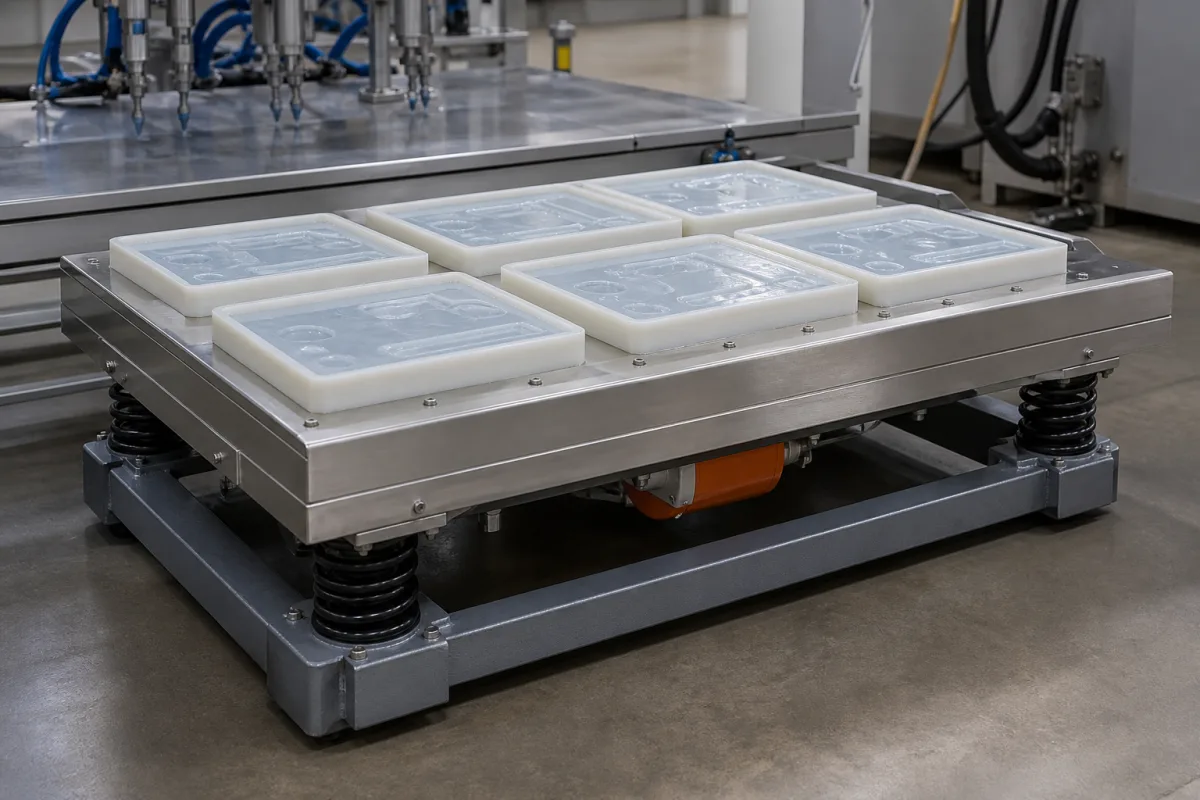
A platform that generates controlled vibrations to remove air bubbles and ensure uniform material distribution in silicone molds.
Product Specifications

Technical details and manufacturing context for Vibration Platform

Definition
A vibration platform is an integral component of a silicone molding station that applies controlled mechanical oscillations to the mold assembly. Its primary function is to eliminate trapped air bubbles from liquid silicone before curing, ensuring defect-free final products with consistent density and surface quality. The platform typically consists of a rigid base plate mounted on vibration-generating mechanisms.
Working Principle
The platform operates by converting electrical energy into mechanical vibrations through electromagnetic or pneumatic actuators. These vibrations create high-frequency oscillations that cause air bubbles within the silicone material to rise to the surface and escape, while simultaneously promoting even material flow into all mold cavities.
Common Materials
Steel, Aluminum alloy
Technical Parameters
  • Platform dimensions (length × width) (mm) Per Request
Components / BOM
  • Base Plate
    Provides a flat, rigid surface for mounting molds
    Material: Steel
  • Vibration Motor
    Generates mechanical oscillations through eccentric weights
    Material: Steel/Copper
  • Spring Dampers
    Isolates vibrations from the surrounding equipment
    Material: Steel/Rubber
Engineering Reasoning
0.5-5.0 mm amplitude at 20-200 Hz frequency
Exceeds 6.0 mm amplitude at resonant frequency (typically 180-220 Hz for silicone mold systems)
Design Rationale: Resonant fatigue failure due to exceeding material yield strength (σ_y = 250 MPa for structural steel) at natural frequency, causing crack propagation at stress concentrations
Risk Mitigation (FMEA)
Trigger Unbalanced eccentric mass distribution exceeding 0.01 kg·m
Mode: Bearing seizure due to excessive radial loading (F_radial > 15 kN)
Strategy: Dynamic balancing to ISO 1940 G2.5 standard with real-time vibration monitoring
Trigger Permanent magnet demagnetization at temperatures above 150°C (Curie point for NdFeB magnets)
Mode: Loss of electromagnetic force (F_em < 80% rated), causing amplitude decay below 0.3 mm
Strategy: Temperature-controlled housing with PTC thermistors and forced-air cooling maintaining T < 120°C

Industry Taxonomies & Aliases

Commonly used trade names and technical identifiers for Vibration Platform.

Applied To / Applications

This component is essential for the following industrial systems and equipment:

Industrial Ecosystem & Supply Chain DNA

Complementary Systems
Downstream Applications
Specialized Tooling

Application Fit & Sizing Matrix

Operational Limits
pressure: Atmospheric (non-pressurized)
other spec: Vibration Frequency: 50-100 Hz, Amplitude: 0.5-2.0 mm, Platform Load Capacity: 50-200 kg
temperature: Ambient to 60°C (140°F)
Media Compatibility
✓ Silicone rubber compounds ✓ Epoxy resins ✓ Polyurethane casting materials
Unsuitable: High-viscosity materials requiring shear mixing (e.g., thick pastes, putties)
Sizing Data Required
  • Mold dimensions (L x W x H)
  • Material viscosity (cP or Pa·s)
  • Required de-airing time per batch (minutes)

Reliability & Engineering Risk Analysis

Failure Mode & Root Cause
Bearing fatigue failure
Cause: Cyclic loading from vibration exceeding bearing design limits, leading to spalling or cracking in raceways or rolling elements
Structural resonance
Cause: Operating frequency coinciding with natural frequency of platform components, causing excessive stress and potential structural failure
Maintenance Indicators
  • Abnormal audible grinding or knocking sounds from motor or bearing housings
  • Visible excessive vibration amplitude or irregular motion patterns during operation
Engineering Tips
  • Implement predictive maintenance with regular vibration analysis to detect early bearing wear and resonance conditions
  • Ensure proper alignment and balancing of all rotating components, and maintain correct fastening torque on all structural connections

Compliance & Manufacturing Standards

Reference Standards
ISO 1940-1:2003 (Mechanical vibration - Balance quality requirements for rotors in a constant (rigid) state) ANSI S2.70-2006 (Guide for the Measurement and Evaluation of Human Exposure to Vibration Transmitted to the Hand) DIN 45669-1:2010 (Measurement of vibration immission - Part 1: Vibration meters - Requirements and tests)
Manufacturing Precision
  • Platform flatness: ±0.5 mm per meter
  • Motor mounting alignment: ±0.1 mm concentricity
Quality Inspection
  • Vibration amplitude and frequency verification test
  • Structural integrity and weld inspection (visual and ultrasonic)

Factories Producing Vibration Platform

Verified manufacturers with capability to produce this product in China

✓ 94% Supplier Capability Match Found

P Project Engineer from United Arab Emirates Jan 01, 2026
★★★★★
"Testing the Vibration Platform now; the technical reliability results are within 1% of the laboratory datasheet."
Technical Specifications Verified
S Sourcing Manager from Australia Dec 29, 2025
★★★★★
"Impressive build quality. Especially the technical reliability is very stable during long-term operation."
Technical Specifications Verified
P Procurement Specialist from Singapore Dec 26, 2025
★★★★★
"As a professional in the Rubber and Plastic Product Manufacturing sector, I confirm this Vibration Platform meets all ISO standards."
Technical Specifications Verified
Verification Protocol

“Feedback is collected from verified sourcing managers during RFQ (Request for Quote) and factory evaluation processes on CNFX. These reports represent historical performance data and technical audit summaries from our B2B manufacturing network.”

10 sourcing managers are analyzing this specification now. Last inquiry for Vibration Platform from Thailand (17m ago).

Supply Chain Compatible Machinery & Devices

Modular Injection Molded Plastic Pallet

Interlocking plastic pallet system for logistics and storage.

Explore Specs →
Multi-Layer Co-Extruded Barrier Film

Plastic film with multiple layers for superior barrier properties.

Explore Specs →
High-Precision Silicone Gasket

Custom-molded silicone seal for industrial equipment.

Explore Specs →
High-Density Polyethylene Storage Container

Industrial-grade plastic container for bulk material storage and transport.

Explore Specs →

Frequently Asked Questions

How does this vibration platform improve silicone mold quality?

The platform generates controlled vibrations that remove trapped air bubbles and ensure uniform material distribution throughout silicone molds, resulting in higher quality, defect-free rubber and plastic products.

What materials are used in the construction of this vibration platform?

This industrial vibration platform is constructed from durable steel and lightweight aluminum alloy components, providing both strength and vibration efficiency while resisting corrosion in manufacturing environments.

What components are included in the vibration platform system?

The complete system includes a sturdy base plate, high-performance vibration motor, and spring dampers that work together to provide controlled, consistent vibrations for optimal material distribution in molds.

Can I contact factories directly on CNFX?

CNFX is an open directory, not a transaction platform. Each factory profile provides direct contact information and production details to help you initiate direct inquiries with Chinese suppliers.

Get Quote for Vibration Platform

Request technical pricing, lead times, or customized specifications for Vibration Platform directly from verified manufacturing units.

Your business information is encrypted and only shared with verified Vibration Platform suppliers.

Thank you! Your message has been sent. We'll respond within 1–3 business days.

Need to Manufacture Vibration Platform?

Connect with verified factories specializing in this product category

Add Your Factory Contact Us
Previous Product
Twin Screw Assembly
Next Product
Winder