Industry-Verified Manufacturing Data (2026)

Temperature-Controlled Barrel

Based on aggregated insights from multiple verified factory profiles within the CNFX directory, the standard Temperature-Controlled Barrel used in the Rubber and Plastic Product Manufacturing sector typically supports operational capacities ranging from standard industrial configurations to heavy-duty production requirements.

Technical Definition & Core Assembly

A canonical Temperature-Controlled Barrel is characterized by the integration of Barrel Body / Liner and Heating Band(s). In industrial production environments, manufacturers listed on CNFX commonly emphasize Stainless Steel (e.g., 316L) construction to support stable, high-cycle operation across diverse manufacturing scenarios.

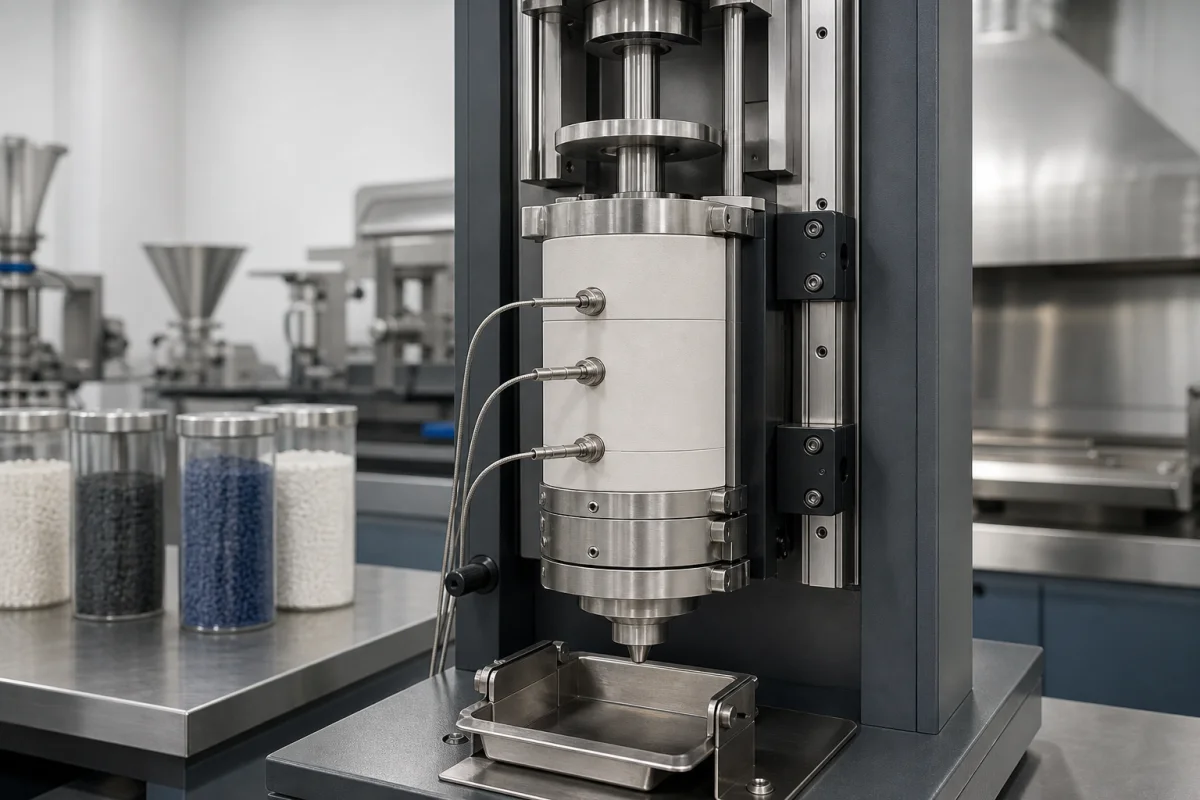
A precisely temperature-regulated cylindrical chamber in a Polymer Melt Flow Index Tester where polymer granules are melted under controlled conditions.
Product Specifications

Technical details and manufacturing context for Temperature-Controlled Barrel

Definition
The Temperature-Controlled Barrel is a critical component of a Polymer Melt Flow Index (MFI) Tester. It is a cylindrical chamber, typically made of high-grade steel, designed to house and melt a precise quantity of polymer granules. Its primary function is to maintain the polymer sample at a specific, uniform temperature (as per testing standards like ASTM D1238 or ISO 1133) to ensure consistent melt viscosity before the material is extruded through a standardized die under a defined load for flow rate measurement.
Working Principle
The barrel is heated by external heating elements (e.g., band heaters) and its temperature is precisely monitored and regulated by a PID controller via a thermocouple sensor embedded in or near the barrel wall. This creates a stable, uniform thermal environment to completely melt the polymer charge without degradation, ensuring the melt's rheological properties are consistent for accurate flow index determination.
Common Materials
Stainless Steel (e.g., 316L), High-Temperature Alloy Steel
Technical Parameters
  • Internal diameter and length, standardized (e.g., ~9.55mm ID) to match the tester's piston and die specifications. (mm) Customizable
Components / BOM
  • Barrel Body / Liner
    Forms the main cylindrical chamber that contains the polymer melt. Provides structural integrity and thermal mass.
    Material: Stainless Steel
  • Heating Band(s)
    Electrical resistance heaters wrapped around the barrel exterior to provide the necessary thermal energy.
    Material: Insulated Metal Sheath with Heating Element
  • Thermocouple Well
    A port or embedded channel to house the temperature sensor for accurate feedback to the controller.
    Material: Stainless Steel
  • Thermal Insulation Jacket
    Minimizes heat loss to the environment, improves temperature stability and efficiency.
    Material: Ceramic Fiber or High-Temperature Insulation
Engineering Reasoning
125-450°C
Thermal stress exceeds yield strength of 316L stainless steel (205 MPa at 450°C) or temperature exceeds 500°C causing carbide precipitation
Design Rationale: Coefficient of thermal expansion mismatch between barrel (17.3 μm/m·°C) and heating elements (13.5 μm/m·°C) creates cyclic thermal stresses exceeding fatigue limit (140 MPa at 10^6 cycles)
Risk Mitigation (FMEA)
Trigger PID controller integral windup during rapid temperature setpoint changes exceeding 50°C/min
Mode: Overshoot to 550°C causing polymer degradation and char formation
Strategy: Implement anti-windup algorithm with back-calculation and conditional integration at 90% of setpoint
Trigger Thermal gradient exceeding 15°C/cm along barrel axis due to uneven heater band power distribution
Mode: Differential expansion creates bending moment of 850 N·m causing permanent barrel deformation
Strategy: Install three-zone PID control with RTD sensors at 120° intervals and cross-coupled control algorithm

Industry Taxonomies & Aliases

Commonly used trade names and technical identifiers for Temperature-Controlled Barrel.

Industrial Ecosystem & Supply Chain DNA

Complementary Systems
Downstream Applications
Specialized Tooling

Application Fit & Sizing Matrix

Operational Limits
pressure: Up to 50 bar (max operating pressure)
flow rate: 0.1-10 g/10 min (MFI test range)
temperature: Ambient to 400°C (typical polymer processing range)
slurry concentration: Not applicable - designed for dry polymer granules only
Media Compatibility
✓ Thermoplastic polymer granules (e.g., PP, PE, PS) ✓ Polymer compounds with additives ✓ Recycled polymer flakes
Unsuitable: Corrosive chemicals or reactive monomers
Sizing Data Required
  • Required melt flow rate range (g/10 min)
  • Maximum polymer processing temperature (°C)
  • Barrel diameter needed for sample volume

Reliability & Engineering Risk Analysis

Failure Mode & Root Cause
Thermal stress cracking
Cause: Rapid temperature cycling or uneven heating/cooling causing material fatigue and micro-fractures in the barrel wall
Insulation degradation
Cause: Moisture ingress, physical damage, or aging of thermal insulation materials leading to heat loss and temperature control instability
Maintenance Indicators
  • Audible hissing or bubbling sounds from insulation indicating moisture intrusion
  • Visible condensation or frost patterns on the external surface suggesting insulation failure
Engineering Tips
  • Implement gradual temperature ramp-up/down protocols to minimize thermal shock and stress accumulation
  • Establish regular infrared thermography inspections to detect insulation gaps and temperature uniformity issues before failure occurs

Compliance & Manufacturing Standards

Reference Standards
ISO 9001:2015 - Quality Management Systems ASTM E230/E230M - Standard Specification for Temperature-Electromotive Force (EMF) Tables for Standardized Thermocouples CE Marking - Directive 2014/68/EU (Pressure Equipment Directive)
Manufacturing Precision
  • Temperature Control Accuracy: +/-0.5°C
  • Barrel Bore Diameter: +/-0.05mm
Quality Inspection
  • Pressure Test - Hydrostatic or Pneumatic per ASME BPVC Section VIII
  • Temperature Uniformity Survey - Per ASTM E230/E230M

Factories Producing Temperature-Controlled Barrel

Verified manufacturers with capability to produce this product in China

✓ 94% Supplier Capability Match Found

S Sourcing Manager from United Arab Emirates Jan 24, 2026
★★★★★
"Reliable performance in harsh Rubber and Plastic Product Manufacturing environments. No issues with the Temperature-Controlled Barrel so far."
Technical Specifications Verified
P Procurement Specialist from Australia Jan 21, 2026
★★★★☆
"Testing the Temperature-Controlled Barrel now; the technical reliability results are within 1% of the laboratory datasheet. (Delivery took slightly longer than expected, but technical support was excellent.)"
Technical Specifications Verified
T Technical Director from Singapore Jan 18, 2026
★★★★★
"Impressive build quality. Especially the technical reliability is very stable during long-term operation."
Technical Specifications Verified
Verification Protocol

“Feedback is collected from verified sourcing managers during RFQ (Request for Quote) and factory evaluation processes on CNFX. These reports represent historical performance data and technical audit summaries from our B2B manufacturing network.”

19 sourcing managers are analyzing this specification now. Last inquiry for Temperature-Controlled Barrel from Vietnam (40m ago).

Supply Chain Compatible Machinery & Devices

Automotive Weatherstrip

Rubber sealing component for vehicle doors, windows, and trunks.

Explore Specs →
Industrial Conveyor Belt

A continuous loop of material used to transport goods in industrial settings.

Explore Specs →
Modular Injection Molded Plastic Pallet

Interlocking plastic pallet system for logistics and storage.

Explore Specs →
Multi-Layer Co-Extruded Barrier Film

Plastic film with multiple layers for superior barrier properties.

Explore Specs →

Frequently Asked Questions

What temperature range does this temperature-controlled barrel support for polymer testing?

Our temperature-controlled barrels typically support ranges from ambient to 400°C, with precise regulation within ±0.5°C for accurate polymer melt flow index measurements in rubber and plastic manufacturing.

Why is stainless steel (316L) used for the barrel construction?

316L stainless steel provides excellent corrosion resistance, high-temperature stability, and minimal contamination risk, ensuring consistent test results and durability when melting various polymer formulations.

How does the thermal insulation jacket improve testing accuracy?

The thermal insulation jacket minimizes heat loss and maintains uniform temperature distribution throughout the barrel, preventing temperature gradients that could affect polymer melt consistency and flow index measurements.

Can I contact factories directly on CNFX?

CNFX is an open directory, not a transaction platform. Each factory profile provides direct contact information and production details to help you initiate direct inquiries with Chinese suppliers.

Get Quote for Temperature-Controlled Barrel

Request technical pricing, lead times, or customized specifications for Temperature-Controlled Barrel directly from verified manufacturing units.

Your business information is encrypted and only shared with verified Temperature-Controlled Barrel suppliers.

Thank you! Your message has been sent. We'll respond within 1–3 business days.

Need to Manufacture Temperature-Controlled Barrel?

Connect with verified factories specializing in this product category

Add Your Factory Contact Us
Previous Product
Temperature Sensor Array
Next Product
Twin Screw Assembly