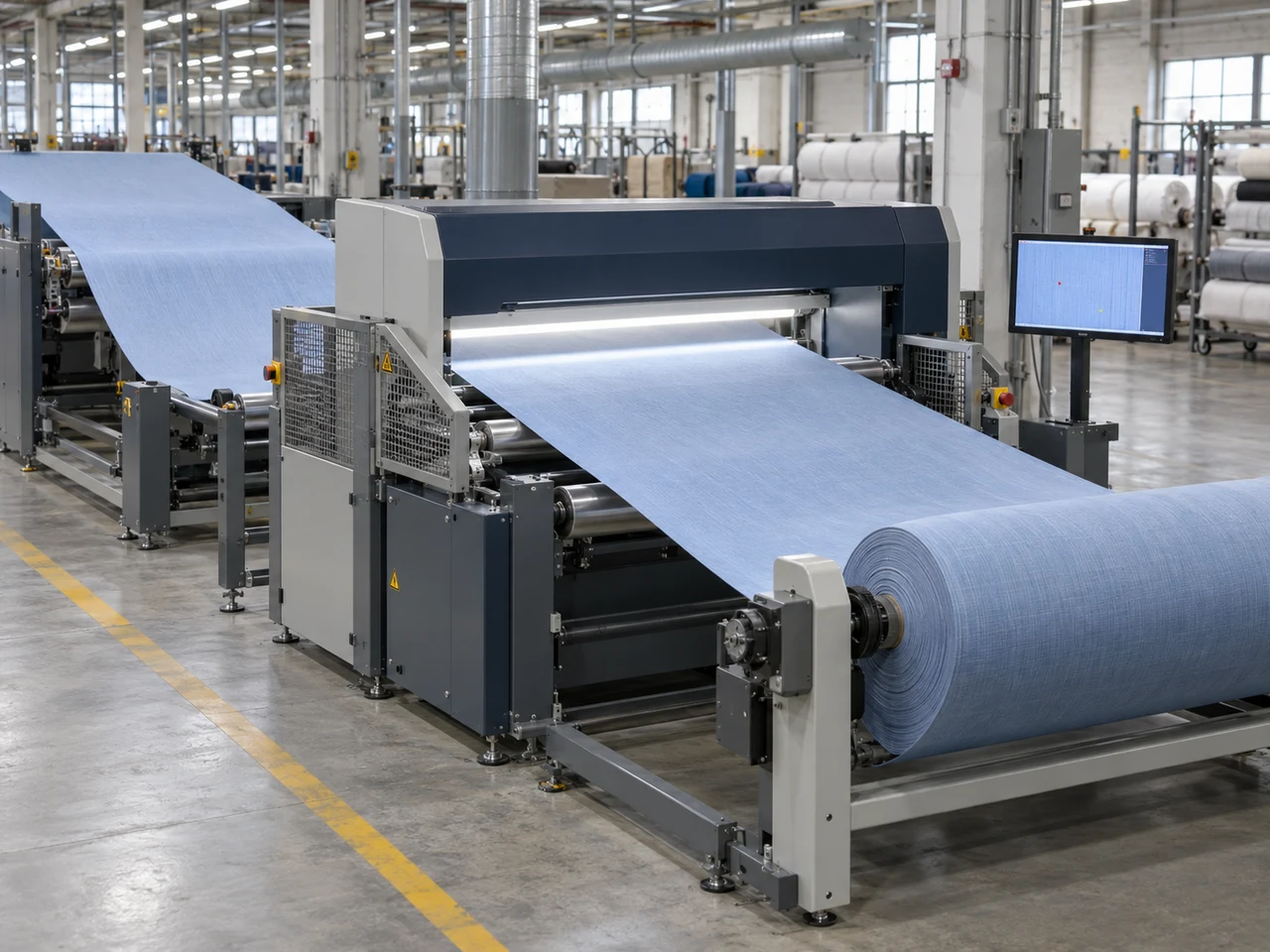
Textile inspection · From camera image to roll decision
Specify what happens to each fabric roll after a camera flags a defect. The useful deliverable is a traceable, reviewed defect map that supports grading, mending or cutting—not simply a fast rewind or a high accuracy headline.
For optical inspection of moving textile webs. Named products illustrate different equipment scopes; their camera, speed and detection claims are not interchangeable.
CNFX editorial research · Sources checked October 10, 2026 · 9 sources
Ask which part of inspection is actually automated
A machine can drive, align and measure cloth while a person still finds the faults. Compare the named equipment rather than treating every “fabric inspection machine” listing as an automatic vision system.
Published offer
What the checked page establishes
What still needs identification
Hans HRM-K1 woven inspection machine
Upper/lower lighting, rolling and operator inspection; the page mentions cameras and sensors as possible additions. [2]
Exact camera package, defect software and integration scope, if required.
Hantex HRM-K1 woven inspection machine
Lighting, edge alignment, meter counter and forward/reverse cloth transport. [3]
Its category describes automatic detection, but this model's specification does not identify that vision configuration.
SUNTECH ST-Thinkor
An automatic visual-inspection offer with defect mapping and a named specification image. [1]
The delivered hardware/software configuration and a test definition for its performance claims.
Define the contract boundary: a vision retrofit on your existing line, a complete inspection/rewind machine, or an inspection package with downstream cutting integration. List the interfaces and the party responsible for commissioning them.
02
Read the fabric conditions beside the detection headline
SUNTECH's ST-Thinkor specification image lists the following. These are supplier-published claims for that offer, not measured CNFX results or a category-wide guarantee. [1]
ST-Thinkor published field
Value in the checked image
Inspection speed
Up to 80 m/min for a fabric inspection machine
Fabric colour
Single colour; colour-difference detection available
The image does not define its test population or denominator. Do not silently interpret “inspection precision” as either the fraction of all defects found or the fraction of alarms that are real defects. Those are different measures. [1]
For a labelled test set, recall is detected true defects divided by all true defects; precision is true defect detections divided by all reported detections. Google's classification guidance explains why overall accuracy can be misleading when the positive class is rare. Keep the threshold fixed when comparing results. [8]
Make the trial specific to your cloth
Prepare a buyer-approved defect register: fabric/style, face to inspect, defect category, size, contrast and location. Include acceptable texture variations as well as rejectable faults. Agree how a long fault, repeated markings and duplicate detections count. Then reserve labelled material that was not used to tune the recipe.
Run that material at the required line conditions and retain the images and settings. Record missed defects by class, false alarms per agreed inspected length or area, and the operator time needed to review the result. These are proposed acceptance records to agree with the supplier, not a claim that any published model already passes them.
03
Trace the fabric, image and position through the assembly
The six roles below are a functional BOM reference. Materials, quantities and part numbers belong to the ordered build. An encoder is included with Uster's named installation; it should also be explicitly allocated when specifying a retrofit. [4]
Assembly role
Work it performs
Identify on the supplied build
Inspection frame and cloth path
Holds the inspection zone and guides the web.
Frame/roller materials, usable width, wrap path and guarding. Do not assign an aluminium/steel construction to every supplier.
Camera, lens and image interface
Captures the strip of cloth presented to the optics.
Sensor format, active pixels, lens, field of view, overlap and data interface; a complete camera is an assembly, not a material grade. [6]
Illumination
Makes the target faults visible to the camera.
Light geometry, wavelength, enclosure and replaceable light unit. Uster offers transmitted or reflected illumination according to the defect. [4]
Processing and operator review
Converts captured images into events and a reviewable roll record.
Computer/on-camera processing, software and recipe revision, storage, review workstation and export scope. [5]
Position recovery or marking
Relates the digital defect location to the physical cloth later.
Encoder origin, mark/read equipment and downstream interface. Physical marking is a selected option, not an inherent result of detecting a fault. [5]
Transport, guiding and tension control
Presents and rewinds the fabric in the required condition.
Existing versus supplied drives, edge guide, tension arrangement and speed feedback. Hantex's listed edge alignment does not establish a tension-control design for every fabric. [3]
Specify pixels across the web and sampling along it
Basler's raL4096-24gm is a line-scan example with 4096 × 1 pixels and a published 26 kHz line rate. That is a row of pixels, not 4096 megapixels. It is an illustration of camera terminology; no use of this camera by the listed fabric-machine suppliers has been established. [6]
Basler describes building an image from successive lines as material moves. For rollers whose speed varies, a shaft encoder can trigger each line after a defined movement. Ask the integrator how starts, stops, reversal and speed changes affect image geometry and roll coordinates. [7]
A pixel pitch on the fabric is not a guaranteed minimum defect size. The acceptance trial must still show the required fault against the actual texture, lighting and motion.
04
Keep line speed attached to the camera and optical setup
Uster's July 2025 Fabriq Vision 2 data sheet pairs each camera option with a spatial resolution and speed. Its footnote says the line-rate and textile-speed values were measured using white material. [4]
Compare columns side by side. On a narrow screen, scroll the table horizontally.
Use these combinations to challenge a quotation that supplies speed and resolution as unrelated maxima. They are not a throughput rating for a complete SUNTECH, Hans or Hantex machine.
For example, 69,000 lines/s × 0.1 mm/line × 60 ÷ 1,000 equals 414 m/min: a sampling-rate check consistent with the stated pair. This arithmetic does not prove that a dark, textured or moving fabric will expose enough detail to detect your specified fault.
Request the field of view, usable width including web movement, exposure and illumination at the proposed speed. Have the supplier state which rate is the transport limit and which rate is validated for your inspection task.
05
Recover the same defect after review and rewinding
Uster's brochure describes a roll inspection chart that can be reviewed in software, and a separate Optimized Cut Control option using synchronization marks and a laser pointer at cutting. Detection, human review and physical position recovery are separate parts of that workflow. [5]
Keep one identity from input roll to exported map
In the agreed witness run, record roll ID, cloth face, leading end, travel direction and origin. Check that the exported record retains them after a stop, reversal and reload.
Review the machine's proposed faults
Retain the original detections, the operator's decisions and the recipe version. Check the difference between a suppressed alarm, a deleted record and a reclassified defect. The buyer must be able to explain the released roll result.
Find a recorded fault on the physical roll
Choose known points after rewinding or transferring the roll. Ask the supplied downstream arrangement to recover them and record the position error. Agree the coordinate and tolerance requirement with the cutting or mending process.
Apply the agreed grading and disposition rules
Define the score, unit basis, defect classes, accepted roll lengths and who approves release. Re-run the same dataset after a setting change and retain the reason for any changed disposition.
A camera's detection percentage is not a fabric grade
ASTM D5430-26 covers visual examination and grading of fabrics; its public scope allows agreed use for roll and shipment acceptance. The public summary also warns that point-assignment options can give different results. Name the agreed grading method and edition in the order. That standard listing does not validate a camera's detection performance. [9]
Repeat a known-roll check after changes
Keep a controlled reference roll or sample set and its expected result. After cleaning or replacing optics, moving lighting, updating software or changing the transport arrangement, use the agreed check to establish whether the images, detections and coordinates remain acceptable. Follow the maker's access and cleaning instructions; this page does not prescribe a universal cleaning interval or optical alignment tolerance.
These witness steps are CNFX's proposed handover checklist. Agree the sample set, tolerances and responsibilities before purchasing; they are not reproduced acceptance clauses from ASTM.
06
Put the optical task and the installed machine on the same order
The specification fields below are a purchasing worksheet. Enter the selected build's confirmed values and attach the supporting drawing, data sheet or trial record. No generic power, mass or environmental range is assumed.
Field
What needs to be stated
Fabric width
Usable inspection width, actual web width and allowed lateral movement; camera coverage at the edges.
Inspection speed
Validated speed for each fabric/recipe and image setup, including acceleration, stopping and reverse travel.
Defect size
Class, dimensions, contrast and cloth location, with examples and the agreed detection criterion.
Camera resolution
Active pixels across the web, camera count and overlap, mm/px on the cloth and along-web line sampling.
Lighting
Transmitted/reflected arrangement, spectral selection, light source, adjustment and replacement requirements.
Detection performance
Labelled test population, matching/counting rules, recall by fault class and operating threshold.
False alarms
Denominator and inspected length/area, duplicate handling and review workload; a bare percentage is incomplete.
Electrical supply
Voltage, phase, frequency and earth for the full supplied installation, including the transport machine.
Electrical load
System load and separately supplied drives/computers; keep W, VA and supply current distinct.
Temperature
Permitted conditions for the optical head, controls and any enclosed cabinet, plus cloth temperature.
Humidity
Permitted ambient and condensation conditions for each supplied subsystem.
Ingress protection
Actual enclosure ratings and evidence for the specified head and cabinet; lint exposure and permitted cleaning method.
Machine mass
Inspection frame, controller, handling machine and roll load shown separately where appropriate.
Footprint and access
Installed envelope, cloth path, roll changes, service openings, floor loading and the downstream inspection/cutting interface.
07
Send the roll and defect brief with the enquiry
Paste it into your enquiry below or into an email to a maker, then replace every bracket.
Fabric family / face: [construction; colour or pattern; finish; stretch; face(s) to inspect]
Roll handling: [width; roll mass/diameter; orientation; tension; existing transport]
Defect register: [classes; labelled images/samples; rejectable vs acceptable variation]
Performance trial: [withheld test rolls; recipe; speed; matching rules; recall and false-alarm criteria]
Optical proposal: [camera/lens; coverage; line sampling; lighting; encoder arrangement]
Roll record: [ID and origin; map coordinates; retained images; review history; export format]
Downstream action: [grading; marking; mending/cutting; position recovery and tolerance]
Installation: [drawing; utilities; environment; guarding; service and cleaning access]
Handover: [witness plan; software/recipe versions; backup and restore; training; sign-off responsibility]
The companies below cover an explicit vision-system offer and cloth-handling inspection machines. Treat those as different scopes when requesting quotations.
SUNTECH Textile Machinery
Hangzhou — published office contact
Lists ST-Thinkor automatic visual inspection and ST-Thinkor-L, separately from woven and knitted inspection machines. Its published ST-Thinkor image gives a single-colour application and customized width; agree the defect set and performance metric before treating the headline as acceptance.
The HRM-K1 cloth inspection machine provides illuminated operator inspection and fabric rolling, with optional additions. For automatic defect recognition, ask for the camera and software package as a named configuration.
The HRM-K1 model lists lighting, edge alignment, a length counter and cloth transport. The category also describes camera detection; ask which vision package is supplied with the quoted model.
Explore company information and manufacturing capabilities, then discuss the scope of your project with a relevant supplier.
Share this page
Compiled and source-reviewed by the CNFX editorial team.
Product-page review does not verify ownership, an installed customer result or a certificate. Ask for the legal supplying entity and exact automation package. Public contact addresses below are not independently verified factory locations. How we source and review
· Page last updated 13 October 2026
Buyer questions
Can the quoted camera IP rating be used for the whole inspection machine?
No. Basler lists IP30 for the example raL4096-24gm camera. A head enclosure, computer cabinet and textile-handling machine may have different protection arrangements. Obtain the ratings and cleaning instructions for the complete supplied configuration; the example component's rating is not a rating for any supplier listed here. [6]
Does an automatic defect map eliminate operator review?
Not by itself. Uster describes reviewing the captured faults and adjusting the quality criteria in its software workflow. Your purchase should identify who reviews uncertain detections, what changes are recorded and who decides that a roll can be released or cut. [5]
Sources and what still needs a direct check
Sources checked 2026-10-10. Original manufacturer pages and documents distinguish camera components, complete optical packages and cloth-handling equipment. Numerical claims retain their model and test conditions. Public ASTM metadata was read; paid standard clauses were not.
Confirm the exact fabric, fault classes and conditions covered by the offered detection guarantee; no universal detection percentage or minimum defect size is asserted.
Identify the actual cameras, lighting, transport and software included in the quotation; no Basler or Uster hardware is attributed to a Chinese supplier without evidence.
Agree the grading rules, position-recovery tolerance and roll-release authority independently of the detector's classification result.
Confirm installation drawings, enclosure ratings, material specifications, applicable machinery documentation and the legal supplying entity.
Buyer enquiry
Request manufacturing insight
for Automated Fabric Inspection System
Ask for use case, specification boundaries, supplier type, and RFQ preparation
information for this product.
Where it goes
Straight to the CNFX editorial desk, and to the manufacturer if this product is
linked to a claimed profile. Nothing is broadcast to a supplier list.
Your details stay here
We do not sell or rent enquiry data, and we do not add you to a mailing list.
Used only to answer this request.
No commission, no middleman
CNFX is a directory. We take no cut of any order and never negotiate on a
supplier's behalf.
What to include
Share your product specifications, quantity, destination and target delivery date.
Need to Manufacture Automated Fabric Inspection System?
Compare manufacturer profiles with relevant product and process capability.