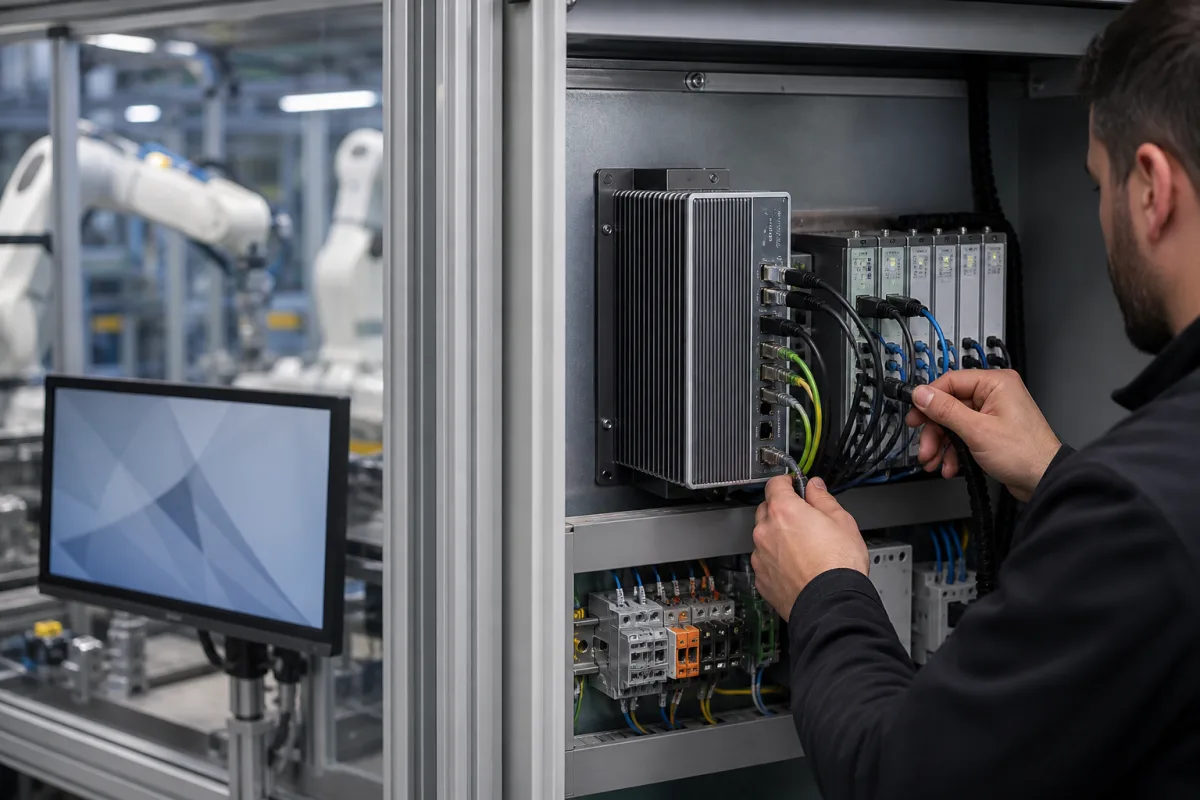
Control computer for real-time machine control (soft-PLC industrial PC)
PC-based machine control · worst-case latency testing, control-task isolation and jitter, cabinet hardware for a soft PLC
A control computer in this sense is an industrial PC that replaces a hardware PLC: a real-time operating system or runtime executes the PLC and motion tasks on a fixed cycle and masters a fieldbus such as EtherCAT, while other software shares the same processor. Ask three things first: what worst-case latency and jitter the controller holds under load, how the control task is isolated from other workloads, and what processor, memory, ports and cabinet conditions the hardware is rated for.
Industrial PCs used as the machine's controller, running a soft PLC or motion runtime on a real-time operating system and mastering a fieldbus. Hardware ruggedness of box and panel PCs, such as cooling, temperature range, shock, vibration, IP rating, storage and power input, is covered on the Industrial computer page. Hardware PLCs and HMI panels are outside this page.
CNFX editorial research · Sources checked October 12, 2026 · 3 sources
Test worst-case latency under load, not average latency
The Open Source Automation Development Lab (OSADL) names the highest latency ever observed, the worst-case latency, as the key result of a latency plot; its example plot from a single-core system shows a worst-case latency of 55 µs, and its plots resolve latency to 1 µs. [1]
OSADL's QA Farm runs its two main cyclictest measurements for 5 hours 33 minutes each. After about two hours close to idle, it adds a mid-range load of about 1 Mbit/s network traffic, 1 MByte/s I/O and filesystem load and 1 MByte/s memory allocation, giving an overall system load of about 30–50% to simulate an average machine. [1]
Editorial note: ask the supplier for a latency plot or cyclictest record from the exact board, BIOS and kernel you will receive, taken over hours with a defined background load, and for the worst-case value rather than the mean.
Give the supplier the control cycle time, maximum allowed jitter, number of axes and I/O, fieldbus, operating system and runtime, other software sharing the PC, and the test duration and load you will accept.
02
Isolate the control task and measure jitter over days
Intel's white paper (December 2022) tested an industrial PC with an 11th Gen Intel Core i5-1145GRE, Debian 10 with the PREEMPT_RT patch and CODESYS Control for Linux, mastering three EtherCAT servo drives for a pick-and-place robot. The CODESYS main task was pinned to core 1 and a stress-ng noisy-neighbour workload to core 2; unneeded services were stopped and timer migration disabled. [2]
Over 48-hour runs, maximum jitter was 163 µs with Intel TCC mode disabled, 60 µs with TCC mode enabled and 22 µs with TCC mode plus Cache Allocation Technology configured; the paper reports the last as 13% of the first configuration. [2]
Editorial note: the result depends on BIOS settings, core pinning and cache partitioning as well as the processor, so ask for jitter figures measured with your own cycle time and background workload.
03
Size the controller hardware for the cabinet
Beckhoff's C6015 ultra-compact control cabinet PC shows what a soft-PLC controller lists: 40 × 82 × 82 mm without mounting plate, aluminium zinc die-cast housing, passive cooling with a single-side cooling plate needing 5 cm of free space above and below, IP20, and 0–55 °C operating temperature. [3]
Its processors run from an Intel Atom E3815 at 1.46 GHz with 1 core to an E3845 at 1.91 GHz with 4 cores, with 2 to 4 GB DDR3L RAM, two 100/1000BASE-T Ethernet ports, a 40 to 320 GB M.2 SSD and a 24 V DC supply. With the four-core option the operating range is listed as 0–50 °C. [3]
Beckhoff notes that Windows Embedded Compact 7 supports only one core, that multicore support needs Windows 10 IoT Enterprise or TwinCAT/BSD, and that the 4 GB memory option needs a 64-bit operating system or only 3 GB are addressable; each processor maps to a TwinCAT 3 platform level (40 or 50). [3]
Editorial note: two Ethernet ports are a minimum for one fieldbus plus one plant network; count ports for each fieldbus, vision or safety network before choosing a model.
04
Processor cores, memory, real-time OS and runtime, Ethernet ports, SSD and cooling plate
Part
Role
Fix in the order
Processor
Runs control and other tasks; cores can be dedicated to the control task. [2][3]
Model, cores, real-time features.
Memory
Program and data; 2–4 GB on one compact model. [3]
Size and OS addressability.
Real-time OS and runtime
PREEMPT_RT Linux with a PLC runtime, or a vendor runtime. [2][1]
Passive cooling plate; clearance above and below. [3]
Mounting and clearance.
05
Processor, RAM, temperature range and cabinet clearance for a soft-PLC control computer
The hardware values below come from one compact Beckhoff model; latency and jitter are not hardware fields and need a test on your own load, as in the OSADL and Intel examples.
Field
What it means and published values
Ask the supplier for
Processor
Atom E3815 1.46 GHz, 1 core, to E3845 1.91 GHz, 4 cores, on one model. [3]
Send the control task, timing and hardware data together
Paste it into your enquiry below or into an email to a maker, then replace every bracket.
Control task: [PLC and motion; axes; I/O count]
Timing: [cycle time; maximum jitter; worst-case latency]
Software: [OS; runtime; other workloads on the PC]
Fieldbus: [EtherCAT or other; ports needed]
Hardware: [processor; RAM; storage]
Cabinet: [temperature; clearance; 24 V DC]
Evidence: [latency or jitter test record, duration and load]
Explore company information and manufacturing capabilities, then discuss the scope of your project with a relevant supplier.
Share this page
Compiled and source-reviewed by the CNFX editorial team.
Each manufacturer above links to the page on that company's own website where the product is listed, with the date we checked it. How we source and review
· Page last updated 13 October 2026
Buyer questions
Which latency figure matters for a control computer?
OSADL treats the worst-case latency observed over long runs under load as the key result; its example plot shows 55 µs. [1]
How much can core isolation reduce jitter?
In Intel's 48-hour CODESYS test, maximum jitter fell from 163 µs to 22 µs with TCC mode and Cache Allocation Technology. [2]
What does a compact soft-PLC PC look like?
Beckhoff's C6015 measures 40 × 82 × 82 mm, is passively cooled, IP20, 0–55 °C, with two Gigabit Ethernet ports and 24 V DC supply. [3]
Sources and what still needs a direct check
Sources checked 2026-10-12. OSADL is an industry association that runs a long-term real-time Linux test farm; Intel published a measured CODESYS case study on its own processors; Beckhoff is a maker describing its own control cabinet PC.