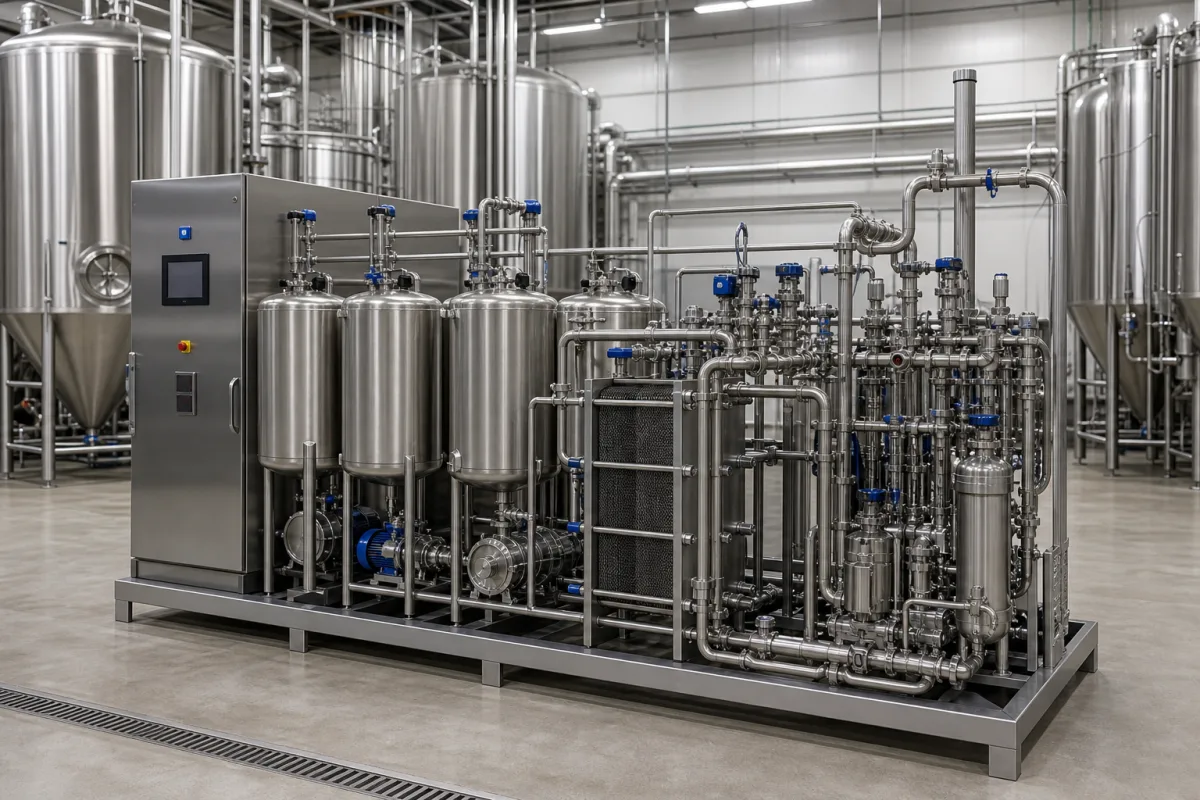
Automated CIP/SIP system for beverage lines: sterilizing in place after cleaning
Sterilize-in-place after cleaning · steam or hot water through filler pipework, F-value at the coldest point, hot-water sanitizing in breweries
An automated CIP/SIP system for beverage production is a skid that runs the clean-in-place sequence and then a sterilize-in-place (SIP) step, circulating heated steam or hot water through tanks, pipework and filling valves until a set temperature has been held long enough at the hardest-to-heat points. Ask three things first: whether the SIP step uses saturated steam or hot water and at what temperature, how the controller decides that sterilization is complete (fixed hold time or integrated F-value), and where its temperature sensors sit on your line.
Combined clean-in-place and sterilize-in-place units for beverage, brewing and aseptic filling lines, with the steam or hot-water supply, temperature sensing and the controls that time or integrate the sterilizing step. Clean-in-place units without a sterilizing step, and the CIP chemistry, flow and spray-device sizing, are covered on the CIP (clean-in-place) system page. Cleaning chemicals, tunnel and flash pasteurizers for product, and container sterilizers are outside this page.
CNFX editorial research · Sources checked October 12, 2026 · 3 sources
Decide when SIP is complete: fixed hold or integrated F-value
A Dai Nippon Printing patent on aseptic drink filling machines describes SIP as circulating heated steam or hot water through the drink filling path after it has been cleaned by CIP. In the conventional method it describes, sensors measure the temperatures at portions of the drink supply line that are hard to heat; when the lowest of them reaches 130 °C a timer starts, and heating stops after 30 minutes, which gives an F-value of 233 that the patent says experience has shown to be sufficient for the drink supply pipeline. [1]
The patent notes that operators heat to 135 °C for a margin, and that the fixed rule ignores the lethality delivered while the line heats from 121.1 °C to 130 °C and above 130 °C. Integrating the F-value over those ranges, with a reference temperature of 121.1 °C and a z-value of 10 °C, the inventors found the target of 233 could be reached in less than 30 minutes, saving heating energy and time. [1]
Editorial calculation: with F = t × 10^((T − 121.1)/10), 30 min at 130 °C gives 30 × 10^0.89 ≈ 233, matching the patent's figure. [1] For comparison, the US FDA rule for equipment used in making biological products requires sterilization no less effective than 121.5 °C held for 20 minutes with saturated steam, or 170 °C for 2 hours with dry heat; on the same formula 20 min at 121.5 °C is about 22. [2] Editorial note: the F-value target belongs to your product and line validation; ask the supplier which target the controller uses and how it is set.
Give the supplier the line layout (tanks, pipe lengths, filler valves), materials and seal ratings, required SIP medium and target (temperature and time, or F-value with reference temperature and z-value), steam pressure and quality available, hot-water capacity, number and position of temperature sensors, CIP sequence, and the records the controller must keep.
02
Choose saturated steam or hot water, and set the hold
The sterilizing medium sets the temperature you can reach. The FDA biologics benchmark is stated for saturated steam (121.5 °C, 20 minutes) and for dry heat (170 °C, 2 hours). [2] The Dai Nippon patent applies either heated steam or hot water to the drink supply line and filling nozzles, exhausting it through every nozzle while temperatures are logged at set intervals. [1]
In breweries, hot water is used to sanitize rather than sterilize. The Brewer's Handbook (Apex Publishers) states that hot water for sanitation should ideally be at least 82 °C (180 °F) at discharge, circulated or held for 10–15 minutes, and that if this temperature cannot be held the time should rise to 20–25 minutes at a minimum of 175 °F (editorial conversion: about 79 °C). It warns that hot-water sanitation of pasteurized storage tanks is difficult and may damage some tanks if done without care. [3]
Editorial note: decide which parts of the line need sterilizing (for example an aseptic filler path) and which need sanitizing (for example a brewery tank), because the temperature, time and medium differ, and confirm that gaskets, valve seats and instruments are rated for the SIP temperature.
03
Compare published sterilizing and sanitizing conditions
These are conditions stated in the cited documents for their own contexts; they are not a validation for your line.
Condition
Medium
Temperature and time
Context
Fixed SIP hold
Heated steam or hot water
30 min after the coldest point reaches 130 °C (F = 233) [1]
SIP temperature, hold time, logging interval and tank volumes for a beverage CIP/SIP skid
Ask how the controller ends SIP: on a fixed 30-minute hold after the coldest point reaches 130 °C, or on an integrated F-value, because the Dai Nippon patent uses the second to shorten heating. [1]
Field
What it means and published values
Ask the supplier for
Tank Capacity (L)
CIP tank volumes for the circuit length.
Volumes per tank.
Temperature Range (°C)
SIP at 130 °C (heated to 135 °C for margin) in the patent example; sanitizing ≥ 82 °C. [1][3]
Maximum SIP temperature at the coldest point.
Cycle Time (min)
30 min hold at 130 °C, or less under F-value control; 10–15 min hot-water sanitizing. [1][3]
Full CIP + SIP cycle time on your line.
Chemical Concentration Accuracy (%)
CIP dosing accuracy.
Conductivity control and tolerance.
Power Consumption (kW)
Heating energy is the reason the patent shortens SIP. [1]
Steam and electric demand.
System Pressure (bar)
Steam pressure follows the SIP temperature.
Design and operating pressure.
Flow Rate (m³/h)
CIP supply flow.
Flow per circuit.
Control Accuracy (%)
Temperature logging at set intervals for F-value. [1]
Sensor accuracy and logging interval.
Material
316L stainless steel in the baseline component list.
Material and surface finish certificates.
Ingress Protection
Not stated in the reviewed sources.
Rating of panel and instruments.
Weight (kg)
Not stated in the reviewed sources.
Skid weight.
Footprint (m²)
Not stated in the reviewed sources.
Layout drawing.
06
Send the line, SIP target and utility data together
Paste it into your enquiry below or into an email to a maker, then replace every bracket.
Line: [tanks; pipe lengths; filler valves; materials]
CIP: [steps; chemistry; temperatures]
SIP: [steam or hot water; temperature; hold or F-value target]
Sensors: [number; positions at hard-to-heat points]
Utilities: [steam pressure; hot water; power]
Records: [batch reports; data retention]
Explore company information and manufacturing capabilities, then discuss the scope of your project with a relevant supplier.
Share this page
Compiled and source-reviewed by the CNFX editorial team.
Each manufacturer above links to the page on that company's own website where the product is listed, with the date we checked it. How we source and review
· Page last updated 13 October 2026
Buyer questions
What is the difference between CIP and SIP?
CIP cleans the line; SIP then sterilizes the cleaned drink filling path by circulating heated steam or hot water, as the Dai Nippon Printing patent describes. [1]
How long does SIP take on a drink filling line?
The patent's conventional method holds 30 minutes after the coldest point reaches 130 °C (F-value 233); integrating the F-value from 121.1 °C reaches 233 in less than 30 minutes. [1]
Is hot water enough to sanitize brewery equipment?
The Brewer's Handbook gives at least 82 °C at discharge for 10–15 minutes, or 20–25 minutes at a minimum of 175 °F. [3]
Sources and what still needs a direct check
Sources checked 2026-10-12. The Dai Nippon Printing patent describes SIP practice on aseptic drink filling lines; 21 CFR 600.11 is a US rule for biological products, cited only as a time-temperature benchmark; The Brewer's Handbook is a brewing reference text.