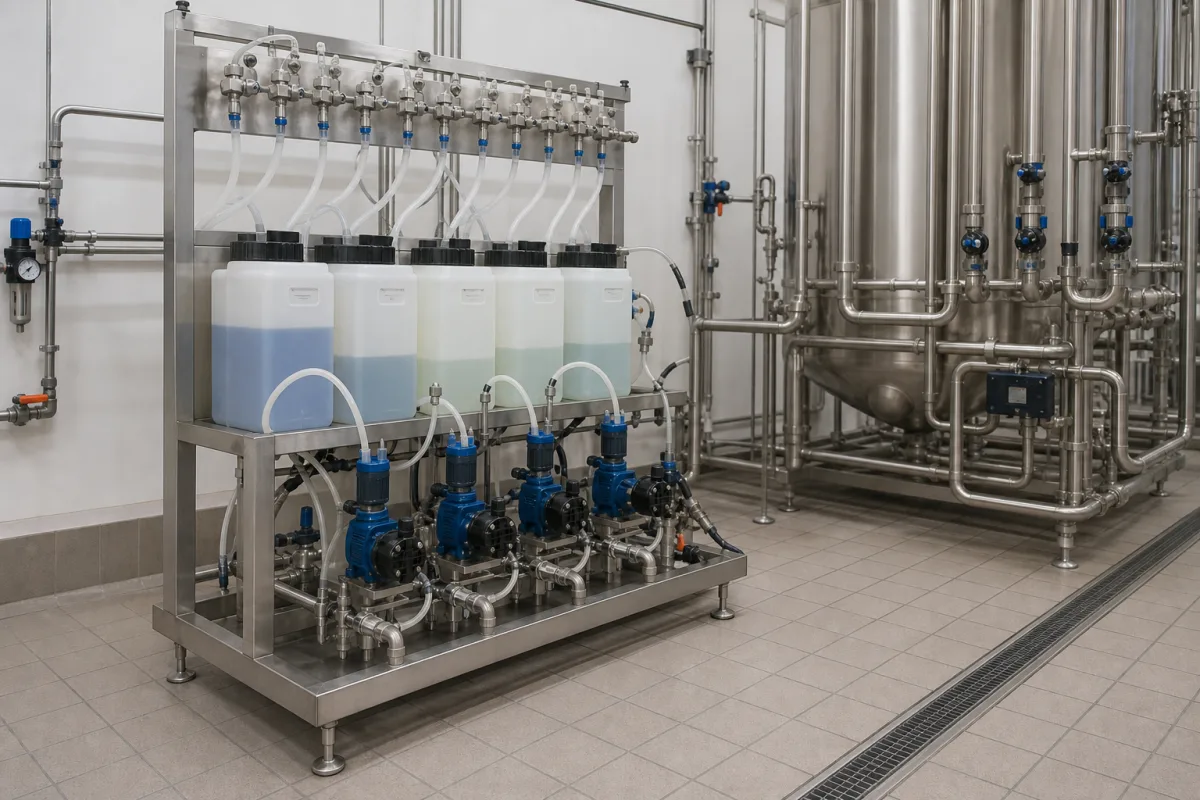
CIP chemical dosing unit for detergent and sanitizer strength control
CIP dosing skids · Caustic and acid strength, sanitizer ceilings, conductivity control and recording
A CIP chemical dosing unit is the skid of chemical containers or day tanks, dosing pumps, valves and a controller that tops up the caustic, acid and sanitizer in a clean-in-place system so every circuit is washed at the intended strength. Ask three things first: which concentrations and temperatures your cleaning programmes need, how the unit keeps sanitizer under the regulatory ceiling, and what measurement (conductivity, flow or weight) closes the loop and is recorded.
Dosing skids and satellite units that meter concentrated detergents and sanitizers into CIP tanks or supply lines in dairy, beverage and food plants, with their containers, pumps, injection points, conductivity measurement and controls. Metering pumps as individual machines (diaphragm, plunger, peristaltic and gear types) are covered on the Metering pump page. Flocculant make-up units for drilling or wastewater sludge, and complete CIP stations with their tanks and heat exchangers, are outside this page.
CNFX editorial research · Sources checked October 12, 2026 · 3 sources
Tetra Pak's Dairy Processing Handbook gives sodium hydroxide dosed at 0.5–2.0 wt% and nitric acid at 0.5–1.5 wt%, with the exact value set by fouling type and severity and by time, temperature and flow. It warns that excess detergent can cause foaming or make protein fouling harder to remove, raises cost and adds chemical load to sewage. [1]
For a circuit with a pasteurizer or other heated surfaces, the handbook's example programme circulates alkaline detergent at 0.5–2% for about 30 minutes at 75 °C and acid at 0.5–1.5% for about 20 minutes at 70 °C. It advises alkaline cleaning at the product's own temperature but at least 70 °C, and 60–75 °C for acid. [1]
Editorial calculation: raising 2,000 kg of solution to 1.0 wt% NaOH needs 20 kg of NaOH, which is 40 kg of a 50% caustic concentrate; topping up from 0.8 to 1.0 wt% needs about 4 kg of NaOH, or 8 kg of concentrate (ignoring the small dilution by the added concentrate). The concentrate strength is an assumed example. [1]
Give the supplier the number of CIP circuits and tanks, solution volumes, each chemical's trade name, concentration as delivered and safety data sheet, target strengths and temperatures, top-up frequency, and whether chemicals arrive in drums, IBCs or bulk.
02
Keep sanitizer under the FDA ceilings
FDA's 21 CFR 178.1010 lets sanitizing solutions be used on food-processing equipment provided they are followed by adequate draining before contact with food. Hypochlorite solutions may provide no more than 200 ppm of available halogen determined as available chlorine, and chloroisocyanurate solutions no more than 100 ppm. [2]
The same section limits the alkyl benzyldimethylammonium chloride (quaternary) solution in paragraph (b)(9) to no more than 200 ppm of the active quaternary compound when ready to use, and names peroxyacetic acid and hydrogen peroxide mixtures that may also be used on dairy-processing equipment. [2]
Editorial calculation: a sodium hypochlorite concentrate with 12.5% available chlorine reaches 200 ppm at a dilution of 0.125 ÷ 0.0002 = 625, i.e. 1 L of concentrate per 625 L of water; a dosing error of +10% gives 220 ppm, above the ceiling. Concentrate strength is an assumed example; use the supplier's certificate. [2]
03
Close the loop with conductivity and record it
Tetra Pak describes central CIP stations in which conductivity transmitters control the return of cleaning solutions: conductivity is proportional to the concentrations used in dairy cleaning, and when it falls to a preset value during rinsing a change-over valve diverts the liquid to drain. It lists flow rate, temperature, time and electrical conductivity as critical CIP parameters to monitor and record, and shows decentralised CIP units with dosing pumps and a flowmeter. [1]
JUMO's data sheet for its tecLine Ci hygienic inductive conductivity sensor lists measuring ranges from 0–500 µS/cm to 0–2000 mS/cm depending on transmitter, accuracy of ≤0.5% to ≤1% depending on range, a Pt1000 temperature probe with t90 ≤ 26 s, IP67, medium temperature −10 to +125 °C in operation and up to 150 °C for no more than 60 minutes at ≤5 bar during sterilization, and process pressure of 12 bar at 20 °C falling to 8 bar at 125 °C. Its body is PEEK and the construction conforms to EHEDG. [3]
Concentrate flow, dosing accuracy, sensor range and chemical compatibility for a CIP dosing skid
Judge dosing accuracy against the sanitizer ceilings: FDA allows no more than 200 ppm available chlorine from hypochlorite and 100 ppm from chloroisocyanurates. [2]
Field
What it means and published values
Ask the supplier for
Flow Rate (L/min)
Concentrate flow per pump; from mass balance.
Range per chemical.
Dosing Accuracy (%)
Compare with the margin to the sanitizer ceiling. [2]
Explore company information and manufacturing capabilities, then discuss the scope of your project with a relevant supplier.
Share this page
Compiled and source-reviewed by the CNFX editorial team.
Each manufacturer above links to the page on that company's own website where the product is listed, with the date we checked it. How we source and review
· Page last updated 13 October 2026
Buyer questions
What caustic and acid strength does CIP use?
Tetra Pak's Dairy Processing Handbook gives NaOH at 0.5–2.0 wt% and nitric acid at 0.5–1.5 wt%, depending on fouling and other cleaning parameters. [1]
What is the limit for chlorine sanitizer on food equipment?
FDA's 21 CFR 178.1010 limits hypochlorite solutions to 200 ppm available chlorine and chloroisocyanurate solutions to 100 ppm, followed by adequate draining. [2]
How does the unit know the solution strength?
Conductivity is proportional to the concentrations used in dairy cleaning, and transmitters control return and diversion; hygienic inductive sensors such as JUMO's tecLine Ci measure up to 0–2000 mS/cm. [1][3]
Sources and what still needs a direct check
Sources checked 2026-10-12. Tetra Pak's Dairy Processing Handbook is a processing-equipment maker's reference text. FDA's regulation sets sanitizer limits. JUMO's data sheet describes its own sensor.