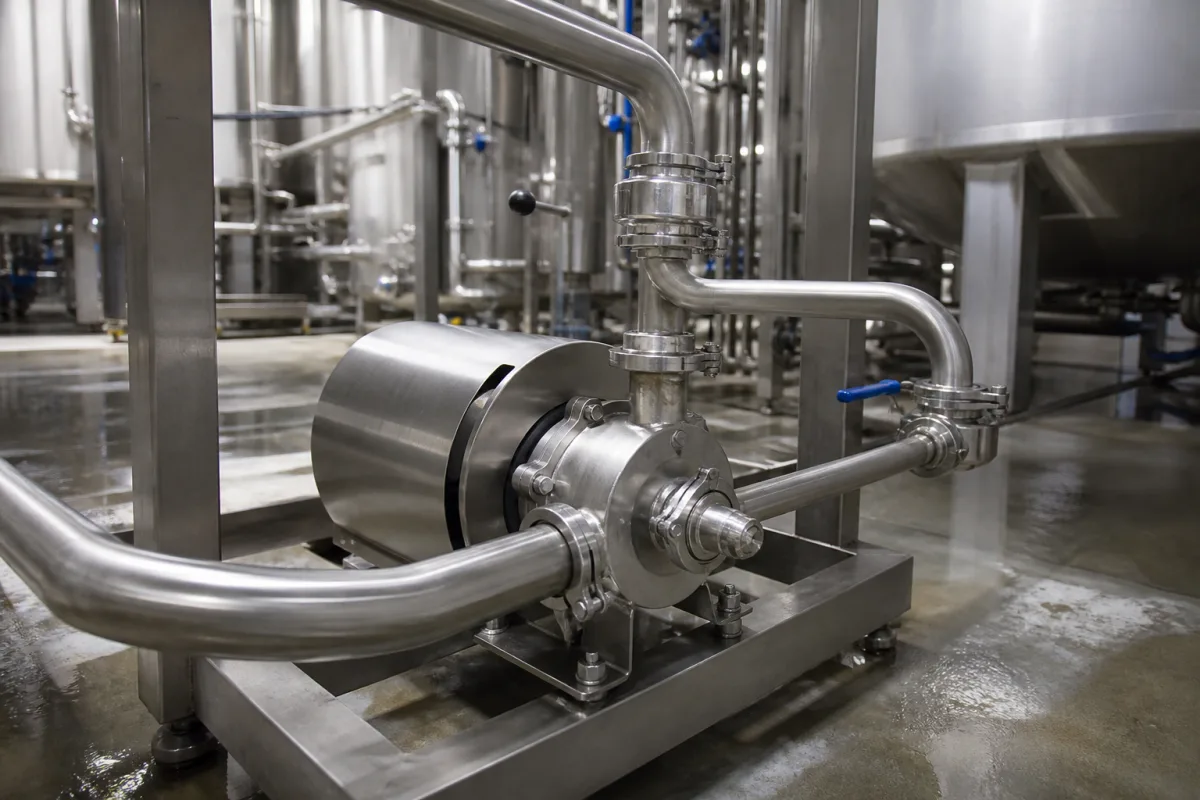
CIP circulation pump: supply and return pumps for clean-in-place circuits
CIP circulation pumps · supply pump sized for 5 ft/s in the largest line, self-priming or liquid-ring return pump that keeps prime on air-laden return, air fraction, lift and temperature
A CIP circuit needs two pumping duties. The supply pump pushes detergent, acid and rinse water from the CIP set through pipework, valves and vessel spray devices fast enough to scrub the surfaces; the return pump brings the spent solution back from the vessel outlet, where it arrives as an air-liquid mixture; one dealer names CIP return systems as a place where such mixtures are encountered. Fristam describes its liquid-ring return pump as keeping its prime "when other pumps become air bound", which is why self-priming and liquid-ring designs take the return duty. Ask three things first: what flow the largest line in each circuit needs, how much air the return pump must handle and from what lift, and what temperatures and chemicals the wetted parts and seals will see.
Pumps that circulate cleaning and rinse solutions in CIP and SIP systems: CIP supply pumps and self-priming, liquid-ring and side-channel CIP return pumps for food, beverage, dairy and pharmaceutical plants. Hygienic centrifugal pumps chosen for product transfer, with their 3-A and EHEDG design claims and seal selection, are covered on the Sanitary centrifugal pump page. Heating and hot-water circulators, automotive coolant pumps and spa pumps are outside this page. The complete skid around these pumps, with tanks, heating, valves and recipes, is a separate purchase: see the CIP (clean-in-place) system page for food, dairy and beverage plants and the Cleaning-in-place (CIP) system for pharmaceutical plants page for GMP-validated skids.
CNFX editorial research · Sources checked October 12, 2026 · 4 sources
Set the CIP supply flow from the velocity needed in the largest line
Equilibar, a maker of sanitary back pressure valves, states that standard CIP requirements are to achieve 5 ft/s of fluid velocity during cleaning to assure good flushing and rinsing, and that with 2 in (DN50) tubing a CIP flow of nearly 45 GPM is required. It adds that a pump, filter, transfer line and valves can all sit in one cleaning loop. [1]
The same note warns that dosing and blending equipment sized for flows sometimes below 1 GPM can be too small to pass the CIP flow, since dosing valves control well only within a 20:1 or 30:1 range; a CIP bypass line around the dosing valve is one solution, but it can leave short sections of tubing that do not see the cleaning velocity. [1]
Editorial calculation: 45 GPM is about 10.2 m³/h (45 × 0.2271). Because flow at a fixed velocity scales with the bore area, a line of twice the inside diameter needs four times the flow; the circuit's largest bore therefore sets the supply pump's duty point, and the pump head must cover that flow through the whole loop including spray devices.
Give the supplier each circuit's largest tube or pipe size and length, the spray devices and their flow and pressure, the solutions and their temperatures, the CIP set tank levels, the return route and lift, and whether the supply and return pumps are controlled together.
02
Choose a return pump that keeps its prime on air-laden solution
Fristam describes its FZX as a sanitary self-priming centrifugal pump for liquids with entrained air or gas: tight internal clearances form a rotating liquid ring that moves liquid and air together, so it keeps its prime when other pumps become air-bound and can evacuate tanks, lines and CIP circuits completely. It lists lift capability up to 23 ft, seven sizes with flow rates up to 400 GPM and heads up to 250 ft, 316L stainless steel wetted parts and 3-A approval, with seal elastomers in EPDM, Viton, Buna, silicone or Kalrez. [2]
Pharmaceutical Processing World reported the FZX 2350 model as handling flows up to 330 gpm and heads up to 230 ft, with an external seal design and certification, testing and validation documents available. [3]
Texas Process Technologies, a process equipment dealer, lists a self-priming CIP return pump with a 4 HP motor, 2½ × 1½ in Tri-Clamp connections, 316L wetted parts, a silicon carbide/carbon mechanical seal with EPDM (FKM optional), a maximum temperature of 180 °F and a maximum speed of 2,900 rpm, performing up to 65 GPM at 35 psi on water at 68 °F. It states that the pump keeps working with up to 50% air by volume at the inlet, that larger models handle higher air fractions, that surfactants in CIP solutions help, and that above 50% air flow and efficiency fall and air separators or deaerators may be needed. [4]
Editorial calculation: 23 ft is about 7.0 m of lift (23 × 0.3048); 65 GPM is about 14.8 m³/h; 35 psi is about 2.4 bar; 180 °F is about 82 °C. Compare the 180 °F limit with the hottest CIP step before choosing the seal and elastomers.
03
Supply and return duties side by side
Published figures for the two duties, kept with their sources.
Donjoy lists its ZLX self-priming centrifugal pump for use as a CIP return pump.
Donjoy Technology
Manufacturing site to be confirmed for the order
Lists the ZLX self-priming centrifugal pump for use as a self-priming return pump in CIP systems, with up to 70 m³/h, 70 m head and 304/316L construction, alongside a CIP-L liquid-ring self-priming pump.
Explore company information and manufacturing capabilities, then discuss the scope of your project with a relevant supplier.
Share this page
Compiled and source-reviewed by the CNFX editorial team.
Each manufacturer above links to the page on that company's own website where the product is listed, with the date we checked it. How we source and review
· Page last updated 13 October 2026
Buyer questions
How much flow does a CIP supply pump need?
Equilibar cites 5 ft/s in the line, which for 2 in (DN50) tubing is nearly 45 GPM. [1]
Why use a liquid-ring pump for CIP return?
Fristam says its FZX keeps its prime when other pumps become air-bound and can lift up to 23 ft, so it can empty tanks and lines completely. [2]
How much air can a self-priming CIP return pump handle?
One dealer states up to 50% air by volume at the inlet; above that, flow and efficiency fall. [4]
Sources and what still needs a direct check
Sources checked 2026-10-12. Equilibar writes about CIP flow from the viewpoint of a valve maker; Fristam describes its own liquid-ring pump, Pharmaceutical Processing World reported one model, and Texas Process Technologies is a dealer listing one return pump.