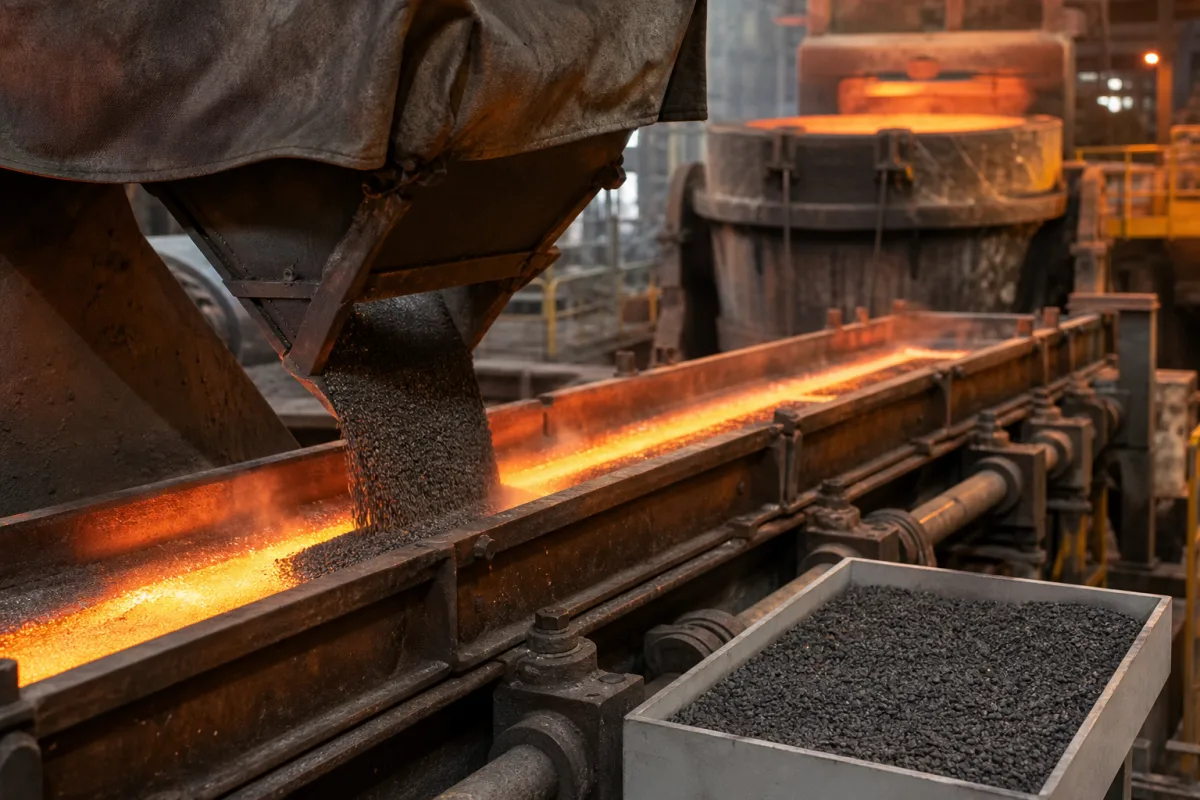
Steel continuous casting · Mould flux functions, basicity and viscosity, liquidus and break temperature, crystallisation and heat transfer
Mould flux, or mould powder, is added on top of the liquid steel in a continuous casting mould, where it melts into a slag layer that insulates the meniscus, protects the steel from oxidation, absorbs inclusions, lubricates the forming shell and controls how fast heat leaves it. Ask three things first: what basicity and viscosity the flux has for your steel grade and casting speed, what liquidus and break temperatures and crystallisation behaviour it gives, and how its carbon, melting rate and consumption are controlled.
Mould fluxes (powders and granules) for continuous casting of steel slabs, blooms and billets. Tundish covering fluxes, ladle slag conditioners, submerged entry nozzles and slag-grinding equipment are outside this page.
CNFX editorial research · Sources checked October 11, 2026 · 4 sources
Match basicity, viscosity and melting to grade and speed
J. Falkus of AGH University of Science and Technology in Kraków describes mould fluxes as based on calcium aluminosilicates with fluxing additions: network formers (SiO₂, Al₂O₃), network breakers (CaO, MgO), fluxes (Na₂O, K₂O, Li₂O, CaF₂, FeO, MnO, B₂O₃), others such as TiO₂ and ZrO₂, and carbon. Basicity, measured as CaO/SiO₂, ranges from 0.7 to 1.4, and its selection is "influenced primarily by the grade of the steel cast and the casting speed". [1]
Falkus lists the flux's functions as preventing meniscus solidification, preventing oxidation, lubricating the shell, stabilising horizontal heat flux and absorbing inclusions. Viscosity, quoted at about 1300 °C, governs flux consumption and lubrication, slag entrapment and SEN erosion; during casting, Falkus writes, a viscosity change "is usually caused by a change in the Al2O3 content", which rises with oxide inclusions floating into the slag and with Al in the steel reducing SiO₂. Carbon controls melting rate because slag does not wet carbon, so more carbon or finer carbon slows melting, and melting rate is closely tied to consumption. [1]
He gives an estimate of liquidus temperature, accurate to about ±30 K: Tliq (°C) = 1191 + 11.4(%SiO₂) − 11(%CaO) + 4.2(%Al₂O₃) + 5.7(%MgO) − 10.1(%Na₂O) − 15.8(%K₂O) + 1.9(%F) + 8.3(%Fe₂O₃) + 11.6(%MnO). [1] Editorial calculation for an assumed illustrative composition (36% SiO₂, 34% CaO, 5% Al₂O₃, 2% MgO, 8% Na₂O, 8% F, 0.5% Fe₂O₃; basicity 0.94): Tliq ≈ 1198 °C, so about 1170–1230 °C allowing for the ±30 K accuracy; measured values should be requested from the supplier.
Give the supplier the steel grades (carbon content, Al, Ti), section size and format, casting speed range, mould type and oscillation, SEN design, current flux and its problems (cracks, sticking, slag entrapment), required basicity, viscosity, liquidus and break temperatures, carbon and melting-rate class, consumption target, particle form (powder or granule), moisture limit and packing.
02
Control crystallisation, heat transfer and cracking
Falkus explains that the break temperature, at which viscosity rises sharply on cooling, sets the thickness of the solid and liquid slag layers between strand and mould, a higher break temperature giving a thicker solid layer, and that it depends on casting parameters as well as the flux; liquid flux density is about 2,500–2,600 kg/m³. [1]
A Nippon Steel patent (US 11,453,048 B2) aims to crystallise cuspidine (Ca₄Si₂O₇F₂) in the slag film to control mould cooling. Its base composition contains 25–60% CaO, 15–45% SiO₂, 5–25% F, 0.2–1.0% S and up to 20% total Li₂O, Na₂O and K₂O. It reports that keeping copper-plate temperature fluctuation to 20 °C or less prevents shell deformation from non-uniform cooling, and that 15 °C or less allows casting speed to be maximised stably, linking sulfur content to fewer longitudinally cracked slabs. [2]
Editorial note: if you cast crack-sensitive grades, give the supplier the grade's carbon content and the crack history so it can propose basicity, fluorine and break temperature together.
03
Mould powder from a casting-refractory maker on the listed page
The supplier reviewed makes casting refractories (nozzles, stoppers, tundish products) with mould powder; ask for the chemical analysis, measured viscosity and temperatures, carbon and melting rate, and reference grades and speeds.
04
Ask how viscosity, melting and break temperature were measured
A 2023 study by Wang and co-authors at Anhui University of Technology, published in Archives of Metallurgy and Materials, shows the test conditions behind the property figures a flux datasheet reports. Viscosity was measured by the rotating cylinder method on a 250 g sample heated to 1300°C, then logged while cooling at 6°C/min at 12 r/min, with temperature error within ±5°C. Melting temperature was the hemispherical melting temperature, which the authors call the industry standard for mould flux, on powder ground below 0.074 mm, pressed into a 3×3 mm cylinder and heated at 15°C/min. Break temperature was read from the sudden change in a plot of ln η against 10⁴/T. [3]
Across the CaO/SiO₂ basicity range of 1.25 to 1.85 tested, the fluxes showed melting temperatures of 1003–1157°C, viscosity at 1300°C of 0.01–0.08 Pa·s and break temperatures of 1109–1239°C. At basicity 1.25–1.65 the crystallisation ratio stayed below 50%, and at R ≥ 1.65 it rose sharply, which the authors describe as effective for heat-transfer control. Adding BaO lowered the break temperature; raising Li₂O lowered it first and then raised it, and the authors conclude that Li₂O should be no more than 0.8 wt% for lubrication. For thin-slab casting they propose 10 wt% BaO, 0.8 wt% Li₂O and R ≥ 1.65. [3]
The paper also cites earlier work that a flux with viscosity at 1300°C below 0.086 Pa·s could be applied at a casting speed of 3.5 m/min for medium-carbon steel, and that raising basicity to increase crystallisation also raises break temperature, which worsens lubrication and can cause sticking breakout. [3] Editorial note: when comparing datasheets from different suppliers, ask for the method, sample mass, heating or cooling rate and spindle speed behind each viscosity, melting and break temperature value, since the study's figures depend on them.
05
Check a fluorine-free flux against your viscosity window
A 2024 peer-reviewed study in Materials by researchers from Vesuvius Group and the University of São Paulo designed mould fluxes for peritectic steel slabs that cut or remove fluorine, because CaF₂ reacts with SiO₂ to form gaseous SiF₄, which reacts with water to produce HF; the emissions can corrode equipment and pose risks to operators. The acceptable ranges it applied, as required by the steel industry, were viscosity of 1.5 to 4.5 dPa·s, crystallisation temperature of 1050 to 1310 °C and melting temperature of 1010 to 1210 °C, with recipe cost increase below 73%. [4]
All four selected formulations had a CaO/SiO₂ basicity of 1.00 to 1.04 and fixed contents of SiO₂ 26–28 wt%, CaO 26–28 wt%, MgO 5–7 wt%, MnO 3–4 wt%, Al₂O₃ 2–4 wt% and C 5 wt%. Samples without fluorine had a higher crystallisation temperature, measured as the onset of viscosity increase on cooling. Sample A, with high Na₂O, crystallised merwinite and perovskite intensely; B₂O₃ in sample B reduced crystallisation. The authors say industrial trials are necessary to validate the fluxes under operating conditions. [4]
Editorial calculation: 1 dPa·s = 0.1 Pa·s, so 1.75–4.58 dPa·s is 0.175–0.458 Pa·s; the paper's abstract quotes the same figures in Pa·s, so confirm units on any datasheet. Sample D's 4.58 dPa·s sits just above the 4.5 dPa·s ceiling. Ask a supplier offering a fluorine-free flux for measured crystallisation temperature and viscosity at 1300 °C, and for plant trial results on your grade.
Network formers, network breakers, fluxing oxides, cuspidine balance and carbon
The groups follow Falkus's classification of flux constituents; the cuspidine row adds Nippon Steel's patent, which balances CaO, SiO₂ and F so that Ca₄Si₂O₇F₂ crystallises in the slag film. [1][2]
Basicity, viscosity at 1300 °C, carbon, fluorine and break temperature for a mould flux order
Measured values for viscosity, melting and break temperature depend on test conditions (sample mass, heating or cooling rate, spindle speed in the Wang study), so ask for the method beside each number. [3]
1 company lists this product among what they make. Company figures are quoted from each
company's own website; every card states where the relationship came from.
Wanhao Refractory
Manufacturing site to be confirmed for the order
Lists casting mould powder with tundish nozzles, submerged entry nozzles and stoppers.
Explore company information and manufacturing capabilities, then discuss the scope of your project with a relevant supplier.
Share this page
Compiled and source-reviewed by the CNFX editorial team.
Each manufacturer above links to the page on that company's own website where the product is listed, with the date we checked it. How we source and review
· Page last updated 13 October 2026
Buyer questions
What basicity do continuous casting mould fluxes have?
Falkus gives CaO/SiO₂ of 0.7–1.4 and says the choice is "influenced primarily by the grade of the steel cast and the casting speed". [1]
What does carbon do in mould powder?
It controls melting rate: slag does not wet carbon, so more or finer carbon slows melting. [1]
Why do some mould fluxes crystallise cuspidine?
To control heat transfer; Nippon Steel's patent links stable cuspidine crystallisation to lower mould temperature fluctuation and fewer cracks. [2]
How is the break temperature of a mould flux determined?
In the 2023 Archives of Metallurgy and Materials study by Wang et al., viscosity was logged while the melt cooled at 6°C/min, and the break temperature was taken as the point where the plot of ln η against 10⁴/T changes abruptly; the fluxes tested gave 1109–1239°C. [3]
Can a mould flux for peritectic steel be made without fluorine?
A 2024 study published by MDPI in Materials made two fluorine-free formulations that measured 2.70 and 4.58 dPa·s at 1300 °C and began crystallising at 1301 and 1309 °C; its authors say industrial trials are necessary to validate such fluxes. [4]
Sources and what still needs a direct check
Sources checked 2026-10-11. Falkus's paper is a peer-reviewed study with a literature review; the Nippon Steel patent describes the applicant's own flux. Property targets for your caster should be agreed with the flux supplier and validated in trials.