Industry-Verified Manufacturing Data (2026)

Continuous Casting Mold Copper Plate

Based on aggregated insights from multiple verified factory profiles within the CNFX directory, the standard Continuous Casting Mold Copper Plate used in the Basic Metal Manufacturing sector typically supports operational capacities ranging from standard industrial configurations to heavy-duty production requirements.

Technical Definition & Core Assembly

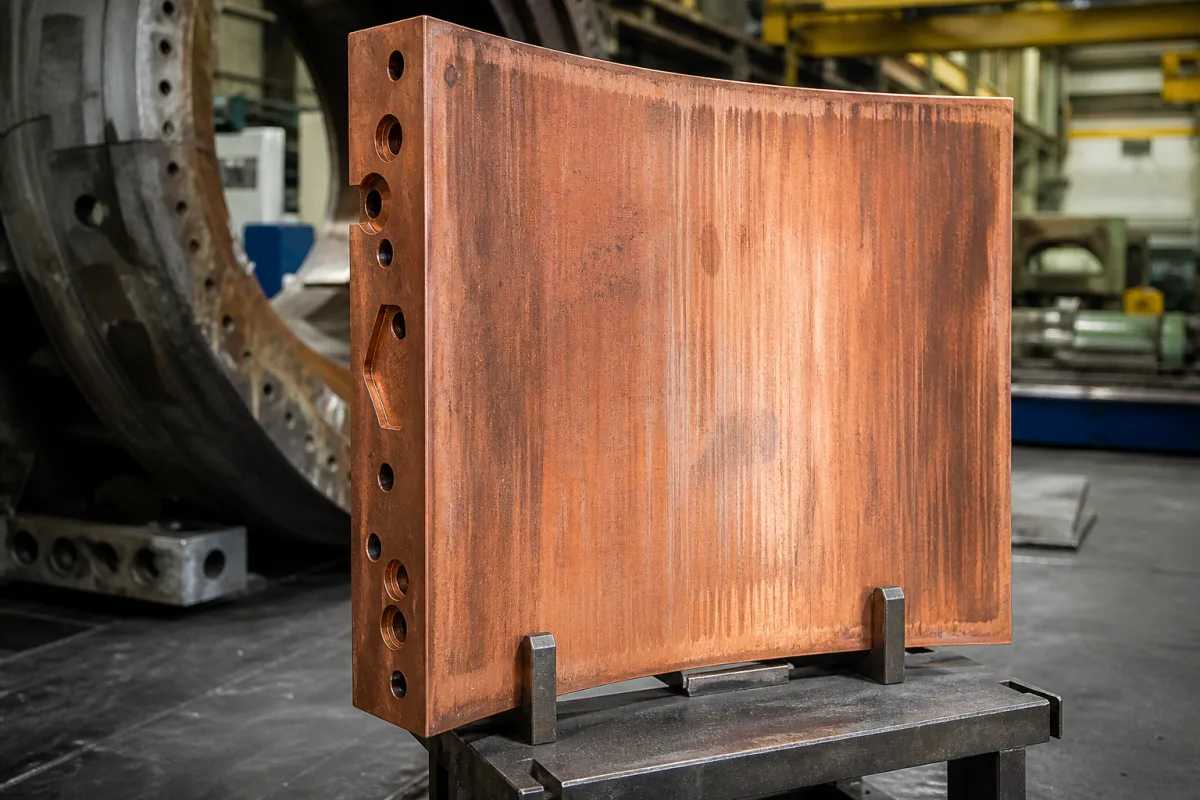
A canonical Continuous Casting Mold Copper Plate is characterized by the integration of Copper Plate Body and Cooling Water Channels. In industrial production environments, manufacturers listed on CNFX commonly emphasize Copper Alloy (CuCrZr) construction to support stable, high-cycle operation across diverse manufacturing scenarios.

Water-cooled copper plate forming molten steel into solid strand in continuous casting.
Product Specifications

Technical details and manufacturing context for Continuous Casting Mold Copper Plate

Definition
A critical consumable component in continuous casting machines that directly contacts molten steel to initiate solidification. It forms the outer shell of the steel strand through rapid heat extraction via internal water channels. These plates are essential for maintaining casting speed, strand quality, and operational stability in steel production. They represent a high-wear component requiring precise metallurgical properties and cooling efficiency.
Working Principle
Molten steel flows against the copper plate surface, transferring heat through the plate to internal cooling water, forming a solidified shell that maintains strand shape while moving through the casting machine.
Common Materials
Copper Alloy (CuCrZr), Stainless Steel Backing
Technical Parameters
  • Plate thickness determining heat transfer rate and structural integrity (mm) Per Request
  • Cooling channel diameter affecting water flow and heat extraction capacity (mm) Per Request
Components / BOM
  • Copper Plate Body
    Primary heat transfer surface contacting molten metal
    Material: Copper Alloy (CuCrZr)
  • Cooling Water Channels
    Internal passages for circulating cooling water
    Material: Machined Copper Alloy
  • Mounting Frame
    Structural support and connection to casting machine
    Material: Stainless Steel
  • Thermal Barrier Coating Optional
    Optional protective layer reducing thermal stress
    Material: Nickel or Chrome Plating
Engineering Reasoning
0.8-1.2 MPa cooling water pressure, 20-40°C inlet temperature, 0.5-2.0 m/s water velocity
Copper plate surface temperature exceeds 350°C, causing recrystallization and permanent deformation; cooling water pressure drops below 0.6 MPa, leading to film boiling
Design Rationale: Thermal fatigue from cyclic temperature gradients (ΔT > 200°C) between hot face (300-400°C) and cold face (80-120°C) during casting cycles; creep deformation at sustained temperatures above 300°C due to copper's yield strength reduction by 50% at 300°C versus 20°C
Risk Mitigation (FMEA)
Trigger Cooling water channel blockage by calcium carbonate scaling exceeding 1.5 mm thickness
Mode: Localized overheating leading to copper plate hot spot formation at >400°C
Strategy: Installation of electromagnetic descaling system with 50 kHz frequency to prevent mineral deposition
Trigger Thermal stress concentration at bolt holes due to coefficient of thermal expansion mismatch (copper: 17×10⁻⁶/°C, steel bolts: 12×10⁻⁶/°C)
Mode: Crack initiation and propagation from stress concentration points exceeding copper's fatigue limit of 70 MPa at 300°C
Strategy: Implementation of compliant layer interface material with thermal conductivity >200 W/m·K and elastic modulus <5 GPa between plate and support structure

Industry Taxonomies & Aliases

Commonly used trade names and technical identifiers for Continuous Casting Mold Copper Plate.

Industrial Ecosystem & Supply Chain DNA

Complementary Systems
Downstream Applications
Specialized Tooling

Application Fit & Sizing Matrix

Operational Limits
pressure: Cooling water: 0.4-1.2 MPa (4-12 bar), Mold containment: up to 2.5 MPa
flow rate: Water: 6-15 m/s channel velocity, 100-400 L/min per plate
temperature: Operating: 150-300°C (mold face), Cooling water: 20-40°C inlet
slurry concentration: Mold powder/lubricant: 0.5-1.5% solids in carrier oil
Media Compatibility
✓ Molten carbon steels (0.1-0.8% C) ✓ Low alloy steels ✓ Continuous casting mold powder/lubricant
Unsuitable: Molten copper or copper alloys (thermal erosion risk)
Sizing Data Required
  • Strand cross-section dimensions (mm)
  • Casting speed (m/min)
  • Required cooling capacity (kW/m²)

Reliability & Engineering Risk Analysis

Failure Mode & Root Cause
Thermal fatigue cracking
Cause: Repeated heating and cooling cycles from molten steel contact cause thermal stress, leading to crack initiation and propagation in the copper plate material.
Copper plate wear and dimensional degradation
Cause: Abrasive wear from steel shell friction, chemical erosion from mold flux, and mechanical wear from oscillation and strand friction reduce plate thickness and alter critical mold dimensions.
Maintenance Indicators
  • Visible longitudinal cracks or crazing on the hot face of the copper plate
  • Audible squealing or scraping sounds during casting, indicating excessive friction or contact issues
Engineering Tips
  • Implement controlled cooling water chemistry and flow optimization to maintain consistent thermal management and minimize thermal shock
  • Establish regular dimensional inspections and surface profiling to detect wear patterns early, allowing for timely reconditioning or replacement before catastrophic failure

Compliance & Manufacturing Standards

Reference Standards
ISO 9001:2015 - Quality Management Systems ASTM B152/B152M - Standard Specification for Copper Sheet, Strip, Plate, and Rolled Bar DIN 1787 - Copper and copper alloys; plates, sheets and strips
Manufacturing Precision
  • Flatness: ≤0.1mm per 1000mm length
  • Thickness: ±0.05mm for plates up to 50mm thickness
Quality Inspection
  • Ultrasonic Testing for internal defects and bonding integrity
  • Hardness Testing (Rockwell or Brinell) for material consistency

Factories Producing Continuous Casting Mold Copper Plate

Verified manufacturers with capability to produce this product in China

✓ 92% Supplier Capability Match Found

T Technical Director from United States Feb 04, 2026
★★★★★
"Standard OEM quality for Basic Metal Manufacturing applications. The Continuous Casting Mold Copper Plate arrived with full certification."
Technical Specifications Verified
P Project Engineer from United Arab Emirates Feb 01, 2026
★★★★☆
"Great transparency on the Continuous Casting Mold Copper Plate components. Essential for our Basic Metal Manufacturing supply chain. (Delivery took slightly longer than expected, but technical support was excellent.)"
Technical Specifications Verified
S Sourcing Manager from Australia Jan 29, 2026
★★★★★
"The Continuous Casting Mold Copper Plate we sourced perfectly fits our Basic Metal Manufacturing production line requirements."
Technical Specifications Verified
Verification Protocol

“Feedback is collected from verified sourcing managers during RFQ (Request for Quote) and factory evaluation processes on CNFX. These reports represent historical performance data and technical audit summaries from our B2B manufacturing network.”

18 sourcing managers are analyzing this specification now. Last inquiry for Continuous Casting Mold Copper Plate from Turkey (1h ago).

Supply Chain Commonly Integrated Components

Purge Air System

A system that provides controlled airflow to clear optical paths and protect sensors in molten metal temperature measurement applications.

Explore Specs →
Degassing Chamber

A specialized vessel within a molten metal degassing system where dissolved gases are removed from molten metal through controlled processes.

Explore Specs →
Gas Control System

A system that regulates and controls the flow, pressure, and composition of gases used in molten metal degassing processes.

Explore Specs →
Burner Assembly

A combustion system component that generates controlled flame for heating applications in industrial preheating stations.

Explore Specs →

Frequently Asked Questions

What is the primary function of a continuous casting mold copper plate?

The copper plate forms molten steel into a solid strand through water-cooled channels during continuous casting, ensuring controlled solidification and surface quality.

Why is CuCrZr alloy used for these plates?

CuCrZr (copper-chromium-zirconium) alloy offers excellent thermal conductivity, high hardness (typically 75-110 HB), and good resistance to thermal fatigue and wear at high temperatures.

How does the cooling system work in these plates?

Precision-machined cooling water channels within the copper plate body circulate water at controlled flow rates (typically 10-50 m³/h) to extract heat from molten steel, maintaining optimal operating temperatures below 400°C.

Can I contact factories directly on CNFX?

CNFX is an open directory, not a transaction platform. Each factory profile provides direct contact information and production details to help you initiate direct inquiries with Chinese suppliers.

Get Quote for Continuous Casting Mold Copper Plate

Request technical pricing, lead times, or customized specifications for Continuous Casting Mold Copper Plate directly from verified manufacturing units.

Your business information is encrypted and only shared with verified Continuous Casting Mold Copper Plate suppliers.

Thank you! Your message has been sent. We'll respond within 1–3 business days.

Need to Manufacture Continuous Casting Mold Copper Plate?

Connect with verified factories specializing in this product category

Add Your Factory Contact Us
Previous Product
Continuous Casting Mold Assembly
Next Product
Continuous Casting Mold Flux