Industry-Verified Manufacturing Data (2026)

Forging-Grade Magnesium Alloy Billet

Based on aggregated insights from multiple verified factory profiles within the CNFX directory, the standard Forging-Grade Magnesium Alloy Billet used in the Basic Metal Manufacturing sector typically supports operational capacities ranging from standard industrial configurations to heavy-duty production requirements.

Technical Definition & Core Assembly

A canonical Forging-Grade Magnesium Alloy Billet is characterized by the integration of Alloy Matrix and Aluminum Additive. In industrial production environments, manufacturers listed on CNFX commonly emphasize Magnesium construction to support stable, high-cycle operation across diverse manufacturing scenarios.

Semi-finished magnesium alloy stock for metal forming processes

Product Specifications

Technical details and manufacturing context for Forging-Grade Magnesium Alloy Billet

Definition
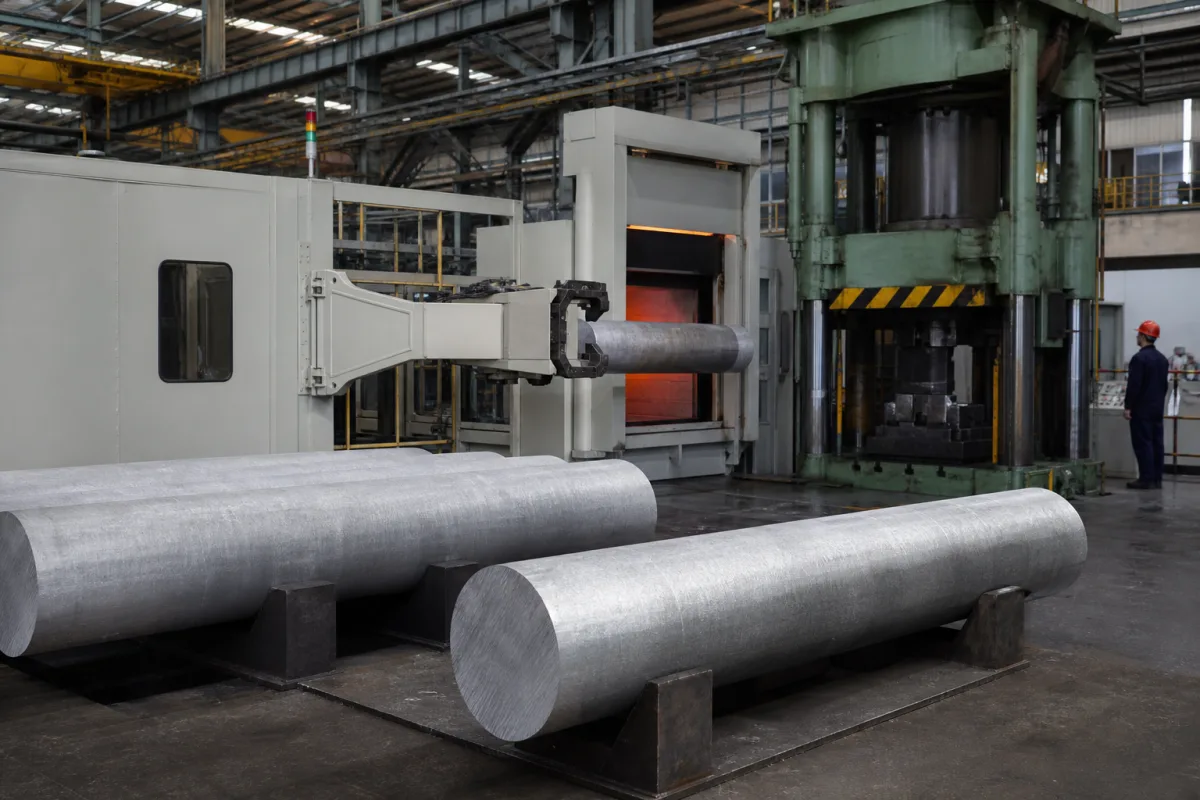
Forging-grade magnesium alloy billet is a semi-finished industrial material specifically formulated for metal forming operations including forging, pressing, and stamping. These billets are produced through casting or extrusion processes to achieve uniform microstructure and mechanical properties suitable for subsequent deformation. They serve as the raw material input for manufacturing lightweight structural components in aerospace, automotive, and consumer electronics industries. The alloy composition is optimized for enhanced forgeability, reduced cracking, and improved mechanical performance in final forged parts.
Working Principle
Pre-shaped metal stock that undergoes plastic deformation through applied force to achieve final component geometry
Common Materials
Magnesium, Aluminum, Zinc, Manganese
Technical Parameters
  • Standard billet diameter range (mm) Per Request
  • Minimum yield strength requirement (MPa) Per Request
Components / BOM
  • Alloy Matrix
    Primary magnesium structure providing base mechanical properties
    Material: Pure magnesium
  • Aluminum Additive
    Enhances strength and corrosion resistance through solid solution strengthening
    Material: Aluminum
  • Zinc Additive
    Improves strength and castability of the alloy
    Material: Zinc
  • Manganese Additive
    Enhances corrosion resistance and refines grain structure
    Material: Manganese
Engineering Reasoning
250-450°C forging temperature range, 0.1-10 MPa flow stress
Oxidation ignition at 473°C in air, 0.5% strain rate for crack initiation
Design Rationale: Pyrophoric oxidation above 473°C due to magnesium's -2.37V electrochemical potential and low ignition energy of 40 mJ/mm²
Risk Mitigation (FMEA)
Trigger Localized heating exceeding 473°C during forging
Mode: Surface ignition and combustion propagation
Strategy: Inert argon atmosphere forging with 99.999% purity and <10 ppm oxygen concentration
Trigger Strain rate exceeding 0.5% during cold working below 250°C
Mode: Cleavage fracture along basal (0001) planes with 45° crack propagation
Strategy: Isothermal forging with ±5°C temperature control and 0.1-0.3% strain rate regulation

Industry Taxonomies & Aliases

Commonly used trade names and technical identifiers for Forging-Grade Magnesium Alloy Billet.

Industrial Ecosystem & Supply Chain DNA

Complementary Systems
Downstream Applications
Specialized Tooling

Application Fit & Sizing Matrix

Operational Limits
pressure: Up to 100 MPa (typical forging pressure), dependent on alloy grade and process
other spec: Billet diameter tolerance: ±1.5%, length tolerance: ±2%, surface finish: Ra ≤ 6.3 μm, grain size: ASTM 5-8
temperature: 250-450°C (forging range), ambient to 350°C (storage/handling)
Media Compatibility
✓ Automotive structural components ✓ Aerospace lightweight parts ✓ Portable electronics housings
Unsuitable: Marine/saltwater environments (due to corrosion susceptibility)
Sizing Data Required
  • Final part volume + 15-25% forging allowance
  • Required mechanical properties (yield strength, elongation)
  • Available forging equipment capacity (press tonnage, die size)

Reliability & Engineering Risk Analysis

Failure Mode & Root Cause
Stress corrosion cracking
Cause: Exposure to chloride-containing environments (e.g., industrial atmospheres, salt spray) combined with residual tensile stresses from forging processes, leading to crack initiation and propagation along grain boundaries.
Thermal fatigue cracking
Cause: Repeated thermal cycling during forging operations causing differential expansion/contraction, leading to microcrack formation at surface discontinuities or inclusions, exacerbated by magnesium's high thermal expansion coefficient.
Maintenance Indicators
  • Visible white powdery corrosion deposits (magnesium hydroxide) forming on billet surfaces, indicating active corrosion requiring immediate intervention.
  • Audible high-frequency cracking or popping sounds during heating/cooling cycles, suggesting internal stress relief or crack propagation that warrants immediate thermal process evaluation.
Engineering Tips
  • Implement controlled atmosphere protection (argon or SF6 gas shielding) during all thermal processing to prevent surface oxidation and chloride contamination that initiates stress corrosion.
  • Apply shot peening or laser shock peening to introduce compressive surface stresses that counteract tensile stresses, significantly improving fatigue resistance and delaying crack initiation.

Compliance & Manufacturing Standards

Reference Standards
ASTM B91/B91M - Standard Specification for Magnesium-Alloy Forgings ISO 3116 - Magnesium and magnesium alloys - Wrought magnesium alloys DIN 9715 - Magnesium alloy forgings; technical delivery conditions
Manufacturing Precision
  • Diameter tolerance: +/- 0.5% of nominal diameter
  • Length tolerance: +/- 2 mm per 100 mm of length
Quality Inspection
  • Ultrasonic Testing for internal defects
  • Chemical Composition Analysis via Optical Emission Spectrometry

Factories Producing Forging-Grade Magnesium Alloy Billet

Verified manufacturers with capability to produce this product in China

✓ 98% Supplier Capability Match Found

P Procurement Specialist from Singapore Feb 01, 2026
★★★★★
"Testing the Forging-Grade Magnesium Alloy Billet now; the Diameter (mm) results are within 1% of the laboratory datasheet."
Technical Specifications Verified
T Technical Director from Germany Jan 29, 2026
★★★★★
"Impressive build quality. Especially the Diameter (mm) is very stable during long-term operation."
Technical Specifications Verified
P Project Engineer from Brazil Jan 26, 2026
★★★★★
"As a professional in the Basic Metal Manufacturing sector, I confirm this Forging-Grade Magnesium Alloy Billet meets all ISO standards."
Technical Specifications Verified
Verification Protocol

“Feedback is collected from verified sourcing managers during RFQ (Request for Quote) and factory evaluation processes on CNFX. These reports represent historical performance data and technical audit summaries from our B2B manufacturing network.”

6 sourcing managers are analyzing this specification now. Last inquiry for Forging-Grade Magnesium Alloy Billet from Poland (34m ago).

Supply Chain Commonly Integrated Components

Purge Air System

A system that provides controlled airflow to clear optical paths and protect sensors in molten metal temperature measurement applications.

Explore Specs →
Degassing Chamber

A specialized vessel within a molten metal degassing system where dissolved gases are removed from molten metal through controlled processes.

Explore Specs →
Gas Control System

A system that regulates and controls the flow, pressure, and composition of gases used in molten metal degassing processes.

Explore Specs →
Burner Assembly

A combustion system component that generates controlled flame for heating applications in industrial preheating stations.

Explore Specs →

Frequently Asked Questions

What are the primary applications for forging-grade magnesium alloy billets?

Forging-grade magnesium alloy billets are used in metal forming processes including forging, pressing, and stamping to create lightweight, high-strength components for automotive, aerospace, and industrial applications.

How does the alloy composition affect the performance of magnesium billets?

The magnesium-aluminum-zinc-manganese alloy matrix provides enhanced strength, corrosion resistance, and formability. Aluminum improves strength, zinc enhances castability, and manganese increases corrosion resistance for optimal forging performance.

What specifications should I consider when selecting magnesium alloy billets for forging?

Key specifications include alloy grade designation, density (g/cm³), diameter and length dimensions, grain size (μm), and yield strength (MPa). These factors determine the billet's suitability for specific forging processes and final component requirements.

Can I contact factories directly on CNFX?

CNFX is an open directory, not a transaction platform. Each factory profile provides direct contact information and production details to help you initiate direct inquiries with Chinese suppliers.

Get Quote for Forging-Grade Magnesium Alloy Billet

Request technical pricing, lead times, or customized specifications for Forging-Grade Magnesium Alloy Billet directly from verified manufacturing units.

Your business information is encrypted and only shared with verified Forging-Grade Magnesium Alloy Billet suppliers.

Thank you! Your message has been sent. We'll respond within 1–3 business days.

Need to Manufacture Forging-Grade Magnesium Alloy Billet?

Connect with verified factories specializing in this product category

Add Your Factory Contact Us
Previous Product
Forging-Grade Copper Alloy Billet
Next Product
Forging-Grade Nickel-Based Superalloy Powder