Industry-Verified Manufacturing Data (2026)

Forging-Grade Nickel-Based Superalloy Powder

Based on aggregated insights from multiple verified factory profiles within the CNFX directory, the standard Forging-Grade Nickel-Based Superalloy Powder used in the Basic Metal Manufacturing sector typically supports operational capacities ranging from standard industrial configurations to heavy-duty production requirements.

Technical Definition & Core Assembly

A canonical Forging-Grade Nickel-Based Superalloy Powder is characterized by the integration of Nickel Matrix and Solid Solution Strengtheners. In industrial production environments, manufacturers listed on CNFX commonly emphasize Nickel construction to support stable, high-cycle operation across diverse manufacturing scenarios.

Fine metallic powder for hot isostatic pressing and forging of high-temperature components

Product Specifications

Technical details and manufacturing context for Forging-Grade Nickel-Based Superalloy Powder

Definition
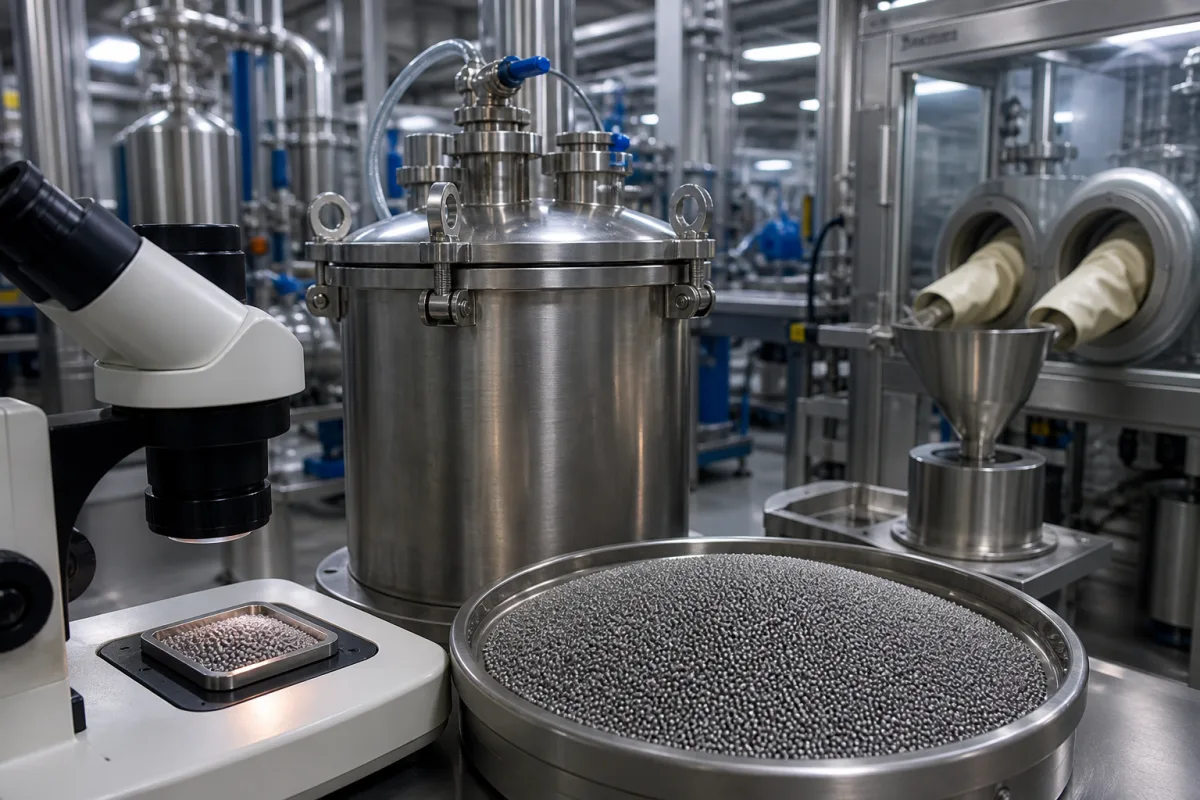
Forging-grade nickel-based superalloy powder is a specialized raw material produced through gas atomization or plasma rotating electrode processes, yielding spherical particles with controlled size distribution. This powder metallurgy feedstock enables near-net-shape manufacturing of complex aerospace and power generation components via hot isostatic pressing (HIP) and subsequent forging operations. Its uniform microstructure and high purity ensure exceptional mechanical properties at elevated temperatures exceeding 1000°C, making it indispensable for turbine blades, discs, and other critical rotating parts. The powder form allows for precise alloy composition control and minimal material waste compared to traditional ingot metallurgy routes.
Working Principle
Spherical powder particles are consolidated under high temperature and isostatic pressure to form fully dense preforms, which are then forged to final dimensions and mechanical properties.
Common Materials
Nickel, Chromium, Cobalt, Molybdenum, Tungsten, Rhenium
Technical Parameters
  • Particle size distribution (D50) (μm) Standard Spec
  • Maximum oxygen content (ppm) Standard Spec
Components / BOM
  • Nickel Matrix
    Primary metallic base providing high-temperature strength and corrosion resistance
    Material: Elemental Nickel
  • Solid Solution Strengtheners
    Chromium, cobalt, molybdenum dissolved in matrix to enhance mechanical properties
    Material: Chromium, Cobalt, Molybdenum
  • Precipitation Hardening Elements
    Aluminum, titanium forming gamma-prime phase for creep resistance
    Material: Aluminum, Titanium
  • Grain Boundary Stabilizers Optional
    Boron, zirconium, carbon improving grain boundary cohesion
    Material: Boron, Zirconium, Carbon
Engineering Reasoning
1100-1250°C hot isostatic pressing temperature, 100-200 MPa consolidation pressure, 10-45 μm particle size distribution
Oxidation at 800°C forming continuous Cr₂O₃ scale, γ' phase dissolution above 1150°C, incipient melting at 1315°C
Design Rationale: Ostwald ripening of γ' precipitates (Ni₃Al/Ti) reducing creep resistance, TCP phase (σ, μ) formation depleting solid solution strengtheners
Risk Mitigation (FMEA)
Trigger Atmospheric oxygen ingress during powder handling exceeding 100 ppm
Mode: Surface oxide layer >100 nm causing poor interparticle bonding and HIP porosity >0.5%
Strategy: Argon glovebox with <10 ppm O₂, powder storage in sealed containers with getter materials
Trigger Carbon pickup from lubricant residues exceeding 0.05 wt%
Mode: M₂₃C₆ carbide precipitation at grain boundaries reducing stress rupture life by 70%
Strategy: Solvent degreasing with trichloroethylene followed by vacuum baking at 200°C for 2 hours

Industry Taxonomies & Aliases

Commonly used trade names and technical identifiers for Forging-Grade Nickel-Based Superalloy Powder.

Industrial Ecosystem & Supply Chain DNA

Complementary Systems
Downstream Applications
Specialized Tooling

Application Fit & Sizing Matrix

Operational Limits
pressure: Up to 200 MPa (29,000 psi) for HIP, 100-150 MPa (14,500-21,750 psi) for forging
other spec: Particle size distribution: 15-150 μm, Flow rate: 0.5-2.0 kg/min for feeding systems, Slurry concentration: 60-70% solids by weight for binder jetting
temperature: Up to 1200°C (2192°F) continuous, 1300°C (2372°F) peak
Media Compatibility
✓ Hot isostatic pressing (HIP) systems ✓ Closed-die forging presses ✓ Additive manufacturing (binder jetting) systems
Unsuitable: Aqueous or corrosive chemical processing environments
Sizing Data Required
  • Component target density (typically 99.5%+ theoretical density)
  • Final part volume and geometry complexity
  • Required mechanical properties (yield strength, creep resistance at operating temperature)

Reliability & Engineering Risk Analysis

Failure Mode & Root Cause
Thermal fatigue cracking
Cause: Cyclic thermal stresses from rapid heating and cooling during forging operations, leading to crack initiation and propagation in the superalloy microstructure.
Oxidation and hot corrosion
Cause: Exposure to high-temperature oxidizing atmospheres and corrosive elements (e.g., sulfur, chlorine) during powder processing or storage, degrading surface integrity and mechanical properties.
Maintenance Indicators
  • Visible discoloration or scaling on powder surfaces indicating oxidation or contamination
  • Audible hissing or abnormal gas flow sounds during inert gas handling, suggesting potential leaks that could compromise powder purity
Engineering Tips
  • Implement strict moisture control and inert gas (argon/nitrogen) blanketing during storage and handling to prevent oxidation and contamination
  • Use controlled, gradual heating/cooling protocols during thermal processing to minimize thermal shock and residual stresses in the forged components

Compliance & Manufacturing Standards

Reference Standards
ASTM B637 - Standard Specification for Precipitation-Hardening Nickel Alloy Bars, Forgings, and Forging Stock for High-Temperature Service ISO 9722 - Nickel and nickel alloys - Forgings AMS 5662 - Nickel Alloy, Corrosion and Heat-Resistant, Bars, Forgings, and Rings 52.5Ni - 19Cr - 3.0Mo - 5.1Cb - 0.90Ti - 0.50Al - 18Fe Consumable Electrode or Vacuum Induction Melted, 1950 °F (1066 °C) Solution Heat Treated, Precipitation-Hardenable
Manufacturing Precision
  • Particle Size Distribution: D90 ≤ 53 μm, D50: 15-45 μm
  • Oxygen Content: ≤ 0.015 wt%
Quality Inspection
  • Gas Analysis (O, N, H) - Inert Gas Fusion Method
  • Scanning Electron Microscopy (SEM) for Powder Morphology and Defect Analysis

Factories Producing Forging-Grade Nickel-Based Superalloy Powder

Verified manufacturers with capability to produce this product in China

✓ 96% Supplier Capability Match Found

P Project Engineer from Australia Jan 30, 2026
★★★★★
"The technical documentation for this Forging-Grade Nickel-Based Superalloy Powder is very thorough, especially regarding Particle Size D50 (μm)."
Technical Specifications Verified
S Sourcing Manager from Singapore Jan 27, 2026
★★★★★
"Reliable performance in harsh Basic Metal Manufacturing environments. No issues with the Forging-Grade Nickel-Based Superalloy Powder so far."
Technical Specifications Verified
P Procurement Specialist from Germany Jan 24, 2026
★★★★★
"Testing the Forging-Grade Nickel-Based Superalloy Powder now; the Particle Size D50 (μm) results are within 1% of the laboratory datasheet."
Technical Specifications Verified
Verification Protocol

“Feedback is collected from verified sourcing managers during RFQ (Request for Quote) and factory evaluation processes on CNFX. These reports represent historical performance data and technical audit summaries from our B2B manufacturing network.”

7 sourcing managers are analyzing this specification now. Last inquiry for Forging-Grade Nickel-Based Superalloy Powder from Germany (48m ago).

Supply Chain Commonly Integrated Components

Signal Processor

Electronic device that conditions, amplifies, filters, and converts raw sensor signals into standardized outputs for temperature measurement systems

Explore Specs →
Purge Air System

A system that provides controlled airflow to clear optical paths and protect sensors in molten metal temperature measurement applications.

Explore Specs →
Degassing Chamber

A specialized vessel within a molten metal degassing system where dissolved gases are removed from molten metal through controlled processes.

Explore Specs →
Gas Control System

A system that regulates and controls the flow, pressure, and composition of gases used in molten metal degassing processes.

Explore Specs →

Frequently Asked Questions

What applications is this forging-grade nickel superalloy powder best suited for?

This powder is specifically engineered for manufacturing high-temperature components through hot isostatic pressing (HIP) and forging processes, commonly used in aerospace turbine blades, industrial gas turbine parts, and other applications requiring exceptional heat resistance and mechanical strength.

How does the particle morphology affect the forging process?

The spherical particle morphology ensures optimal flow characteristics during powder handling and uniform compaction during HIP and forging. This results in improved density, reduced porosity, and enhanced mechanical properties in the final forged components.

What are the key advantages of the nickel-chromium-cobalt-molybdenum composition?

This alloy composition provides exceptional high-temperature strength, oxidation resistance, and creep resistance. The combination of nickel matrix with chromium, cobalt, molybdenum, tungsten, and rhenium creates a material capable of withstanding extreme thermal and mechanical stresses in demanding applications.

Can I contact factories directly on CNFX?

CNFX is an open directory, not a transaction platform. Each factory profile provides direct contact information and production details to help you initiate direct inquiries with Chinese suppliers.

Get Quote for Forging-Grade Nickel-Based Superalloy Powder

Request technical pricing, lead times, or customized specifications for Forging-Grade Nickel-Based Superalloy Powder directly from verified manufacturing units.

Your business information is encrypted and only shared with verified Forging-Grade Nickel-Based Superalloy Powder suppliers.

Thank you! Your message has been sent. We'll respond within 1–3 business days.

Need to Manufacture Forging-Grade Nickel-Based Superalloy Powder?

Connect with verified factories specializing in this product category

Add Your Factory Contact Us
Previous Product
Forging-Grade Magnesium Alloy Billet
Next Product
Forging-Grade Steel Plate