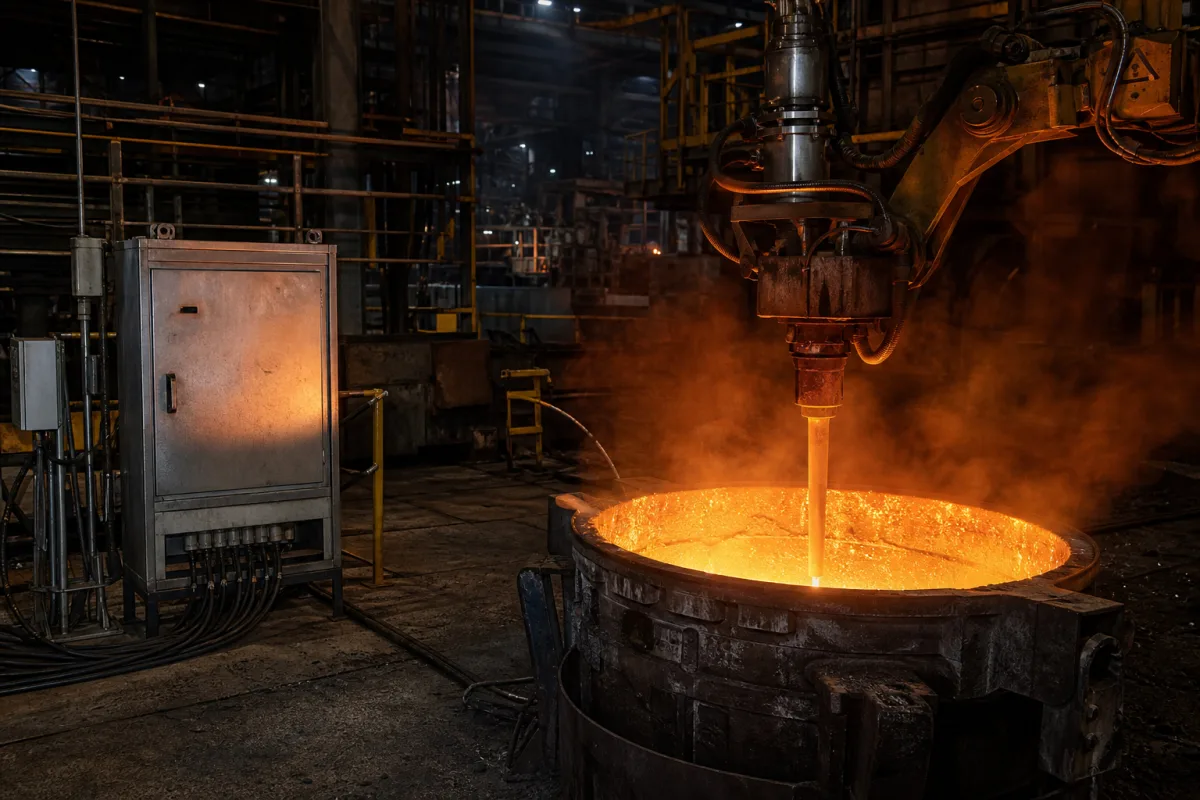
Molten steel temperature measurement · Expendable immersion thermocouple probes on lances or manipulators, continuous immersion sensors, optical fibre measurement, tolerance of the measuring chain
A molten-metal temperature measurement system gives steelmakers and foundries the liquid-metal temperature they need to control melting, ladle treatment and casting. Ask three things first: whether spot dip readings with expendable probes or continuous measurement are needed, whether probes are placed by hand lance or an automatic manipulator, and what accuracy the process requires.
Immersion temperature measurement of liquid steel and metals: expendable thermocouple probes, lances and automatic probe manipulators, continuous immersion sensors and optical-fibre immersion systems, with their instruments. Non-contact infrared pyrometers (see infrared pyrometer), thermocouple assemblies for general industry (see thermocouple assembly) and samplers for chemical analysis are outside this page except where compared.
CNFX editorial research · Sources checked October 12, 2026 · 5 sources
Choose dip, continuous or optical-fibre measurement
Heraeus Electro-Nite describes fast, accurate liquid-metal temperature readings as essential for cost-effective temperature control in steelmaking, offering expendable temperature sensors with a wide choice of thermocouple types, probe lengths and immersion lances for all process applications, plus non-splash and multi-immersion designs for critical applications and foundries. For continuous casting it offers a robust permanent sensor to control temperature profiles, with precision the same as dip measurements and a range of holding devices and cable lengths. [2][1]
MINKON explains that thermocouples are quick, precise and inexpensive but cannot give an instantaneous continuous reading, while contactless optical measurement needs a free view, reads only the surface and suffers large errors because surface emissivity is unknown. Its DynTemp approach continuously immerses an optical fibre into the melt to transmit thermal radiation without emissivity losses or slag influence, for use by hand lance, manipulator, stirring lance or bottom tuyere. [3]
Give the supplier the metal and process stage (furnace, ladle, degasser, tundish, mould), temperature range, spot or continuous measurement, deployment (hand lance, automatic manipulator, permanent mount), required accuracy and repeatability, probe consumption per heat, instrument and data interface, and plant safety requirements.
02
Set accuracy expectations and deployment
MINKON gives a maximum thermocouple wire tolerance of ±1.5 °C (0.1%) at the palladium point and a tolerance of ±3.5 °C for the total measuring chain; in a 100 t ladle furnace, continuous measurement detected the required tapping temperature about two minutes earlier than interpolating manual thermocouple readings, and showed temperature homogenisation about 50 s after arc power-off without bottom stirring against about 10 s with stirring. For RH degassing it describes a manual lance with heavy-duty probes measuring for 4–6 minutes. [3]
Editorial calculation: the ±3.5 °C chain tolerance is a little over twice (2.3×) the ±1.5 °C wire tolerance, so specifications should state which of the two is meant. [3]
03
Weigh a non-contact tapping-stream pyrometer against dip thermocouples
AMETEK Land's SPOT+ MM (MeltMaster) is an infrared pyrometer for liquid iron and steel in foundry tapping, aimed at the pouring stream as it runs into each mould instead of dipping thermocouples into the ladle, which its application sheet calls dangerous and dependent on operator technique and dip depth. The product page lists a measurement range of 600 to 1,800 °C, accuracy in application of ±0.5% of the reading in kelvin, 0.1 °C resolution, 0.5 °C noise, detection in selected near-infrared bands, IP65 sealing, response time adjustable from 1 ms to 10 s, 0/4–20 mA analogue outputs plus Ethernet with Modbus TCP, and power over Ethernet or 19–30 V DC at 8 W maximum. Its application mode is designed to read through the thin oxide layers that form and re-form on the stream, it holds the tapping temperature until the next pour, and an integrated camera lets the operator watch the stream. [4][5]
Editorial calculation: at 1,600 °C (1,873 K), ±0.5% K is about ±9.4 °C, wider than the ±3.5 °C measuring-chain tolerance MINKON gives for dip thermocouples, but the pyrometer reads every pour without consumables or a person at the ladle. Specify which you need: per-mould continuous readings for documentation, or ladle reference readings for heat control. [4][3]
Ask any supplier for the thermocouple type and calibration, stated accuracy of the probe and complete measuring chain, measuring time per dip, probe lengths and lance or manipulator compatibility, continuous-sensor life, instrument outputs and data integration, and references in similar melt shops.
05
Probes, lances, permanent sensors and the optical fibre route
The expendable probe and lance rows apply to dip readings; the permanent sensor and optical fibre rows are the continuous options. [2][3]
Which accuracy figure: wire, measuring chain or pyrometer?
State whether accuracy means the thermocouple wire, the whole measuring chain or a pyrometer reading in kelvin, since the sources quote all three. [3][4]
Explore company information and manufacturing capabilities, then discuss the scope of your project with a relevant supplier.
Share this page
Compiled and source-reviewed by the CNFX editorial team.
Each manufacturer above links to the page on that company's own website where the product is listed, with the date we checked it. How we source and review
· Page last updated 13 October 2026
Buyer questions
How accurate are immersion thermocouples in molten steel?
MINKON cites ±1.5 °C maximum wire tolerance at the palladium point and ±3.5 °C for the complete measuring chain. [3]
Why not measure molten steel with an infrared pyrometer?
MINKON notes optical surface measurement needs a clear view, reads only the surface and has large errors from unknown emissivity. [3]
Can temperature be measured continuously in casting?
Heraeus Electro-Nite offers a permanent sensor for continuous casting with precision equal to dip measurements. [2]
Can molten metal temperature be measured without dipping a thermocouple?
Yes: one tapping-stream pyrometer measures 600–1,800 °C from the pouring stream with ±0.5% K accuracy in application and 1 ms to 10 s response. [4]
Sources and what still needs a direct check
Sources checked 2026-10-12. Heraeus Electro-Nite makes immersion sensors for steelmaking; MINKON presented its measurement data in a webinar published by BFI.