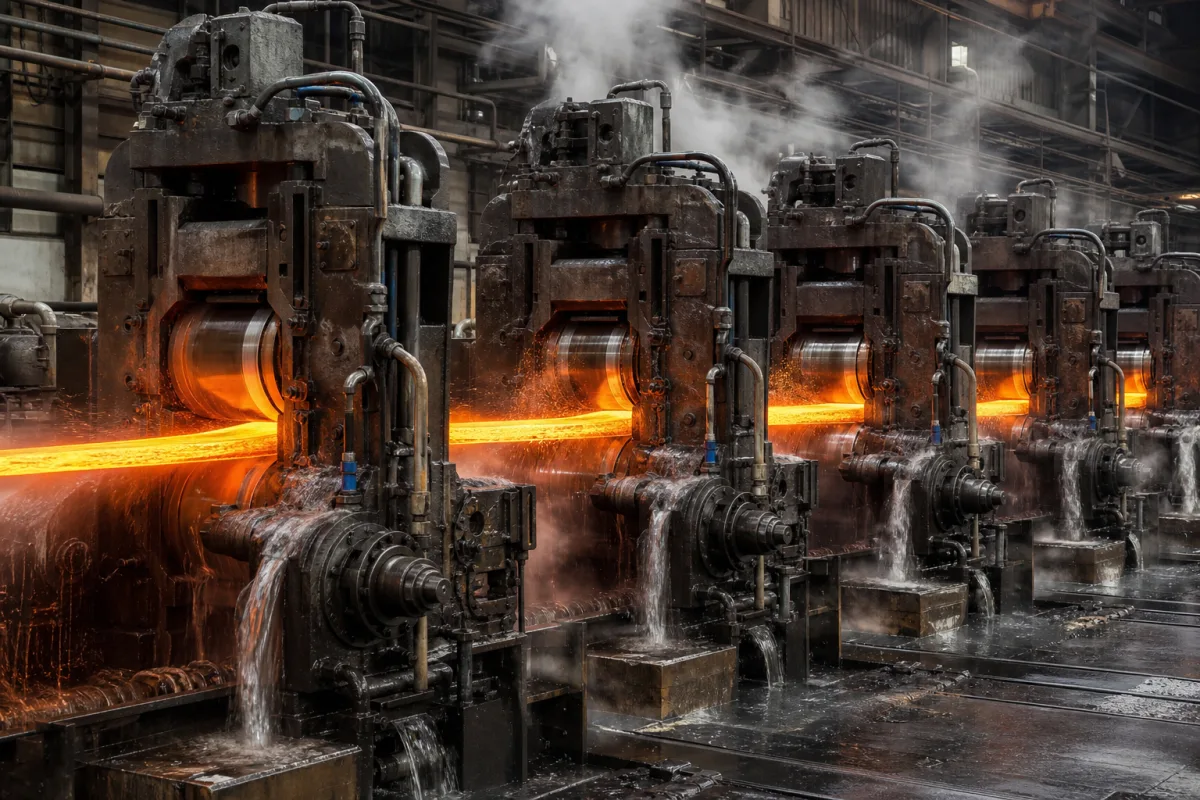
Multi-stand hot tandem finishing mill for aluminium strip: the 1+3 and 1+4 trains that roll a reversing-mill transfer bar down to coil
The three- or four-stand finishing train that follows a reversing roughing mill on an aluminium hot line · built up stand by stand (1+3, 1+4, an added F0), run to finish hot enough for the coil to anneal itself
Aluminium ingots are broken down on a reversing roughing mill, then the transfer bar runs once through a finishing train of three or four stands in a row and is coiled. Because each stand only takes one pass, the train sets the hot band thickness, profile and flatness, and its exit temperature decides whether the metal recrystallises in the coil or needs a separate anneal before cold rolling to can stock or autobody sheet. This page covers that finishing train as a whole, how plants extend it, and the temperatures it is run to.
Multi-stand hot tandem finishing mills for aluminium alloys, fed by a reversing roughing mill in 1+3, 1+4 or similar layouts: number of stands, added stands, gauge, profile and flatness actuators, coolant sprays and exit temperature for self-annealing or batch annealing. Individual hot strip and plate stands, their housings and roll stacks for steel are covered on the Heavy-duty rolling mill stand page; single-line reversing mills with coiler furnaces on the Steckel mill page; work-roll spray cooling in steel finishing stands on the Work rolls under spray cooling in hot strip finishing stands page; complete steel hot strip lines on the Integrated hot strip rolling and finishing system page; and twin-roll and twin-belt casting with in-line rolling on the Non-ferrous strip continuous casting and rolling line page.
CNFX editorial research · Sources checked October 13, 2026 · 5 sources
From one finishing stand to four: the Henan Yirui 1+4 conversion and Baowu's added F0 stand
Two recent Chinese projects show how an aluminium hot line becomes a tandem mill by adding stands to an existing roughing mill rather than building a new line.
Editorial calculation: at Baowu one added stand was to double annual capacity, from 300,000 to 600,000 t, a gain of 300,000 t a year from the F0 upgrade. [3] Primetals describes the F0 package as working with the line's existing smart crown system: work roll bending keeps strip profile constant regardless of rolling load, the solenoid-valve spray bars apply zone cooling and lubrication to control the mill's bulk temperature and residual flatness errors, and servo-valve AGC cylinders control thickness and also adjust the pass line height to the roll diameters. [3]
At Henan Yirui the harder part was control rather than steel: SMS's X-Pact® Level 2 model and pass schedule calculation drive both the re-used roughing mill and the new finishing stands as one 1+4 mill, and the customer's general manager names the integration of the second-hand equipment as the challenge. [1]
Project
Before
After
Stated equipment and range
Henan Yirui, Gongyi (SMS group)
Second-hand 1+1 mill: reversing roughing mill and a single-stand reversing finishing mill [1]
1+4: the roughing mill plus a four-stand finishing mill, three of its stands new [1]
CVC® on the three new stands; side-trimming shear, down coiler and offline strip surface inspection; trimmed strip up to 2,150 mm wide; first coil 22 November 2023; production started two months earlier than originally planned [1][2]
Plate mill with a three-stand hot finishing mill F1–F3, 300,000 t a year [3]
Four stands with a new F0 ahead of F1–F3; capacity to rise to 600,000 t a year [3]
Work roll bending and shifting, coolant spray bars with integral solenoid valves, hydraulic AGC cylinders; heavy plate from 1.8 to 200 mm thick; implementation scheduled for October 2024 [3]
State the roughing mill you have, the number of finishing stands wanted, strip width, hot band gauge range, alloys, annual tonnage, and which profile, flatness and gauge actuators are required on each stand.
02
Rolling at 350–500 °C and coiling at 300 °C or more: what the last stand's exit temperature does to the coil
Wells and co-workers at the University of British Columbia, with Alcan's Kingston research centre, modelled hot tandem rolling of AA5182 and AA5052, coupling heat flow and deformation in the roll bite with recrystallisation, grain size and texture between stands. [4]
Novelis states that hot rolling speed and temperature can be controlled so that full recrystallisation, the self-anneal, is reached during coiling at the exit of the tandem mill, or else the coils are batch annealed. [5] Editorial note: that makes the speed and cooling of the last finishing stands part of the metallurgy, not only of the gauge.
The UBC model treats the strip between stands as a place where the microstructure changes: its interstand module tracks per cent recrystallisation, grain size and texture with a one-dimensional heat-conduction model of the through-thickness temperature. Checked against industrial data it gave reasonable predictions of temperature and grain size but overestimated mill loads in the last stands for both alloys and underestimated cube and S texture in the recrystallised strip. [4]
Quantity
Value
Source context
Deformation temperature
350–500 °C
Laboratory window chosen to represent industrial aluminium hot tandem rolling [4]
Give the target hot band exit temperature and whether the coil must self-anneal, the alloys rolled, the minimum hot band gauge, and the coolant system and spray zoning wanted on the finishing stands.
03
What to send for an aluminium hot tandem finishing mill
Paste it into your enquiry below or into an email to a maker, then replace every bracket.
Line: [existing roughing mill; 1+3, 1+4 or added stand]
Product: [alloys; width; hot band gauge; coil weight]
Capacity: [tonnes per year]
Stands: [roll sizes; bending; shifting or CVC; hydraulic AGC]
Coolant: [spray zoning; solenoid valve bars]
Exit: [target exit temperature; self-anneal or batch anneal]
Control: [Level 1 and Level 2; pass schedule model]
Explore company information and manufacturing capabilities, then discuss the scope of your project with a relevant supplier.
Share this page
Compiled and source-reviewed by the CNFX editorial team.
Each manufacturer above links to the page on that company's own website where the product is listed, with the date we checked it. How we source and review
· Page last updated 13 October 2026
Buyer questions
What does 1+4 mean on an aluminium hot rolling line?
One reversing roughing mill followed by a four-stand finishing mill, as at Henan Yirui where SMS converted a 1+1 mill to 1+4 for trimmed strip up to 2,150 mm wide. [1]
Why add an F0 stand to an aluminium finishing mill?
Baowu Aluminium ordered a new F0 ahead of its three-stand F1–F3 mill to raise capacity from 300,000 to 600,000 t a year. [3]
How hot must aluminium leave a tandem mill to self-anneal?
In Novelis's US 10,947,613 the exit temperature is controlled to at least 300 °C so that the coil recrystallises during coiling; otherwise coils are batch annealed at 350–450 °C. [5]
Sources and what still needs a direct check
Sources checked 2026-10-13. Project facts are from SMS group and Primetals Technologies press releases about their own work; process windows are from the UBC–Alcan modelling series (OSTI record) and a Novelis patent.