Industry-Verified Manufacturing Data (2026)

Oscillation Table

Based on aggregated insights from multiple verified factory profiles within the CNFX directory, the standard Oscillation Table used in the Basic Metal Manufacturing sector typically supports operational capacities ranging from standard industrial configurations to heavy-duty production requirements.

Technical Definition & Core Assembly

A canonical Oscillation Table is characterized by the integration of Table Frame and Mounting Interface. In industrial production environments, manufacturers listed on CNFX commonly emphasize High-strength steel construction to support stable, high-cycle operation across diverse manufacturing scenarios.

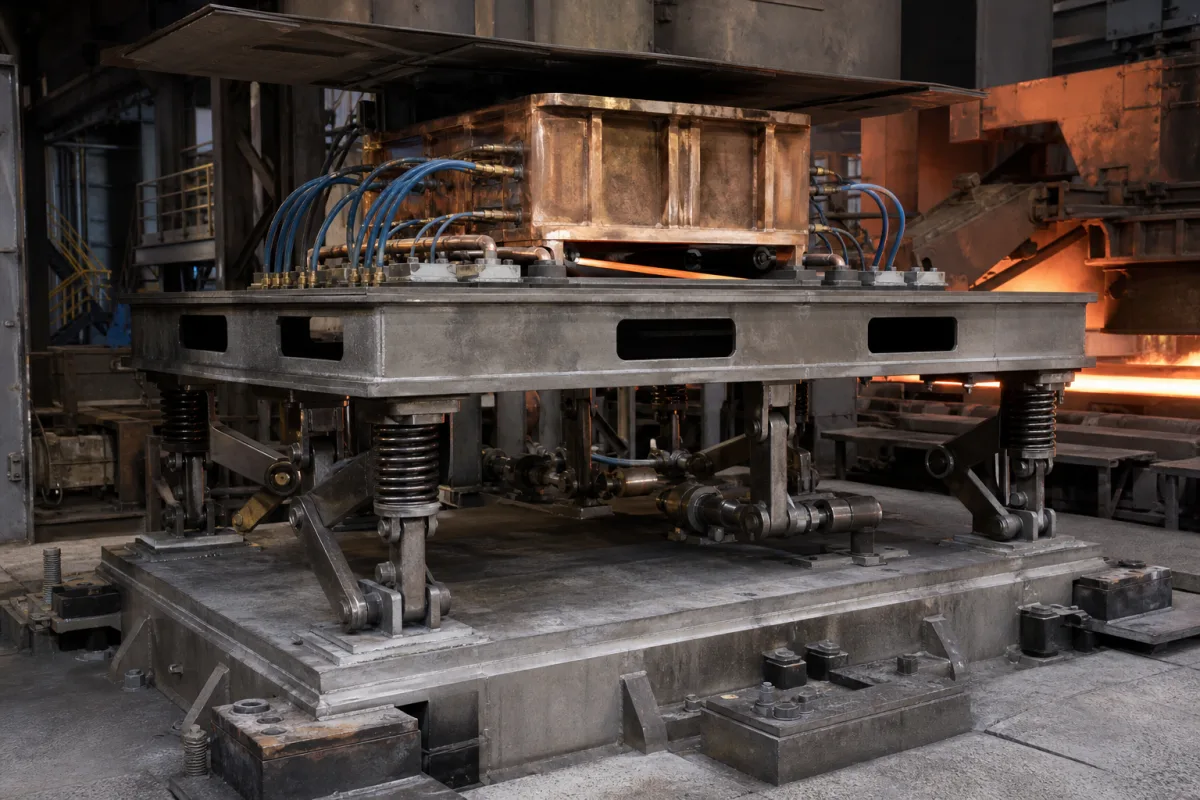
A mechanical platform that provides controlled oscillatory motion to the continuous casting mold during steel production.
Product Specifications

Technical details and manufacturing context for Oscillation Table

Definition
The oscillation table is a critical component of the continuous casting mold oscillation system in steel manufacturing. It serves as the structural foundation that supports the mold assembly while imparting precise vertical oscillatory motion to prevent sticking of the solidifying steel shell to the mold walls. This controlled movement ensures uniform heat transfer, reduces friction, and improves surface quality of the cast product.
Working Principle
The oscillation table operates through hydraulic or electromechanical actuators that convert rotational or linear input into controlled vertical oscillations. These oscillations follow specific waveform patterns (typically sinusoidal or non-sinusoidal) with adjustable amplitude and frequency to match casting parameters. The table's rigid construction ensures precise motion transmission to the mold while withstanding high thermal and mechanical loads.
Common Materials
High-strength steel, Heat-resistant alloys
Technical Parameters
  • Table dimensions and mounting interface specifications (mm) Customizable
Components / BOM
  • Table Frame
    Primary structural support that distributes loads and maintains rigidity during oscillation
    Material: High-strength steel
  • Mounting Interface
    Precision-machined surface for secure attachment of the continuous casting mold assembly
    Material: Heat-treated alloy steel
  • Actuator Connection Points
    Hardened attachment points for hydraulic cylinders or electromechanical actuators that generate oscillatory motion
    Material: Forged steel
Engineering Reasoning
0.5-3.0 mm oscillation amplitude at 50-250 cycles/min frequency
Exceeding 3.5 mm amplitude at 300 cycles/min or operating below 0.3 mm amplitude at 40 cycles/min
Design Rationale: Resonance-induced structural fatigue at natural frequency of 320±15 cycles/min, causing stress concentration exceeding material yield strength of 450 MPa
Risk Mitigation (FMEA)
Trigger Hydraulic fluid contamination exceeding ISO 4406 18/16/13 cleanliness level
Mode: Servo valve spool sticking causing irregular oscillation patterns
Strategy: Install dual 3-micron absolute filtration with pressure differential monitoring at 0.5 bar threshold
Trigger Bearing lubrication failure due to grease degradation at 120°C operating temperature
Mode: Increased friction torque exceeding 850 N·m, causing drive motor overload
Strategy: Implement forced-air cooling maintaining bearing temperature below 80°C with PTFE-based high-temperature grease

Industry Taxonomies & Aliases

Commonly used trade names and technical identifiers for Oscillation Table.

Industrial Ecosystem & Supply Chain DNA

Complementary Systems
Downstream Applications
Specialized Tooling

Application Fit & Sizing Matrix

Operational Limits
pressure: N/A (mechanical system, not pressure vessel)
temperature: Ambient to 150°C (cooling system dependent)
stroke length: 3-25 mm
max load capacity: 5-50 tons (mold dependent)
operating environment: High humidity, water spray, steel dust
oscillation frequency: 50-400 cycles per minute
Media Compatibility
✓ Continuous casting molds (steel) ✓ Molten steel splash zone ✓ Water-based cooling/mist systems
Unsuitable: Corrosive chemical environments (acids, chlorides)
Sizing Data Required
  • Mold dimensions and weight
  • Required oscillation frequency and stroke
  • Continuous casting line speed

Reliability & Engineering Risk Analysis

Failure Mode & Root Cause
Bearing fatigue and seizure
Cause: Continuous oscillatory motion under load leads to cyclic stress on bearings, compounded by inadequate lubrication or contamination, causing premature wear and eventual failure.
Structural fatigue cracking
Cause: Repeated mechanical stress from oscillation cycles induces metal fatigue at weld joints or high-stress points, potentially exacerbated by material defects or overloading.
Maintenance Indicators
  • Unusual grinding or knocking sounds during operation, indicating bearing wear or loose components
  • Visible excessive vibration or irregular motion patterns, suggesting imbalance or structural issues
Engineering Tips
  • Implement a strict lubrication schedule with vibration analysis to detect early bearing wear before catastrophic failure
  • Conduct periodic non-destructive testing (e.g., ultrasonic or dye penetrant) on critical welds and stress points to identify fatigue cracks early

Compliance & Manufacturing Standards

Reference Standards
ISO 1940-1:2003 (Balance quality requirements for rotors) ASTM E2309/E2309M-20 (Standard Practices for Verification of Displacement Measuring Systems and Devices) CE Machinery Directive 2006/42/EC (Essential health and safety requirements)
Manufacturing Precision
  • Flatness of table surface: ≤0.1 mm/m
  • Oscillation frequency accuracy: ±0.5 Hz
Quality Inspection
  • Vibration analysis test (to verify smooth operation within specified frequency range)
  • Surface hardness and wear resistance test (e.g., Rockwell hardness test)

Factories Producing Oscillation Table

Verified manufacturers with capability to produce this product in China

✓ 95% Supplier Capability Match Found

P Procurement Specialist from Brazil Jan 16, 2026
★★★★★
"As a professional in the Basic Metal Manufacturing sector, I confirm this Oscillation Table meets all ISO standards."
Technical Specifications Verified
T Technical Director from Canada Jan 13, 2026
★★★★★
"Standard OEM quality for Basic Metal Manufacturing applications. The Oscillation Table arrived with full certification."
Technical Specifications Verified
P Project Engineer from United States Jan 10, 2026
★★★★★
"Great transparency on the Oscillation Table components. Essential for our Basic Metal Manufacturing supply chain."
Technical Specifications Verified
Verification Protocol

“Feedback is collected from verified sourcing managers during RFQ (Request for Quote) and factory evaluation processes on CNFX. These reports represent historical performance data and technical audit summaries from our B2B manufacturing network.”

6 sourcing managers are analyzing this specification now. Last inquiry for Oscillation Table from Vietnam (1h ago).

Supply Chain Compatible Machinery & Devices

Continuous Casting Machine

Industrial machine for solidifying molten metal into continuous billets/blooms/slabs.

Explore Specs →
Electromagnetic Induction Heater

Industrial heating device using electromagnetic induction for metal processing

Explore Specs →
Vacuum Induction Melting Furnace

Industrial furnace for melting metals under vacuum using electromagnetic induction

Explore Specs →
Electroslag Remelting Furnace

Secondary refining furnace for high-quality metal ingots

Explore Specs →

Frequently Asked Questions

What is the primary function of an oscillation table in basic metal manufacturing?

The oscillation table provides controlled oscillatory motion to the continuous casting mold during steel production, helping prevent sticking and ensuring uniform solidification of the steel strand.

What materials are used in constructing industrial oscillation tables?

Our oscillation tables are built with high-strength steel for structural integrity and heat-resistant alloys in critical components to withstand the extreme temperatures of steel casting environments.

How does the oscillation table integrate with continuous casting systems?

The table features actuator connection points for precise motion control, a mounting interface for secure mold attachment, and a robust table frame that integrates seamlessly with existing casting line infrastructure.

Can I contact factories directly on CNFX?

CNFX is an open directory, not a transaction platform. Each factory profile provides direct contact information and production details to help you initiate direct inquiries with Chinese suppliers.

Get Quote for Oscillation Table

Request technical pricing, lead times, or customized specifications for Oscillation Table directly from verified manufacturing units.

Your business information is encrypted and only shared with verified Oscillation Table suppliers.

Thank you! Your message has been sent. We'll respond within 1–3 business days.

Need to Manufacture Oscillation Table?

Connect with verified factories specializing in this product category

Add Your Factory Contact Us
Previous Product
Oscillation Mechanism
Next Product
Oxygen Lance System