Industry-Verified Manufacturing Data (2026)

Oxygen Lance System

Based on aggregated insights from multiple verified factory profiles within the CNFX directory, the standard Oxygen Lance System used in the Basic Metal Manufacturing sector typically supports operational capacities ranging from standard industrial configurations to heavy-duty production requirements.

Technical Definition & Core Assembly

A canonical Oxygen Lance System is characterized by the integration of Lance Body/Tube and Lance Tip/Nozzle Block. In industrial production environments, manufacturers listed on CNFX commonly emphasize Copper (for lance tip/nozzles) construction to support stable, high-cycle operation across diverse manufacturing scenarios.

A critical subsystem in basic oxygen steelmaking that delivers high-purity oxygen into the molten iron bath to oxidize impurities.

Product Specifications

Technical details and manufacturing context for Oxygen Lance System

Definition
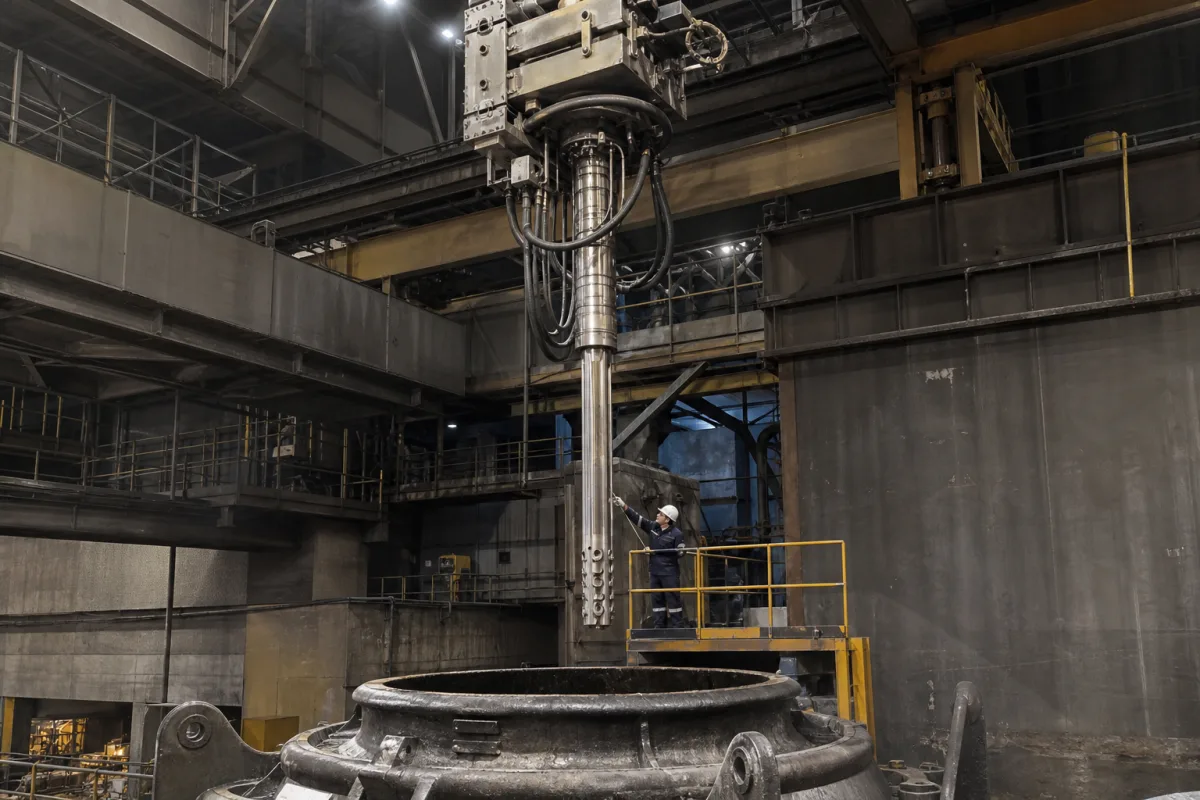
The Oxygen Lance System is an essential component of the Integrated Blast Furnace and Basic Oxygen Furnace Steelmaking System. It consists of a water-cooled lance that injects high-pressure, high-purity oxygen into the molten iron bath within the basic oxygen furnace (BOF). This injection facilitates the oxidation of carbon, silicon, manganese, and phosphorus impurities, enabling precise control over the steelmaking process, temperature regulation, and slag formation.
Working Principle
The system operates by lowering a water-cooled lance into the BOF vessel. High-pressure oxygen (typically 8-12 bar) is forced through nozzles at the lance tip, creating supersonic jets that penetrate the molten bath. This creates intense turbulence, promoting rapid oxidation reactions (decarburization) and efficient heat transfer. The lance's height and oxygen flow rate are precisely controlled to optimize the refining process.
Common Materials
Copper (for lance tip/nozzles), Carbon Steel (for lance body), Stainless Steel (for internal piping)
Technical Parameters
  • Lance outer diameter and nozzle bore diameter, critical for oxygen jet characteristics and penetration. (mm) Standard Spec
Components / BOM
  • Lance Body/Tube
    Main structural conduit carrying oxygen and cooling water; typically a concentric pipe assembly.
    Material: Carbon Steel
  • Lance Tip/Nozzle Block
    Contains precisely machined nozzles that shape and accelerate the oxygen jets into the bath.
    Material: Copper (for high thermal conductivity)
  • Cooling Water System
    Circulates water through the lance's annular space to absorb extreme heat from the furnace.
    Material: Stainless Steel (piping), Carbon Steel (headers)
  • Lance Carriage/Positioning Mechanism
    Raises, lowers, and positions the lance vertically and sometimes rotationally above the furnace.
    Material: Structural Steel
Engineering Reasoning
8-15 bar (oxygen pressure), 1200-1600°C (tip temperature), 0.8-1.2 m³/min per ton of steel (flow rate)
Lance tip temperature exceeds 1650°C (copper melting point), oxygen pressure drops below 6 bar (insufficient penetration), or flow turbulence exceeds Reynolds number 4000
Design Rationale: Thermal fatigue from cyclic heating (1200-1600°C) and cooling (water cooling at 25°C) causes microcrack propagation in copper tip; cavitation erosion occurs when local pressure drops below oxygen vapor pressure (0.5 bar at 1600°C)
Risk Mitigation (FMEA)
Trigger Water cooling flow reduction below 30 L/min per meter of lance length
Mode: Copper tip melting and structural deformation
Strategy: Redundant cooling circuits with flow sensors and automatic lance retraction at <25 L/min flow
Trigger Oxygen purity drop below 99.5% (industrial grade threshold)
Mode: Increased refractory wear and slag foaming instability
Strategy: Cryogenic distillation backup system with purity monitoring and automatic switchover at 99.3%

Industry Taxonomies & Aliases

Commonly used trade names and technical identifiers for Oxygen Lance System.

Industrial Ecosystem & Supply Chain DNA

Complementary Systems
Downstream Applications
Specialized Tooling

Application Fit & Sizing Matrix

Operational Limits
pressure: 10-20 bar (operating pressure range)
flow rate: 500-1200 Nm³/min (oxygen flow capacity)
temperature: 1500-1700°C (molten iron bath temperature range)
slurry concentration: Not applicable (handles high-purity oxygen only)
Media Compatibility
✓ High-purity oxygen (>99.5% O2) ✓ Molten iron bath with carbon content 3-4% ✓ Basic refractory-lined vessels
Unsuitable: Chlorine or sulfur-containing atmospheres (causes severe corrosion)
Sizing Data Required
  • Required oxygen flow rate (Nm³/min)
  • Lance immersion depth and angle
  • Vessel capacity and desired blow time

Reliability & Engineering Risk Analysis

Failure Mode & Root Cause
Thermal fatigue cracking
Cause: Rapid thermal cycling from high-temperature oxygen injection into molten metal, causing repeated expansion/contraction stresses that exceed material endurance limits.
Erosion-corrosion
Cause: High-velocity oxygen flow combined with particulate matter in gas stream and chemical reactions with process materials, leading to accelerated material degradation at lance tip and internal surfaces.
Maintenance Indicators
  • Irregular flame pattern or backfire at lance tip during operation
  • Visible oxidation scale buildup or localized discoloration on lance exterior beyond normal operating parameters
Engineering Tips
  • Implement staged cooling protocols post-operation to minimize thermal shock, using controlled inert gas purging before full shutdown
  • Install real-time oxygen purity monitoring with automatic diversion systems to prevent particulate contamination and moisture ingress

Compliance & Manufacturing Standards

Reference Standards
ISO 9001:2015 - Quality Management Systems ASTM A53/A53M-20 - Standard Specification for Pipe, Steel, Black and Hot-Dipped, Zinc-Coated, Welded and Seamless CE Marking - Directive 2014/68/EU (Pressure Equipment Directive)
Manufacturing Precision
  • Bore Diameter: +/-0.05mm
  • Wall Thickness: +/-10% of nominal thickness
Quality Inspection
  • Hydrostatic Pressure Test
  • Visual and Dimensional Inspection

Factories Producing Oxygen Lance System

Verified manufacturers with capability to produce this product in China

✓ 97% Supplier Capability Match Found

P Project Engineer from Canada Jan 06, 2026
★★★★★
"The technical documentation for this Oxygen Lance System is very thorough, especially regarding technical reliability."
Technical Specifications Verified
S Sourcing Manager from United States Jan 03, 2026
★★★★★
"Reliable performance in harsh Basic Metal Manufacturing environments. No issues with the Oxygen Lance System so far."
Technical Specifications Verified
P Procurement Specialist from United Arab Emirates Dec 31, 2025
★★★★★
"Testing the Oxygen Lance System now; the technical reliability results are within 1% of the laboratory datasheet."
Technical Specifications Verified
Verification Protocol

“Feedback is collected from verified sourcing managers during RFQ (Request for Quote) and factory evaluation processes on CNFX. These reports represent historical performance data and technical audit summaries from our B2B manufacturing network.”

16 sourcing managers are analyzing this specification now. Last inquiry for Oxygen Lance System from Vietnam (31m ago).

Supply Chain Compatible Machinery & Devices

Electromagnetic Induction Heater

Industrial heating device using electromagnetic induction for metal processing

Explore Specs →
Vacuum Induction Melting Furnace

Industrial furnace for melting metals under vacuum using electromagnetic induction

Explore Specs →
Electroslag Remelting Furnace

Secondary refining furnace for high-quality metal ingots

Explore Specs →
Molten Metal Flow Control Valve

Precision valve for regulating molten metal flow in casting and pouring operations.

Explore Specs →

Frequently Asked Questions

What materials are used in oxygen lance construction and why?

Copper is used for lance tips/nozzles due to its high thermal conductivity and resistance to oxidation at high temperatures. Carbon steel forms the lance body for structural strength, while stainless steel internal piping prevents corrosion from oxygen and cooling water.

How does the oxygen lance system improve steel quality?

The system delivers precisely controlled, high-purity oxygen into the molten iron bath, oxidizing impurities like carbon, silicon, and phosphorus. This controlled oxidation process reduces impurities to specified levels, resulting in higher quality steel with consistent chemical composition.

What maintenance is required for oxygen lance systems?

Regular maintenance includes inspecting and replacing worn lance tips/nozzles, checking cooling water system integrity to prevent leaks, monitoring lance positioning mechanism accuracy, and inspecting the lance body for thermal fatigue or corrosion damage to ensure safe, efficient operation.

Can I contact factories directly on CNFX?

CNFX is an open directory, not a transaction platform. Each factory profile provides direct contact information and production details to help you initiate direct inquiries with Chinese suppliers.

Get Quote for Oxygen Lance System

Request technical pricing, lead times, or customized specifications for Oxygen Lance System directly from verified manufacturing units.

Your business information is encrypted and only shared with verified Oxygen Lance System suppliers.

Thank you! Your message has been sent. We'll respond within 1–3 business days.

Need to Manufacture Oxygen Lance System?

Connect with verified factories specializing in this product category

Add Your Factory Contact Us
Previous Product
Oscillation Table
Next Product
Pinch Roll Assembly