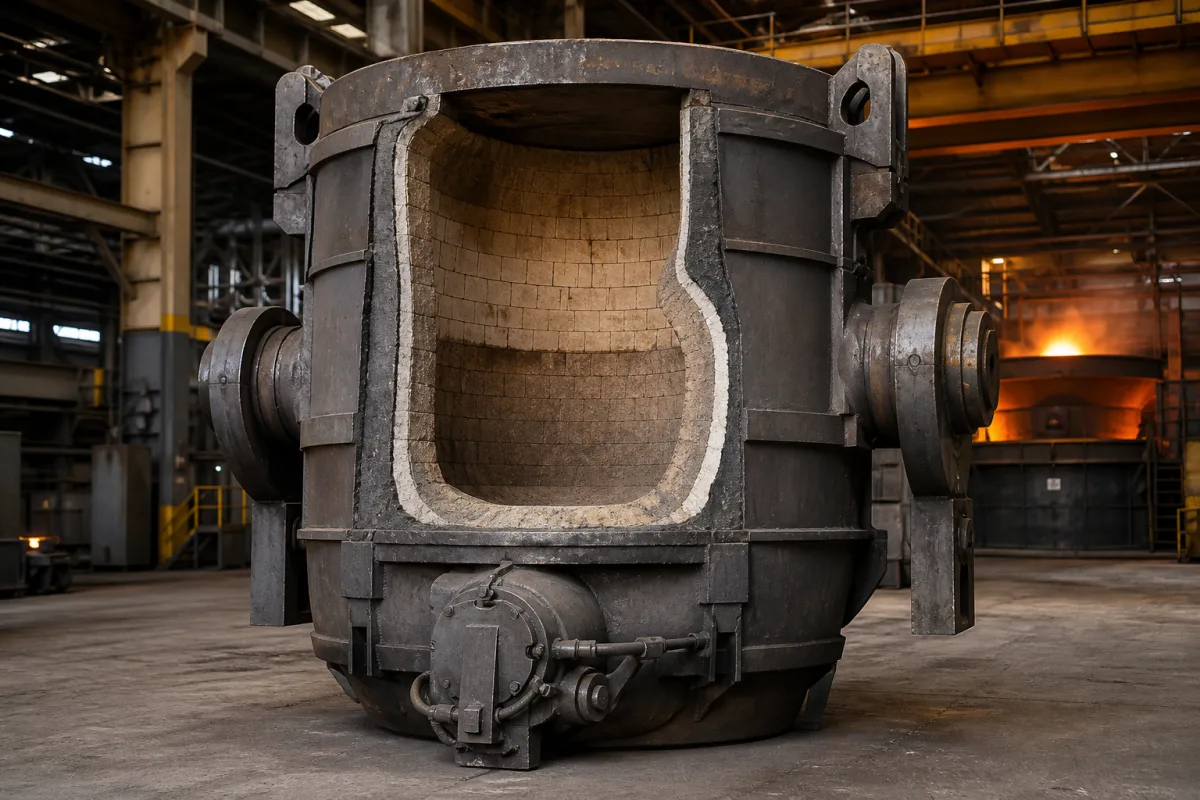
Steel ladles · Lining zones and materials, permanent lining against breakout, drying and preheating, thickness monitoring and repair
A refractory-lined ladle is a steel shell with trunnions, lined with refractory brick and castable, that carries molten steel from the furnace through secondary refining to the caster, and may have a bottom porous plug for argon stirring and a slide gate for teeming. Ask three things first: which refractory goes in each zone for your steel and slag, how the permanent lining protects against breakout, and how the lining is dried, preheated, monitored and repaired.
Molten steel ladles and their refractory linings: wear lining, permanent (safety) lining, impact pad, porous plug and well blocks, plus the shell and trunnions. Tundishes, torpedo (hot-metal) ladles, slag pots, small foundry hand ladles and the slide-gate nozzles themselves are outside this page.
CNFX editorial research · Sources checked October 11, 2026 · 4 sources
Nippon Steel's 2020 technical report describes a ladle that carries steel tapped from a converter or electric arc furnace at temperatures the report places from the upper 1500s to the 1700s °C, serves as a secondary refining vessel and teems into the tundish or moulds. Its representative lining uses magnesia-carbon brick in the slag line for corrosion and structural-spalling resistance, alumina–magnesia monolithic (castable) refractory on the side wall and bottom where steel contacts the lining, and a dense precast alumina–magnesia impact pad where the tapping stream strikes the bottom. [1]
The report traces side-wall materials from high-silica (roseki) brick to zircon brick from the 1960s, alumina–spinel castables in the late 1980s and alumina–magnesia castables in the early 1990s, which densify through MgO·Al₂O₃ and CaO·6Al₂O₃ formation to resist slag penetration; monolithic magnesia–zircon materials were applied in the slag line, but magnesia-carbon brick returned because structural spalling could not be eliminated. Bottom porous plugs for argon stirring use mullite, alumina, magnesite-chrome or magnesia materials, and slide-gate plates and nozzles are mainly carbon–alumina. [1]
RHI Magnesita's ladle portfolio adds alumina–magnesia–carbon brick for the bath area, fired alumina brick for bath, safety lining and insulation, and doloma brick and mixes for wear linings, with fired doloma suited to slag lines in ultra-low-carbon steel because it is carbon-free. [2]
Give the supplier the ladle capacity and shell drawing, steel grades and slag basicity, secondary refining route (stirring, vacuum treatment), tapping temperature, heats per day and current lining life, preheating equipment, repair practice, and whether the scope is the shell, the lining or both.
02
Guard against breakout and manage the lining in service
Nippon Steel stresses that a steel leak through a perforated shell must be absolutely prevented. A permanent lining of refractory brick beneath the wear lining on the side wall and bottom must signal when the wear lining has gone, prompting visual inspection, and must let the current heat finish safely. Nippon Steel says "generally, high alumina bricks are selected in many cases"; magnesia or magnesite-chrome where hot, basic slag contacts it. Two or more layers are desirable because very thin layers can separate or fall off, and exchange criteria should be defined and observed. [1]
Side-wall castables fail by slag-penetration peeling, heat spalling and excessive sintering. The report describes drying castable linings with burner hot air, which must be mild to avoid explosive spalling and therefore slow, or with microwave drying; repair by wet gunning at ambient temperature or hot gunning guided by laser profile measurement of remaining thickness; and online monitoring of remaining refractory by laser profiling or infrared imaging of shell temperature. [1]
RHI Magnesita notes that carbon in magnesia-carbon and alumina-magnesia-carbon bricks (bonding matrix, graphite and carbon black) can burn out during preheating, and offers antioxidant concepts and glaze coatings to protect the brick before first steel contact. It also offers reduced- and zero-emission brick binders to cut smoke during preheating, and insulating permanent linings and ladle lids to reduce heat loss and protect the shell from overheating. [2]
A study of a 230-tonne casting ladle at Liberty Ostrava with VSB-Technical University of Ostrava gives one plant's lining chemistry and what drove its campaign life. The wall and bottom working lining used alumina–magnesia–carbon (AMC) bricks of 84% Al₂O₃, 8.5% MgO, 7% residual carbon and 2.5% SiO₂; the MgO-C slag line is given as 95% MgO and 10% residual carbon. Lining life was measured as the number of castings (continuous-casting cycles) per campaign and modelled with a neural network against operating factors such as empty-ladle time, full-ladle period, tapping temperature from a tandem furnace, argon blown and electricity consumption. In that model longer empty-ladle time and more argon went with more castings, while higher electricity consumption and higher tapping temperature went with fewer. [4]
03
Compare what suppliers offer
Suppliers linked to this page list steel ladles or ladle refractories; each card links to the page reviewed.
Listings include ladle shells, turrets, transfer cars and hooks, and ladle refractories such as magnesia-carbon bricks, castables and bottom materials.
04
Ask for shell temperature and ladle mass for each lining build-up
A peer-reviewed finite-element study by Sun et al. (Frontiers in Bioengineering and Biotechnology, 2022) shows why lining thicknesses should be specified together with the shell temperature and mass they produce. Its model ladle is 4917 mm high with a 40 mm shell, 58192 kg initial mass and 14.35 m³ volume, holding steel at 1,600°C in 20°C ambient air. The authors note that a thicker working layer lowers shell temperature but adds weight and cost, and that the permanent and insulating layers exist to lower shell temperature and prevent high-temperature creep of the shell. [3]
In the paper's optimised design, adding an 8.02 mm insulating layer behind a 76.20 mm permanent layer and 148.61 mm working layer, in place of 0, 81 and 152 mm, cut the maximum shell temperature from 214.46°C to 149.25°C (30.41%) and total ladle mass from 59020 kg to 58225 kg, with lining stress almost unchanged (43.94 to 43.66 MPa). These are simulation results for one ladle geometry; ask suppliers for the modelled or measured shell temperature of the build-up they quote. [3]
Fill the specification fields with values for your shop
A ladle quotation needs values for your steelmaking route. The table explains each field, gives published values where a reviewed source states them, and says what to obtain from the supplier.
Explore company information and manufacturing capabilities, then discuss the scope of your project with a relevant supplier.
Share this page
Compiled and source-reviewed by the CNFX editorial team.
Published product pages show what a company offers, not tested performance. Confirm the legal seller, factory and scope for your order. How we source and review
· Page last updated 13 October 2026
Buyer questions
What refractories line a steel ladle?
Nippon Steel describes magnesia-carbon brick in the slag line, alumina–magnesia castable on walls and bottom, and a dense precast impact pad. [1]
What does the permanent lining do?
It signals that the wear lining has gone and lets the heat finish safely; two or more layers are desirable. [1]
Why protect MgO-C bricks during preheating?
RHI Magnesita notes that carbon can burn out during preheating, reducing lining life, and offers antioxidants and glaze coatings. [2]
How much does an insulating layer lower ladle shell temperature?
In a 2022 finite-element study published in Frontiers in Bioengineering and Biotechnology, adding an 8.02 mm insulating layer and slightly thinning the other layers cut the modelled maximum shell temperature from 214.46°C to 149.25°C. [3]
What does a steel ladle working lining contain?
In a 230-tonne ladle at Liberty Ostrava, the wall and bottom used alumina–magnesia–carbon bricks of 84% Al₂O₃, 8.5% MgO, 7% residual carbon and 2.5% SiO₂, with an MgO-C slag line. [4]
Sources and what still needs a direct check
Sources checked 2026-10-11. Nippon Steel's report describes its own practice; RHI Magnesita is a refractory maker describing its own products; the Frontiers and VSB-Technical University of Ostrava papers report modelled and plant results for particular ladles. Lining choices depend on your steel, slag and route.