Industry-Verified Manufacturing Data (2026)

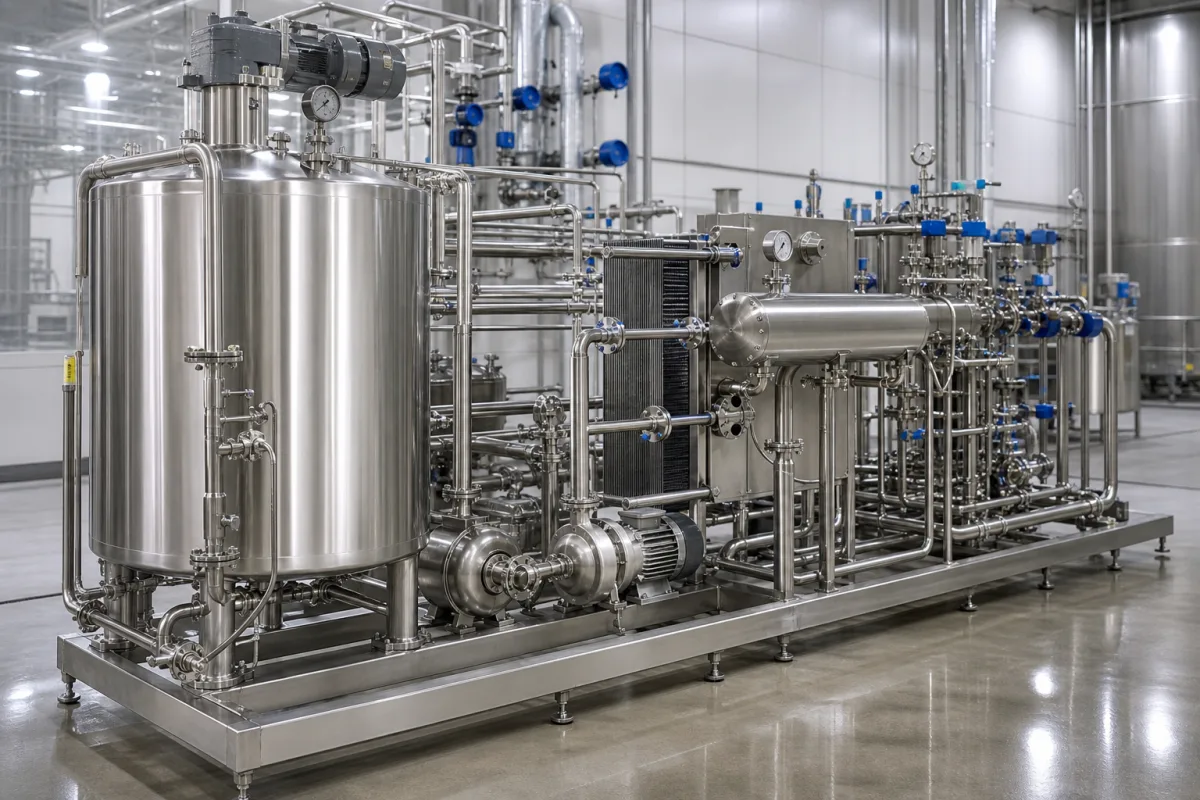
Automated Beverage Blending and Carbonation System

Based on aggregated insights from multiple verified factory profiles within the CNFX directory, the standard Automated Beverage Blending and Carbonation System used in the Beverage Manufacturing sector typically supports operational capacities ranging from standard industrial configurations to heavy-duty production requirements.

Technical Definition & Core Assembly

A canonical Automated Beverage Blending and Carbonation System is characterized by the integration of Proportioning Dosing Unit and In-Line Blender. In industrial production environments, manufacturers listed on CNFX commonly emphasize Stainless Steel 316L construction to support stable, high-cycle operation across diverse manufacturing scenarios.

Integrated industrial system for precise beverage formulation, mixing, and carbonation.

Product Specifications

Technical details and manufacturing context for Automated Beverage Blending and Carbonation System

Definition
A complete industrial production system designed for the precise formulation, blending, and carbonation of non-alcoholic beverages. It integrates ingredient dosing, water treatment, syrup mixing, and carbon dioxide injection into a coordinated, automated line. This system is critical for B2B manufacturing of consistent, high-volume products like soft drinks, sparkling waters, and carbonated juices. It ensures product uniformity, optimizes ingredient usage, and interfaces directly with upstream water treatment and downstream filling lines.
Working Principle
The system meters precise volumes of water, syrup concentrates, and additives into a blending tank under controlled conditions. The mixture is then chilled and subjected to high-pressure carbon dioxide injection in a carbonator unit, dissolving the CO2 to achieve the target carbonation level before transfer to the filling station.
Common Materials
Stainless Steel 316L, Food-Grade Elastomers, Sanitary Tubing
Technical Parameters
  • Maximum system throughput capacity (Liters/hour) Per Request
  • Final beverage sugar concentration accuracy (Brix) Per Request
Components / BOM
  • Proportioning Dosing Unit
    Precisely meters and injects syrup, water, and additives into the blend stream
    Material: Stainless Steel 316L
  • In-Line Blender
    Continuously mixes ingredients to achieve a homogeneous solution
    Material: Stainless Steel 316L
  • Carbonation Vessel
    Chills the beverage and injects CO2 under pressure for dissolution
    Material: Stainless Steel 316L
  • PLC Control Panel
    Automates and monitors the entire blending and carbonation process
    Material: Powder-Coated Steel
Engineering Reasoning
0.5-6.0 bar
8.2 bar at 20°C for carbonation vessel
Design Rationale: Yield strength of 316L stainless steel (205 MPa) exceeded at 8.2 bar internal pressure with 2.0 mm wall thickness
Risk Mitigation (FMEA)
Trigger CO2 pressure regulator diaphragm rupture at 10 bar upstream pressure
Mode: Carbonation level drops below 2.4 volumes CO2
Strategy: Dual redundant regulators with 15 bar burst pressure rating
Trigger Syrup pump cavitation at NPSH below 0.8 m
Mode: Flow rate deviation exceeds ±2% from 50 L/min setpoint
Strategy: Positive displacement pump with 1.2 m NPSH margin at maximum flow

Industry Taxonomies & Aliases

Commonly used trade names and technical identifiers for Automated Beverage Blending and Carbonation System.

Industrial Ecosystem & Supply Chain DNA

Complementary Systems
Downstream Applications
Specialized Tooling

Application Fit & Sizing Matrix

Operational Limits
pressure: 0 to 6 bar (carbonation), 0 to 3 bar (mixing/blending)
flow rate: 100 to 5000 L/hr (adjustable per configuration)
temperature: 2°C to 40°C (operating), -10°C to 60°C (storage)
slurry concentration: Up to 30% solids by weight (non-abrasive particulates)
Media Compatibility
✓ Carbonated soft drinks (CSD) ✓ Flavored water and seltzers ✓ Alcoholic RTD beverages (low viscosity)
Unsuitable: Highly abrasive slurries or corrosive chemicals (e.g., hydrochloric acid solutions)
Sizing Data Required
  • Required production capacity (L/hr)
  • Target carbonation level (volumes of CO2)
  • Beverage viscosity and particulate content

Reliability & Engineering Risk Analysis

Failure Mode & Root Cause
Corrosion and scaling in carbonation components
Cause: Exposure to carbonated water and dissolved CO2 creates acidic conditions that corrode metal surfaces, while mineral deposits from water form scale that reduces efficiency and causes blockages.
Pump and valve seal degradation
Cause: Continuous exposure to high-pressure CO2 and beverage ingredients causes elastomer seals to harden, crack, or swell, leading to leaks and pressure loss in the blending and carbonation system.
Maintenance Indicators
  • Inconsistent carbonation levels or foaming in final product, indicating pressure regulation failure or CO2 system leaks
  • Unusual grinding or whining noises from pumps or motors, suggesting bearing wear, cavitation, or mechanical obstruction
Engineering Tips
  • Implement routine water quality monitoring and treatment to control pH and mineral content, preventing corrosion and scaling in carbonation tanks, lines, and valves
  • Establish a preventive maintenance schedule for seal replacement and lubrication of moving parts, using food-grade compatible materials to withstand chemical exposure and pressure cycles

Compliance & Manufacturing Standards

Reference Standards
ISO 22000:2018 - Food safety management systems ANSI/NSF 61 - Drinking water system components CE - Machinery Directive 2006/42/EC
Manufacturing Precision
  • Carbonation pressure: +/- 0.05 bar
  • Blending ratio accuracy: +/- 0.5% volume
Quality Inspection
  • Pressure vessel hydrostatic test
  • Beverage microbiological contamination test

Factories Producing Automated Beverage Blending and Carbonation System

Verified manufacturers with capability to produce this product in China

✓ 93% Supplier Capability Match Found

P Procurement Specialist from Germany Jan 19, 2026
★★★★★
"Found 41+ suppliers for Automated Beverage Blending and Carbonation System on CNFX, but this spec remains the most cost-effective."
Technical Specifications Verified
T Technical Director from Brazil Jan 16, 2026
★★★★★
"The technical documentation for this Automated Beverage Blending and Carbonation System is very thorough, especially regarding Blending Capacity (L/h)."
Technical Specifications Verified
P Project Engineer from Canada Jan 13, 2026
★★★★★
"Reliable performance in harsh Beverage Manufacturing environments. No issues with the Automated Beverage Blending and Carbonation System so far."
Technical Specifications Verified
Verification Protocol

“Feedback is collected from verified sourcing managers during RFQ (Request for Quote) and factory evaluation processes on CNFX. These reports represent historical performance data and technical audit summaries from our B2B manufacturing network.”

5 sourcing managers are analyzing this specification now. Last inquiry for Automated Beverage Blending and Carbonation System from USA (19m ago).

Supply Chain Commonly Integrated Components

Sanitary Flow Meter

A precision instrument designed to measure the volumetric or mass flow rate of liquids in hygienic processing environments, featuring smooth surfaces and cleanable designs to prevent contamination.

Explore Specs →
Ingredient Inlet Valve Manifold

A multi-port valve assembly that controls and directs the flow of liquid ingredients into an automated beverage blending system.

Explore Specs →
In-line Mixer/Static Mixer

A stationary mixing device installed directly in a pipeline that blends beverage ingredients through geometric flow manipulation without moving parts.

Explore Specs →
Human-Machine Interface (HMI)

A hardware and software interface that allows human operators to monitor, control, and interact with the automated beverage blending system.

Explore Specs →

Frequently Asked Questions

What materials are used in this beverage blending system to ensure food safety?

The system is constructed with Stainless Steel 316L, food-grade elastomers, and sanitary tubing to meet strict hygiene standards for non-alcoholic beverage production.

How does the system maintain precise mixing accuracy for beverage formulation?

It utilizes an in-line blender and proportioning dosing unit controlled by a PLC panel to achieve consistent mixing accuracy, ensuring uniform beverage quality.

What is the carbonation level range this system can achieve?

The system offers adjustable carbonation levels measured in volumes of CO2, suitable for various non-alcoholic beverage types from lightly sparkling to highly carbonated drinks.

Can I contact factories directly on CNFX?

CNFX is an open directory, not a transaction platform. Each factory profile provides direct contact information and production details to help you initiate direct inquiries with Chinese suppliers.

Get Quote for Automated Beverage Blending and Carbonation System

Request technical pricing, lead times, or customized specifications for Automated Beverage Blending and Carbonation System directly from verified manufacturing units.

Your business information is encrypted and only shared with verified Automated Beverage Blending and Carbonation System suppliers.

Thank you! Your message has been sent. We'll respond within 1–3 business days.

Need to Manufacture Automated Beverage Blending and Carbonation System?

Connect with verified factories specializing in this product category

Add Your Factory Contact Us
Previous Product
Automated Beverage Batch Blending System
Next Product
Automated Beverage Bottle Inspection System