Industry-Verified Manufacturing Data (2026)

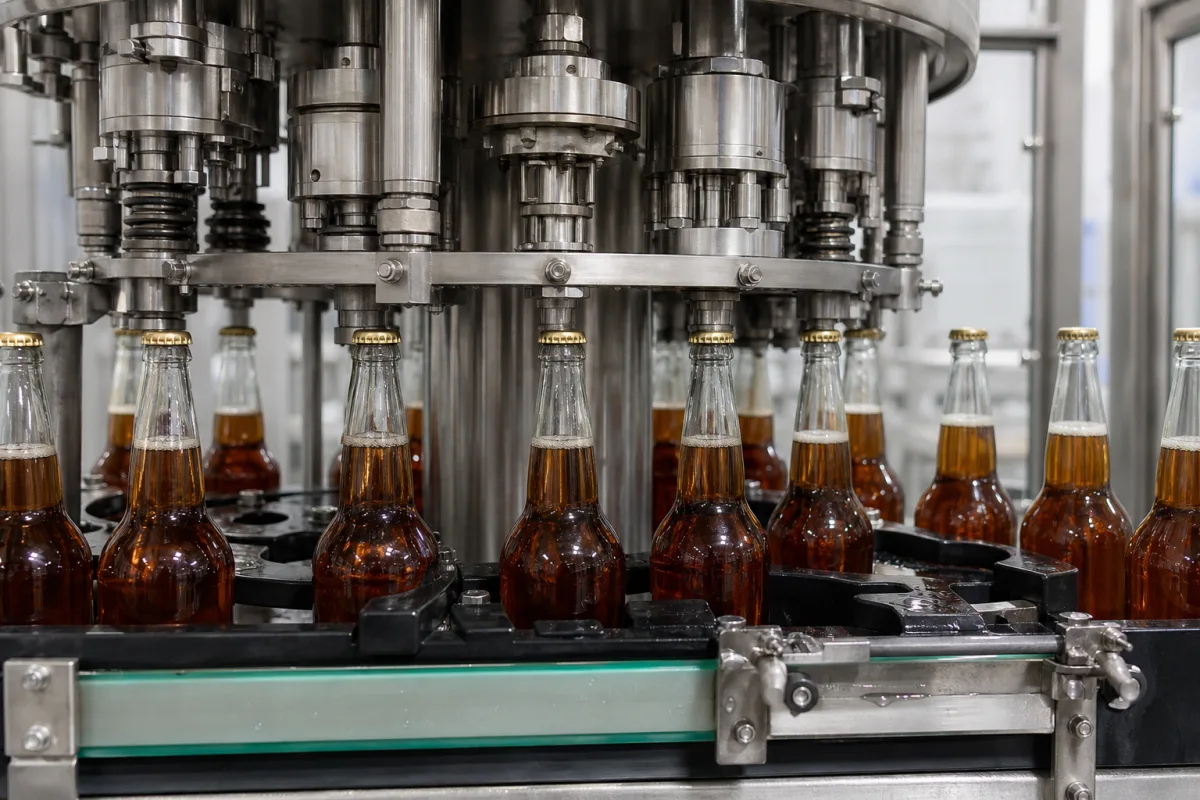
Automated Bottle Capping Machine

Based on aggregated insights from multiple verified factory profiles within the CNFX directory, the standard Automated Bottle Capping Machine used in the Beverage Manufacturing sector typically supports operational capacities ranging from standard industrial configurations to heavy-duty production requirements.

Technical Definition & Core Assembly

A canonical Automated Bottle Capping Machine is characterized by the integration of Cap Hopper and Capping Spindle Head. In industrial production environments, manufacturers listed on CNFX commonly emphasize Stainless Steel 316L construction to support stable, high-cycle operation across diverse manufacturing scenarios.

Industrial machine for applying and sealing caps on beverage bottles at high speed
Product Specifications

Technical details and manufacturing context for Automated Bottle Capping Machine

Definition
An automated industrial device designed for the final packaging stage in alcoholic beverage production lines. It precisely applies and seals caps onto filled bottles of beer, wine, or spirits at high throughput rates. The machine ensures consistent torque application for proper seal integrity, preventing contamination and preserving product quality. It integrates seamlessly with upstream filling and downstream labeling systems to create a complete packaging solution for beverage manufacturers.
Working Principle
Uses a rotary or linear motion system to transport bottles through capping stations where caps are fed from a hopper, placed on bottle necks, and mechanically torqued to specified tightness using spindle heads or chuck mechanisms.
Common Materials
Stainless Steel 316L, Food-Grade Plastics, Anodized Aluminum
Technical Parameters
  • Maximum production capacity (bottles/hour) Customizable
  • Bottle neck diameter range (mm) Customizable
Components / BOM
  • Cap Hopper
    Stores and feeds caps to the capping mechanism
    Material: Stainless Steel 304
  • Capping Spindle Head
    Applies precise rotational torque to secure caps
    Material: Hardened Steel
  • Bottle Transport Conveyor
    Moves bottles through capping stations
    Material: Food-Grade Plastic Belt
  • PLC Control System
    Automates machine operation and monitors performance
    Material: Electronic Components
  • Torque Monitoring Sensor Optional
    Measures and verifies applied capping torque
    Material: Strain Gauge Elements
Engineering Reasoning
0.8-1.2 N·m torque at 1200-1800 rpm capping head rotation
Cap torque exceeds 1.5 N·m or falls below 0.5 N·m, causing thread stripping or insufficient seal
Design Rationale: Plastic deformation of bottle threads (PET material yield strength: 55 MPa) or cap liner compression beyond elastic limit (EPDM liner compression set >25%)
Risk Mitigation (FMEA)
Trigger Servo motor encoder feedback loss due to EMI from adjacent 480V AC drives
Mode: Torque control failure leading to over-tightening and bottle neck fracture
Strategy: Shielded encoder cables with ferrite cores and 30 dB EMI filtering at 10-100 MHz frequency range
Trigger Cap feeder vibratory bowl amplitude drift beyond ±0.2 mm due to spring fatigue (S-N curve degradation at 10⁷ cycles)
Mode: Cap misalignment causing jamming and production line stoppage
Strategy: Piezoelectric amplitude sensors with 0.01 mm resolution and automatic spring preload adjustment via PID control (Kp=2.5, Ki=0.1, Kd=0.05)

Industry Taxonomies & Aliases

Commonly used trade names and technical identifiers for Automated Bottle Capping Machine.

Industrial Ecosystem & Supply Chain DNA

Complementary Systems
Downstream Applications
Specialized Tooling

Application Fit & Sizing Matrix

Operational Limits
pressure: 0.5 to 6 bar (cap application pressure)
other spec: Bottle diameter: 30-120 mm, Cap diameter: 15-60 mm, Speed: 100-600 bottles/min
temperature: 5°C to 40°C (operating environment)
Media Compatibility
✓ PET beverage bottles ✓ Glass bottles with threaded caps ✓ Aluminum cans with screw caps
Unsuitable: High-viscosity products requiring heated capping (e.g., honey, syrup)
Sizing Data Required
  • Bottle production rate (units/hour)
  • Bottle diameter and neck finish specifications
  • Cap type and torque requirements

Reliability & Engineering Risk Analysis

Failure Mode & Root Cause
Cap Misalignment or Jamming
Cause: Worn or misaligned capping heads, accumulation of debris or adhesive residue on conveyor belts, or sensor calibration drift leading to improper cap positioning and feed.
Torque Inconsistency
Cause: Degradation of torque control mechanisms such as slipping clutches, pneumatic pressure fluctuations, or wear in drive components (gears, belts) resulting in under-tightened or over-tightened caps.
Maintenance Indicators
  • Audible grinding, squealing, or irregular knocking sounds from the capping head or drive assembly during operation.
  • Visual increase in rejected bottles due to skewed, loose, or missing caps, or visible residue buildup on capping components.
Engineering Tips
  • Implement a routine cleaning and inspection schedule for capping heads, sensors, and conveyors to prevent debris accumulation and ensure precise alignment.
  • Establish a preventive maintenance program for torque calibration and component wear checks, including lubrication of moving parts and replacement of worn belts or gears before failure.

Compliance & Manufacturing Standards

Reference Standards
ISO 9001:2015 - Quality management systems CE Marking - Machinery Directive 2006/42/EC ANSI/ASME B46.1-2019 - Surface Texture
Manufacturing Precision
  • Cap thread pitch: +/-0.01mm
  • Capping torque repeatability: +/-2%
Quality Inspection
  • Torque verification test
  • Leak detection test (pressure decay method)

Factories Producing Automated Bottle Capping Machine

Verified manufacturers with capability to produce this product in China

✓ 97% Supplier Capability Match Found

S Sourcing Manager from Canada Mar 01, 2026
★★★★★
"Reliable performance in harsh Beverage Manufacturing environments. No issues with the Automated Bottle Capping Machine so far."
Technical Specifications Verified
P Procurement Specialist from United States Feb 26, 2026
★★★★☆
"Testing the Automated Bottle Capping Machine now; the Production Speed (bottles/hour) results are within 1% of the laboratory datasheet. (Delivery took slightly longer than expected, but technical support was excellent.)"
Technical Specifications Verified
T Technical Director from United Arab Emirates Feb 23, 2026
★★★★★
"Impressive build quality. Especially the Production Speed (bottles/hour) is very stable during long-term operation."
Technical Specifications Verified
Verification Protocol

“Feedback is collected from verified sourcing managers during RFQ (Request for Quote) and factory evaluation processes on CNFX. These reports represent historical performance data and technical audit summaries from our B2B manufacturing network.”

9 sourcing managers are analyzing this specification now. Last inquiry for Automated Bottle Capping Machine from Poland (1h ago).

Supply Chain Commonly Integrated Components

Central Control Unit (PLC)

The programmable logic controller that serves as the central processing and control unit for the automated beverage batch blending system.

Explore Specs →
Precision Metering Pump Assembly

A precision fluid handling component designed to accurately measure and dispense specific volumes of liquid ingredients within an automated beverage blending system.

Explore Specs →
Sanitary Flow Meter

A precision instrument designed to measure the volumetric or mass flow rate of liquids in hygienic processing environments, featuring smooth surfaces and cleanable designs to prevent contamination.

Explore Specs →
Ingredient Inlet Valve Manifold

A multi-port valve assembly that controls and directs the flow of liquid ingredients into an automated beverage blending system.

Explore Specs →

Frequently Asked Questions

What materials are used in this capping machine to ensure food safety?

The machine uses Stainless Steel 316L, food-grade plastics, and anodized aluminum throughout all contact surfaces, meeting strict food safety standards for alcoholic beverage production.

How does the torque monitoring system improve capping quality?

The integrated torque sensor ensures consistent cap tightness for every bottle, preventing under-tightening (leaks) or over-tightening (damage), maintaining product integrity and reducing waste.

Can this machine handle different bottle sizes and cap types?

Yes, with adjustable bottle height and cap diameter ranges, plus quick-change tooling options, it accommodates various bottle formats common in alcoholic beverage manufacturing.

Can I contact factories directly on CNFX?

CNFX is an open directory, not a transaction platform. Each factory profile provides direct contact information and production details to help you initiate direct inquiries with Chinese suppliers.

Get Quote for Automated Bottle Capping Machine

Request technical pricing, lead times, or customized specifications for Automated Bottle Capping Machine directly from verified manufacturing units.

Your business information is encrypted and only shared with verified Automated Bottle Capping Machine suppliers.

Thank you! Your message has been sent. We'll respond within 1–3 business days.

Need to Manufacture Automated Bottle Capping Machine?

Connect with verified factories specializing in this product category

Add Your Factory Contact Us
Previous Product
Automated Beverage Labeling and Coding System
Next Product
Automated CIP/SIP System for Beverage Production