Industry-Verified Manufacturing Data (2026)

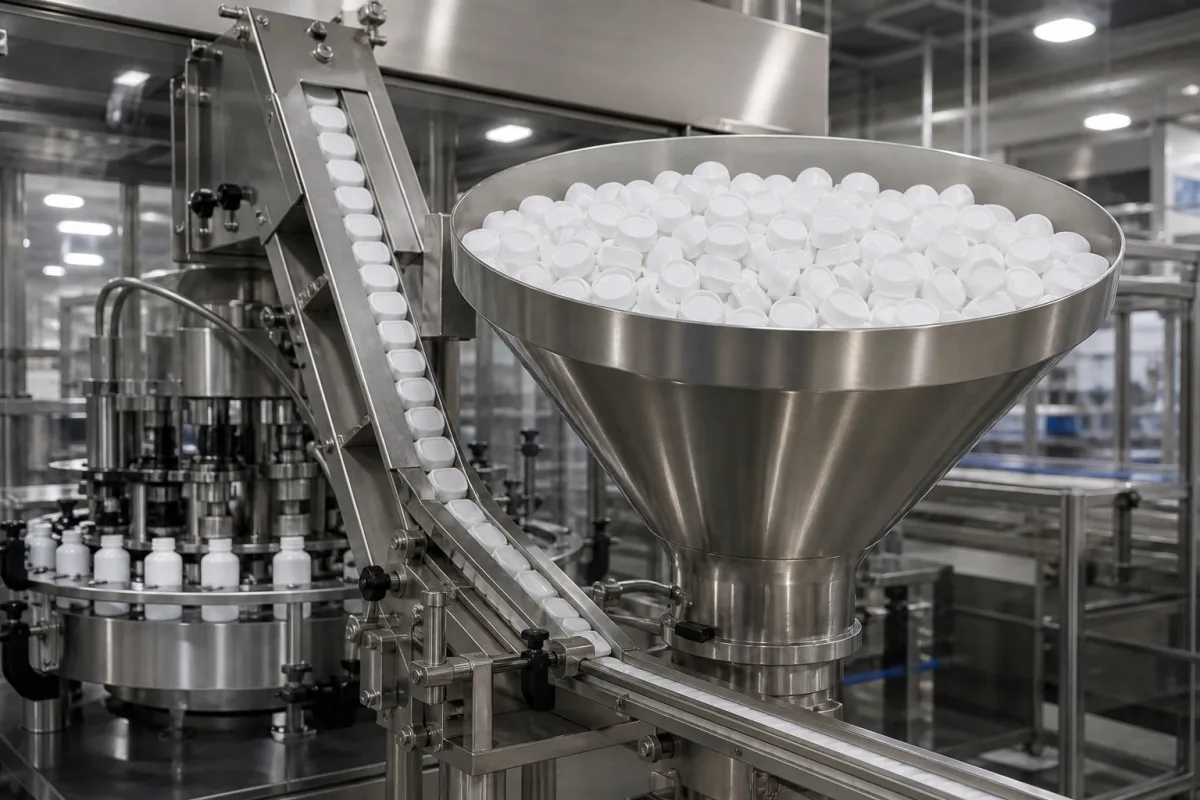
Cap Hopper

Based on aggregated insights from multiple verified factory profiles within the CNFX directory, the standard Cap Hopper used in the Machinery and Equipment Manufacturing sector typically supports operational capacities ranging from standard industrial configurations to heavy-duty production requirements.

Technical Definition & Core Assembly

A canonical Cap Hopper is characterized by the integration of Vibration Mechanism and Orientation Tracks. In industrial production environments, manufacturers listed on CNFX commonly emphasize Stainless Steel construction to support stable, high-cycle operation across diverse manufacturing scenarios.

A storage and feeding component in automated capping systems that holds and dispenses bottle caps in an organized manner.

Product Specifications

Technical details and manufacturing context for Cap Hopper

Definition
The Cap Hopper is an essential part of Automated Bottle Capping Machines, serving as the primary storage and feeding mechanism for bottle caps. It maintains a controlled supply of caps, ensuring consistent and reliable delivery to the capping station. This component typically includes features to prevent cap jamming, maintain orientation, and regulate flow, contributing to the overall efficiency and reliability of the capping process.
Working Principle
The Cap Hopper operates by storing a bulk quantity of bottle caps and using mechanical agitation, vibration, or gravity-fed mechanisms to orient and feed caps individually or in batches to the downstream capping mechanism. It ensures caps are properly aligned and delivered at the required rate to match the production line speed.
Common Materials
Stainless Steel, Food-Grade Plastic
Technical Parameters
  • Hopper opening diameter compatible with cap dimensions (mm) Customizable
Components / BOM
  • Vibration Mechanism
    Agitates caps to prevent bridging and ensure consistent flow
    Material: Stainless Steel
  • Orientation Tracks
    Guides caps into proper alignment for feeding
    Material: Stainless Steel
  • Level Sensor
    Monitors cap quantity and triggers refill alerts
    Material: Plastic/Electronic Components
Engineering Reasoning
0.5-2.0 bar feed pressure, 15-35°C ambient temperature, 40-70% relative humidity
Cap jam occurs at >3.0 bar feed pressure differential, >85% humidity causing cap adhesion, or <10°C causing lubricant viscosity increase beyond 500 cP
Design Rationale: Cap adhesion failure due to electrostatic charge accumulation exceeding 5 kV/m, or mechanical jamming from dimensional tolerance stack-up exceeding ±0.2 mm in cap orientation mechanisms
Risk Mitigation (FMEA)
Trigger Electrostatic charge accumulation on polypropylene caps exceeding 3 kV surface potential
Mode: Cap adhesion to hopper walls causing feed interruption
Strategy: Install ionizing air curtain with 1.2 MHz AC ionization and maintain surface resistivity below 10^9 Ω/sq
Trigger Wear particle accumulation in linear guide rails exceeding 50 mg/m³ concentration
Mode: Increased friction coefficient from 0.15 to >0.35 causing mechanism binding
Strategy: Implement magnetic filtration system with 5 μm particle capture and automated purge cycle every 5000 cycles

Industry Taxonomies & Aliases

Commonly used trade names and technical identifiers for Cap Hopper.

Industrial Ecosystem & Supply Chain DNA

Complementary Systems
Downstream Applications
Specialized Tooling

Application Fit & Sizing Matrix

Operational Limits
pressure: Atmospheric (non-pressurized)
other spec: Cap feed rate: 50-300 caps/min, Cap size range: 15-70mm diameter
temperature: -10°C to 80°C
Media Compatibility
✓ Plastic bottle caps (HDPE, PP) ✓ Metal bottle caps (aluminum, tinplate) ✓ Composite caps with liners
Unsuitable: Highly abrasive or corrosive particulate media (e.g., metal shavings, acidic powders)
Sizing Data Required
  • Cap dimensions (diameter, height, shape)
  • Required throughput (caps per minute)
  • Available footprint and hopper capacity (liters)

Reliability & Engineering Risk Analysis

Failure Mode & Root Cause
Material fatigue cracking
Cause: Cyclic stress from repeated loading/unloading operations causing micro-cracks that propagate through hopper walls or support structures
Wear and abrasion at discharge points
Cause: Friction from material flow against hopper surfaces, especially at chutes, gates, or valves, leading to thinning and eventual perforation
Maintenance Indicators
  • Visible material leakage or dust emission from seams, welds, or joints indicating structural compromise
  • Unusual vibrations or audible grinding noises during operation suggesting internal obstructions or excessive wear
Engineering Tips
  • Implement regular ultrasonic thickness testing at high-wear areas to monitor material loss and schedule proactive repairs before failure occurs
  • Install and maintain proper liner systems (e.g., abrasion-resistant plates, polymer coatings) at critical wear points to protect base material and extend service life

Compliance & Manufacturing Standards

Reference Standards
ISO 9001:2015 Quality Management Systems ASTM A370 Standard Test Methods and Definitions for Mechanical Testing of Steel Products CE Marking for Pressure Equipment Directive 2014/68/EU
Manufacturing Precision
  • Bore Diameter: +/-0.05mm
  • Surface Flatness: 0.08mm per 100mm
Quality Inspection
  • Dimensional Verification with CMM (Coordinate Measuring Machine)
  • Material Composition Analysis via Spectrometer

Factories Producing Cap Hopper

Verified manufacturers with capability to produce this product in China

✓ 94% Supplier Capability Match Found

T Technical Director from United Arab Emirates Jan 30, 2026
★★★★★
"Reliable performance in harsh Machinery and Equipment Manufacturing environments. No issues with the Cap Hopper so far."
Technical Specifications Verified
P Project Engineer from Australia Jan 27, 2026
★★★★☆
"Testing the Cap Hopper now; the technical reliability results are within 1% of the laboratory datasheet. (Delivery took slightly longer than expected, but technical support was excellent.)"
Technical Specifications Verified
S Sourcing Manager from Singapore Jan 24, 2026
★★★★★
"Impressive build quality. Especially the technical reliability is very stable during long-term operation."
Technical Specifications Verified
Verification Protocol

“Feedback is collected from verified sourcing managers during RFQ (Request for Quote) and factory evaluation processes on CNFX. These reports represent historical performance data and technical audit summaries from our B2B manufacturing network.”

11 sourcing managers are analyzing this specification now. Last inquiry for Cap Hopper from Poland (39m ago).

Supply Chain Compatible Machinery & Devices

Hydraulic Press

Industrial machine using hydraulic pressure to compress, form, or assemble materials

Explore Specs →
Heavy-Duty CNC Plasma Cutting Machine

Industrial machine for precision metal cutting using plasma arc technology

Explore Specs →
Automated Assembly Line System

Integrated production system for sequential component assembly operations

Explore Specs →
Automated Powder Coating System

Integrated industrial system for applying dry powder coatings to metal substrates.

Explore Specs →

Frequently Asked Questions

What materials are used in the Cap Hopper to ensure hygiene and durability?

The Cap Hopper is constructed from stainless steel for structural durability and food-grade plastic for contact surfaces, ensuring compliance with hygiene standards in food, beverage, and pharmaceutical manufacturing.

How does the Cap Hopper maintain consistent cap feeding in automated systems?

It uses a vibration mechanism to gently agitate caps, orientation tracks to align them correctly, and a level sensor to monitor inventory and prevent jams or shortages, ensuring smooth, uninterrupted operation.

Can the Cap Hopper be integrated with existing automated capping machinery?

Yes, the Cap Hopper is designed as a modular component with standard interfaces, making it compatible with most automated capping systems in machinery and equipment manufacturing for easy upgrades or replacements.

Can I contact factories directly on CNFX?

CNFX is an open directory, not a transaction platform. Each factory profile provides direct contact information and production details to help you initiate direct inquiries with Chinese suppliers.

Get Quote for Cap Hopper

Request technical pricing, lead times, or customized specifications for Cap Hopper directly from verified manufacturing units.

Your business information is encrypted and only shared with verified Cap Hopper suppliers.

Thank you! Your message has been sent. We'll respond within 1–3 business days.

Need to Manufacture Cap Hopper?

Connect with verified factories specializing in this product category

Add Your Factory Contact Us
Previous Product
Cap Feeding System
Next Product
Cap Hopper & Elevator