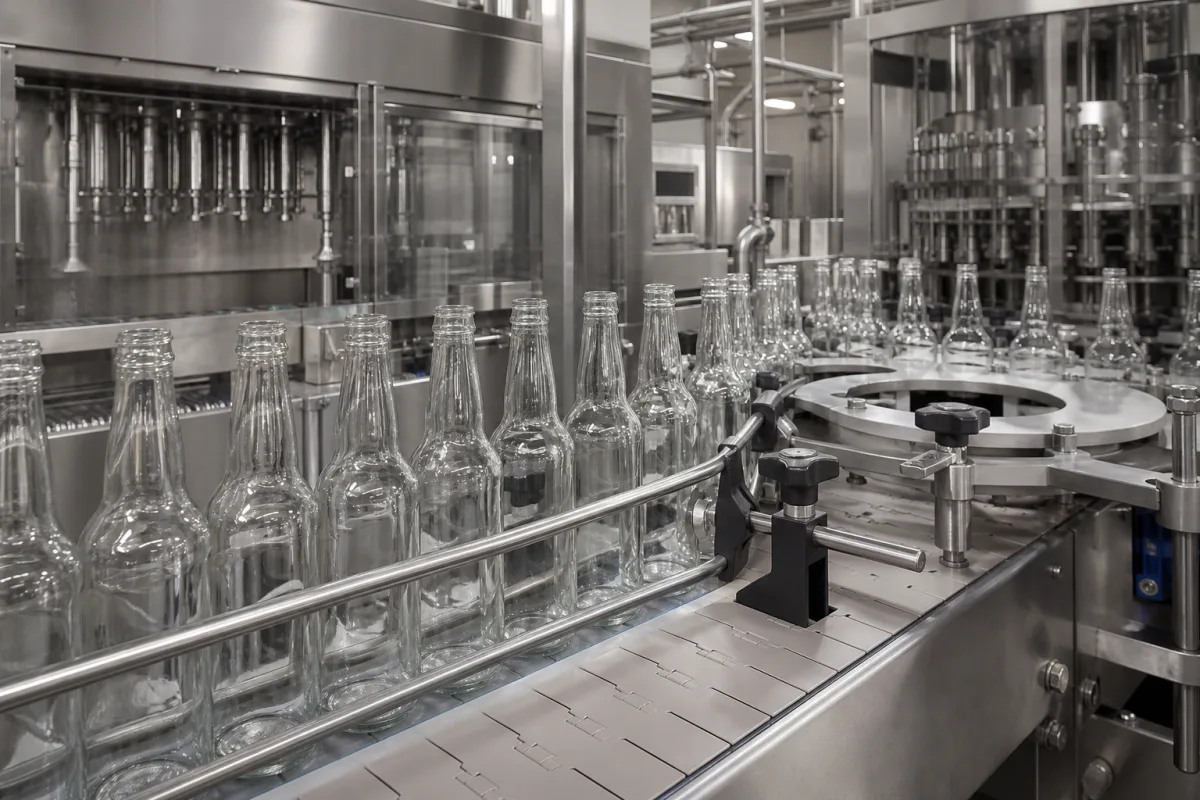
Lubricated bottle transport conveyor: wet, semi-dry and dry track lubrication for glass and PET bottles on stainless and plastic chains
The lubricated track that carries glass and PET bottles between filler, capper and labeller · wet soap-and-water at 100 to 500 parts water, semi-dry sprays switched on and off, or dry-running with no water, judged by the friction between bottle and chain
Wherever bottles queue on a conveyor that keeps moving, such as in front of a filler infeed star, a capper or a labeller, the chain slides under the bottles. Too much friction and the bottles at the back push the front ones over; too little and bottles skate and cannot climb a slight incline. The conveyor is therefore lubricated, and the way it is lubricated decides how wet the floor is, how dirty the bottles get and how much water the line uses.
Lubrication of bottle and container transport conveyors in beverage and food lines: wet dilute, semi-dry and dry lubricants, spray timing and dosing, friction between container and chain and between chain and wear strip, soiling, friction-controlled lubrication and dry-running conversions. TableTop chains, wear strips, guide rails, speed steps and the plastic chain materials chosen for dry running are covered on the Conveyor module for beverage containers page; accumulation after the filler on the Outfeed conveyor of a beverage filler page; guide rails on the Beverage bottle conveyor guide rail page; bulk and unit-load belt conveyors on the Belt conveyor page; and centralised grease and oil systems for machines on the Lubrication system page.
CNFX editorial research · Sources checked October 13, 2026 · 3 sources
Wet lube at 100 to 500 parts water, semi-dry spraying and water-free dry lube
Ecolab's patent sets out why conveyor lubrication moved away from continuous wet spraying: wet lubricants are concentrates diluted with 100 to 500 parts of water, applied at least half the time the conveyor runs or continuously, because friction rises quickly once the watery film drains. [1]
Diversey also states that in the food and beverage industry about 90 % of slips result from wet or contaminated floors, which is its case for removing water from conveyor lubrication. [3] These are the supplier's own claims about its service, not independent measurements.
Editorial note: the choice also depends on container and chain. Ecolab's statement that silicone dry lubricants are less effective on glass on metal matters for a line like the one pictured, where glass bottles run on a stainless slat chain. [1]
Mode
How it is applied
Stated drawbacks or limits
Wet (dilute aqueous)
Diluted 100:1 to 500:1 with water; sprayed or pumped continuously or for at least half the running time [1]
Large water use, run-off to drip pans and drains, a wet environment, and friction sensitive to minerals and alkalinity in the water [1]
Dry
Applied intermittently without dilution, earlier with energised nozzles (high pressure, compressed air or sonication) [1]
Silicone dry lubricants work on PET but are less effective on glass or metal containers, particularly on a metal surface [1]
Semi-dry (Ecolab method)
Dilute emulsion sprayed intermittently; non-application to application time from 2:1 to 32:1 [1]
Film kept at 0.0001 mm or more at the container–conveyor interface between sprays [1]
Dry-running service (Diversey DryFormance)
Water-free lubricant with zonal distribution, after an audit of each conveyor's friction and motor temperatures [3]
Diversey claims up to 100 % less water for conveyor lubrication and plastic belt life extended by at least 100 % [3]
State the containers (glass, PET, cans), chain material (stainless or plastic), line speed, where bottles accumulate, the water quality available, and whether the plant wants to stop using water for conveyor lubrication.
02
Friction on a 6½-inch stainless chain at 51 m/min: 0.10 with heavy residue at dry dosing, 0.17 and clean at semi-dry
Ecolab's short-track test ran 16.5 cm (6½ in) wide austenitic and ferritic stainless straight-running chains at 51 m/min (170 ft/min), with two 12-ounce glass beer bottles tethered to a strain gauge and further bottles held stationary behind them; friction is the drag force divided by the weight of the tethered bottles. Spray nozzles ran at 2.4–3 bar delivering 60–80 mL per minute. [1]
Editorial calculation: 15,260 mL over 20 hours is about 0.76 L per hour per track for the semi-dry cycle, against about 0.05 L per hour in the dry-mode run; the lower-friction dry run left the bottles dirty, so the lowest friction figure is not the target on its own. [1] The patent puts targets on cleanliness as well: on stainless conveyors, acceptable soil levels below 100, 50 or 25 µg of iron per bottle and below 800, 400 or 100 µg of iron per square inch of chain link, and friction kept below about 0.4, 0.2, 0.15 or 0.12 in different embodiments even while lubricant is not being applied. [1]
Friction changes over a shift. Sunbird Investments' patent EP 1 790 968 notes that friction between belt and bottles depends on materials and lubricant but also on ambient temperature and humidity, and that over-lubricated bottles slide and cannot overcome small inclines while under-lubricated bottles braked at an accumulation point overturn. It measures a quantity proportional to that friction with a slider dragged by the belt against a force sensor and doses lubricant to keep the reading within a set range. [2] Ecolab describes a similar feedback loop that switches lubricant on when friction reaches an unacceptable level and off when it returns to an acceptable one. [1]
Conveyor moderately soiled; no black greasy residue [1]
Ask the lubricant or conveyor supplier for measured bottle-to-chain and wear-strip-to-chain friction on your chain, the spray cycle that achieves it, the water and lubricant used per hour, and how residue on bottles and links will be checked.
03
What to send for bottle conveyor lubrication
Paste it into your enquiry below or into an email to a maker, then replace every bracket.
Containers: [glass, PET, cans; sizes; labels]
Chains: [stainless or plastic; width; total conveyor length]
Line: [speed; accumulation points; inclines]
Current practice: [wet, semi-dry or dry; water use; dilution]
Targets: [friction range; water reduction; floor dryness; bottle cleanliness]
Control: [timed spraying or friction feedback; zones]
Explore company information and manufacturing capabilities, then discuss the scope of your project with a relevant supplier.
Share this page
Compiled and source-reviewed by the CNFX editorial team.
Each manufacturer above links to the page on that company's own website where the product is listed, with the date we checked it. How we source and review
· Page last updated 13 October 2026
Buyer questions
What is the difference between wet and dry conveyor lubrication?
Wet lubricants are diluted with 100 to 500 parts of water and sprayed continuously or at least half the time; dry lubricants are applied intermittently without dilution. [1]
What friction is measured between a glass bottle and a lubricated stainless chain?
In Ecolab's 20-hour tests on 6½-inch stainless chains at 51 m/min, bottle-to-track friction was 0.10 in a dry-mode run with heavy residue and about 0.17 in a semi-dry run without black residue. [1]
Can conveyor lubrication follow changing friction automatically?
Sunbird's EP 1 790 968 measures a value proportional to belt-to-bottle friction with a slider and force sensor and regulates the lubricant to keep it within a set range. [2]
Sources and what still needs a direct check
Sources checked 2026-10-13. Friction tests and lubrication modes are from Ecolab's granted European patent EP 2 619 296; friction-controlled dosing from Sunbird Investments' application EP 1 790 968, both read on the EPO publication server; dry-running claims from Diversey's DryFormance fact sheet, published by Solenis.