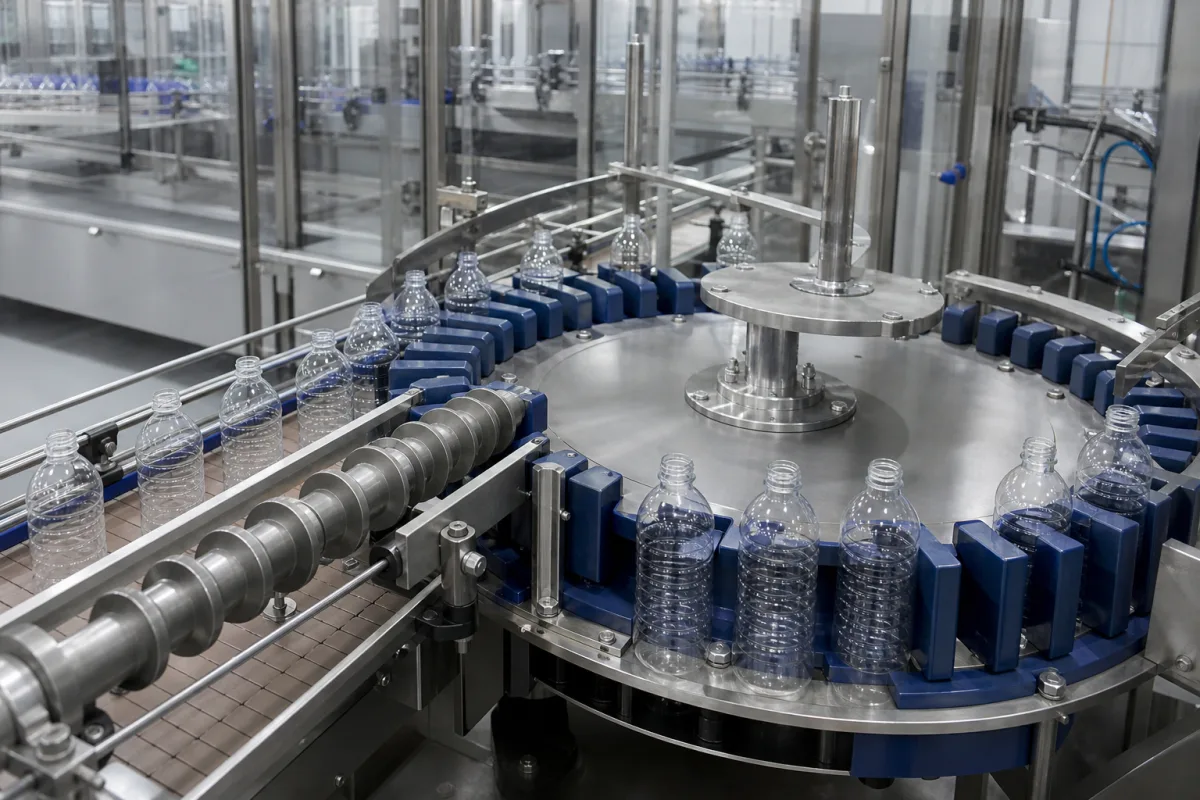
Container infeed starwheel: the hand-off into the pocket, and adjustable-pocket infeed wheels that take a new bottle diameter without change parts
Filler infeed · how a pocket takes the bottle from the conveyor, extended tooth tips against backlash, and infeed starwheels whose pockets adjust to a new bottle diameter instead of being swapped
The infeed starwheel is where a free-standing container on a moving conveyor becomes a container held at a fixed pitch on the filler. Two things decide whether that works: how the pocket and its guide catch the container during the hand-off, before it is seated, and how the wheel is changed when the line moves to another bottle size. A fixed wheel is changed by swapping it and its guides; an adjustable wheel moves its pockets and guide to the new diameter. Four patents show what each approach involves.
Infeed starwheels that take bottles and cans from a conveyor or feed screw into a rotary filler, seamer or other rotary machine, looked at for the geometry of the hand-off into the pocket and for designs whose pockets and guides adjust to a new container diameter: radial push rods, rotatable fingers and stacked rotating disks, with their guide rails. Fixed starwheels as change parts, matching their pocket pitch to the timing screw and turret, and quick-change mounting that speeds up their swap, are covered on the Infeed starwheel (container change part) page; conveyor guide rails on the Beverage bottle conveyor guide rail page; UHMW-PE as a starwheel material on the Star wheel in UHMW-PE for bottle transfer page; the filler turret and its bearing on the Rotating carousel of a rotary bottle filler page; complete fillers on the Rotary bottle filling machine page; feed screws and starwheels of in-line leak testers on their own page.
CNFX editorial research · Sources checked October 13, 2026 · 4 sources
Holding the container before it reaches the pitch circle: extended cycloid tooth tips
Mitsubishi Heavy Industries' patent starts from a fault in plain pockets with semicircular grooves: their teeth end at the pitch circle, so a container delivered by the feed conveyor has nothing in front of it until it reaches the pitch circle and touches the end corner of the groove. Until then it moves with backlash, and on a can seamer infeed, where the can is full and not yet lidded and is travelling at a considerably high speed, this promotes spilling. [1]
The patent's answer is to extend the tip of each tooth outside the pitch circle and shape the extension to the cycloid that the container's centre traces relative to the rotating wheel. The container is then guided by the tooth extension before it enters the groove, and while it is being drawn in it is held front and back and left and right at four points by the guide members, the starwheel and the feed conveyor. The tooth tip can be cut short or rounded instead of left sharp. [1]
Diageo's patent describes the other half of the hand-off. Its infeed wheel and guide rail carry bottles through an arc of about 135° from the straight conveyor to a tangent with the filler's rotating conveyor, presenting them at the required spacing; on a filler, the neck of each bottle must follow a path that passes exactly beneath a filling nozzle. [3] Procter & Gamble's patent adds that the position of the bottle in the direction of travel must also be controlled. [4]
Give the supplier the container drawings with tolerances, whether containers arrive full or empty, the conveyor speed and pitch at the hand-off, and the filler's pitch circle and valve pitch.
02
Push rods, rotatable fingers or a stack of disks: three ways to change the pocket instead of the wheel
All three patents start from the same cost: a fixed starwheel suits one container, so a size change means stopping the machine, swapping wheels and guides and stocking a set for every size. [2][3][4] They differ in what moves.
The P&G patent gives a range of about 4 to 15 pockets, shows 12 pockets and eight disks in its drawings, and names about 30° to 75° from the radial line as the value for the control-surface angle, with one disk's surface close to radial to give draft so the bottle releases. [4] SARCMI states that its aim is to fit a new diameter without changing the pitch circle along which the containers travel, and notes that the guide can be split into more sections with more handwheels for finer adjustment. [2] Diageo's input guide rail is adjustable while its output rail is not. [3]
Editorial calculation: a starwheel with 12 pockets feeding 36,000 containers per hour turns at 36,000 ÷ 12 = 3,000 revolutions per hour, or 50 rpm; with 15 pockets it would turn at 40 rpm. The output figure is an assumed example, not taken from the patents.
Design
What moves to fit a new diameter
How it is set
Limits named in the patents
SARCMI push rods
Radial push rods between two pocketed disks push the container out against an outer guide made in four quarter-circle sections [2]
One handwheel moves all rods through a pinion and gear; another handwheel moves the guide sections [2]
Diageo says the push-rod shape limits the range of sizes, so very different bottles need other rods [3]
Diageo rotatable fingers
A pair of fingers forms each pocket; at least one finger turns on a shaft parallel to the wheel axis to set the pocket width [3]
Setting means hold the finger at any position in its range [3]
Diageo says jaw-type wheels that must open and close around the bottle accept only a small range of sizes and suit round bottles only [3]
Procter & Gamble stacked disks
A stack of rotatable disks, each with a control surface at its own angle; together they form the pocket width and depth [4]
Motors with pinions turn each disk; a computer can take the angles from a CAD model of the bottle at each disk's height [4]
P&G says earlier designs used complex pistons, finger mechanisms or locking pins that limit pocket depth [4]
For an adjustable infeed wheel, ask for the range of diameters and shapes it covers, how pockets and guide are set (handwheel, tool or motor), whether the pitch circle stays fixed through the range, and the time for a size change.
03
For an infeed starwheel quotation
Paste it into your enquiry below or into an email to a maker, then replace every bracket.
Containers: [drawings; diameters; shapes; full or empty]
Machine: [filler or other rotary machine; pitch circle; pitch]
Infeed: [conveyor or feed screw; speed; pitch at hand-off]
Wheel: [fixed change part or adjustable; pocket count]
Adjustment: [push rods, fingers or disks; manual or motor; size range]
Guides: [fixed or adjustable; inlet and outlet]
Changeover: [target minutes]
Explore company information and manufacturing capabilities, then discuss the scope of your project with a relevant supplier.
Share this page
Compiled and source-reviewed by the CNFX editorial team.
Each manufacturer above links to the page on that company's own website where the product is listed, with the date we checked it. How we source and review
· Page last updated 13 October 2026
Buyer questions
Why extend starwheel teeth beyond the pitch circle?
Mitsubishi's patent shapes the tooth tips as a cycloid outside the pitch circle so the container is guided before it seats in the pocket, removing the backlash that promotes spilling at a seamer infeed. [1]
Can one infeed starwheel handle different bottle sizes?
Patents from SARCMI, Diageo and Procter & Gamble describe wheels that adjust push rods, rotatable fingers or a stack of disks, with adjustable guides, instead of swapping the wheel. [2][3][4]
How many pockets does an adjustable starwheel have?
Procter & Gamble's patent gives about 4 to 15 pockets and shows 12. [4]
Sources and what still needs a direct check
Sources checked 2026-10-13. European patents from Mitsubishi Heavy Industries (tooth profile at the hand-off), SARCMI (push-rod adjustable wheel), Diageo (rotatable-finger wheel) and Procter & Gamble (stacked-disk wheel set by motors).