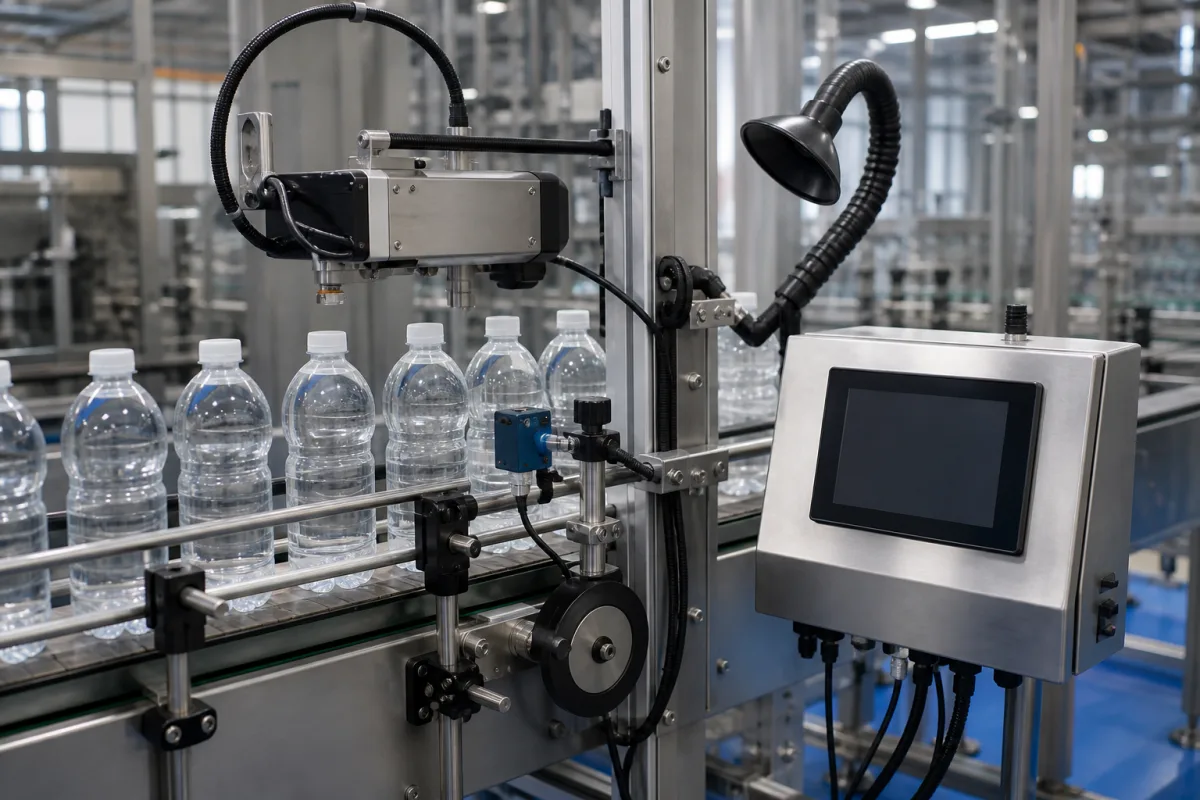
Coding unit (inkjet and laser coders for beverage packaging lines)
Date, lot and code marking on beverage lines · Continuous inkjet against CO2 laser, line speed and character height, throw distance and focal length, codes and bar codes, product-detect and encoder triggering, enclosure and laser safety
A coding unit is the printer or marker on a filling, labelling or packing line that applies best-before dates, lot numbers, times and machine-readable codes to each bottle, can, label, cap or carton as it passes, triggered by a product sensor and synchronised to conveyor travel by an encoder. Ask three things first: what surface and container the code goes on, what the code must contain and how large it must be, and how fast the line runs and where the coder can sit.
Non-contact coders used on beverage and packaging lines: continuous inkjet (CIJ) printers and CO2 laser markers with their heads, controllers, sensors and mounting. Thermal transfer overprinters for film, large-character case coders, labellers and vision code verification are outside this page except where compared.
CNFX editorial research · Sources checked October 11, 2026 · 4 sources
Videojet's data sheet for its 1580 continuous inkjet printer lists single-line fonts from 5×5 to 25×34 dots and up to five lines of 5×5 text, linear bar codes (UPC, EAN, Code 128, Code 39, GS1), QR codes and DataMatrix codes, a heated printhead 41.3 mm in diameter on a 3 m umbilical (6 m optional), 750 ml ink and make-up cartridges, make-up consumption of 5.0 ml per hour (MEK at 20 °C), a reserve tank giving at least 8 hours of extra runtime, storage for more than 250 messages, 100–240 V AC at 70 W and a weight of 21 kg. [1]
Its 3340 data sheet describes a sealed 30 W CO2 laser that marks by steering the beam with galvanometer scanners: wavelengths of 10.6, 10.2 and 9.3 µm, fonts, bar codes, 2D codes and graphics, automatic date and time coding, air cooling, a laser source life of up to 45,000 hours, 100–240 V AC at 0.70 kW, supply and marking units in IP54 (IP65 optional) and laser safety to IEC/EN 60825-1:2014, with an optional safety module to Performance Level d under EN 13849-1. [2]
iBottling lists a flying CO2 laser date coder for non-contact coding on PET and glass bottles and cartons after sample review, with 9.3 µm and 10.6 µm wavelength options and source power bands of 30 W and 40 W or more, and stresses a stable code window, a head kept in its focal zone and contrast sufficient for downstream verification. [3]
Editorial note: inkjet adds ink to the surface and uses ink and make-up fluid, while a laser changes the surface itself and uses no ink; which one gives a readable, permanent code depends on the substrate, so run code samples on your bottles, caps, labels or cartons before choosing.
Give the supplier the containers and surfaces to be coded (material, colour, coating, wet or dry, curved or flat), code content and layout (dates, lot, time, bar or 2D codes), character height and position, line speed and container pitch, mounting space and distance to the product, environment (humidity, temperature, wash-down), interfaces to the line and verification, and safety requirements.
02
Set speed, mark size and triggering
The 1580 prints 1 to 5 lines at up to 278 m/min (914 ft/min, measured for one line at 10 characters per inch) with nominal character heights selectable from 2 mm to 10 mm depending on font, at a throw distance of 12 mm optimal within a 5–15 mm range; it takes product-detect and encoder inputs and gives beacon and relay outputs, USB and Ethernet, and runs from 0 to 50 °C and 0–90% RH non-condensing in an IP55 stainless cabinet with IP65 electronics as an option. [1]
The 3340 is rated up to 2,000 characters per second, line speeds up to 15 m/s and up to 150,000 products per hour (both application-dependent), with a marking window from about 30.8 × 38.2 mm to 601.0 × 439.8 mm depending on lens, focal lengths from 63.5 mm to 600 mm, encoder and product-detector inputs, 16 inputs and 11 outputs for line signals and interlocks, and operation from 5 to 40 °C. [2]
iBottling explains that encoder feedback and sensor timing keep the message in the right window when conveyor speed or bottle pitch changes, and places the coder after adhesive or sleeve labelling and before shrink wrapping or case packing, alongside camera verification or reject gates. [3]
Editorial calculation: line speed needed = containers per minute × pitch. At 600 bottles/min and a 70 mm pitch the conveyor runs at 600 × 0.07 = 42 m/min, well inside 278 m/min; check instead that the code length and line count fit the time each bottle spends in front of the head. [1]
03
Compare a second CIJ data sheet line by line before you order
Leibinger's JET3up brochure lists a continuous inkjet printer printing 1 to 5 lines, with fonts from 5x5 to 32x20, printing heights of 1.5 to 16 mm depending on nozzle size and head type, nozzles from 50 to 70 µm depending on model, a 3 m umbilical (6 m or 10 m optional) and ink and solvent tanks of 1.3 litres each that can be refilled while printing. [4]
It gives ink consumption of up to 160 million characters per litre (5x5 matrix, 50 µm nozzle) and solvent consumption that can be reduced to 1.2 ml per hour with the EcoSolv option, depending on nozzle size, solvent type and ambient temperature. It takes a 24 V PNP/NPN product detector and a shaft encoder input. The print head weighs 1.5 kg and the cabinet 20.5 kg; protection is IP 54 (IP 65 option), operation 5 to 45 °C at up to 90% relative humidity, non-condensing, and the supply is listed as 100 - 240 V, 50 - 60 Hz, 20 VA (typ.) [4]
Editorial note: the two makers state fluid use under different conditions; ask each supplier for ink and solvent use per shift with your message and room temperature.
Explore company information and manufacturing capabilities, then discuss the scope of your project with a relevant supplier.
Share this page
Compiled and source-reviewed by the CNFX editorial team.
Each manufacturer above links to the page on that company's own website where the product is listed, with the date we checked it. How we source and review
· Page last updated 13 October 2026
Buyer questions
How fast can an inkjet coder print on a beverage line?
One CIJ data sheet gives 1–5 lines at up to 278 m/min, measured for a single line at 10 characters per inch. [1]
Why use a laser coder instead of inkjet?
A CO2 laser marks without ink; one model is rated up to 15 m/s and 150,000 products per hour, but suitability depends on the substrate. [2][3]
How does the coder know where to print?
A product detector triggers each mark and an encoder keeps it synchronised with conveyor travel when speed or pitch changes. [1][3]
How much ink and solvent does a CIJ coder use?
Leibinger's JET3up brochure gives up to 160 million characters per litre of ink (5x5 matrix, 50 µm nozzle) and solvent use that can be reduced to 1.2 ml per hour with its EcoSolv option, depending on nozzle, solvent and ambient temperature. [4]
Sources and what still needs a direct check
Sources checked 2026-10-11. The Videojet data sheets describe one maker's models and the iBottling page a supplier's laser coder; code readability on your containers must be proven with samples from the supplier offered.