Packaging lines · Heads and output, application torque by cap and container, clutch type and reject control
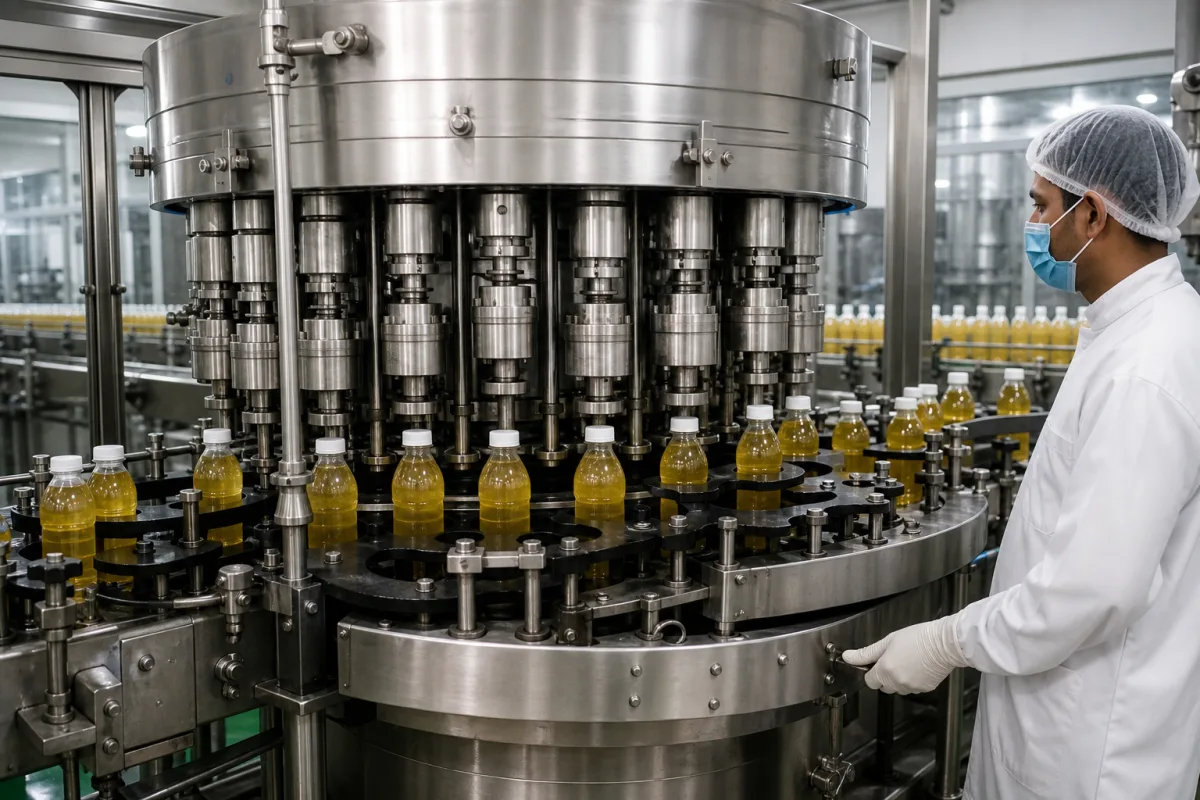
A rotary bottle capping machine carries bottles on a starwheel turret under a ring of capping heads that place and tighten screw caps while the turret turns. Ask three things first: the output you need and the number of heads, the caps, bottles and application torque it must hold, and how torque is controlled and faulty bottles rejected.
Automatic rotary and inline screw-capping machines for bottles in beverage, food, cosmetic, chemical and pharmaceutical lines, including press-on and vial capping heads. Can seamers, cap liners and closures themselves, and filling machines are outside this page.
CNFX editorial research · Sources checked October 12, 2026 · 4 sources
Zonesun's ZS-XG440Q rotary capping machine lists 8 capping heads, up to 9,000 bottles per hour, a permanent magnetic clutch for cap torque control, 380 V 50 Hz 3 kW power, 0.5–0.69 MPa air, a 900 ± 50 mm conveyor height, about 2,000 × 1,800 × 2,900 mm and 3,000 kg, with photoelectric bottle detection at inlet and outlet and a reject structure for unqualified products. [1]
Editorial calculation: 9,000 bottles per hour is 150 per minute; across 8 heads each head caps about 1,125 bottles an hour, one every 3.2 s of turret travel. [1] Ask at which cap and bottle the rated output was measured.
Inline cappers on other supplier pages are listed at lower rates, for example 800 to 3,000 bottles per hour for linear tracking cappers and 1,000 to 2,000 for a rotary chuck capper. [3]
Give the supplier the bottles (material, shape, size range), caps (type, diameter, liner, tamper band), target output, application and removal torque, line height and direction, changeover time, hygiene and washdown needs, upstream filler and downstream labeller.
02
Set the application torque for the cap and container
Berlin Packaging's torque table for closures in dangerous-goods kits shows how torque depends on cap size, cap material and container: 28 mm caps at 15 in-lb in each combination, 38 mm 400-finish caps at 20 in-lb on glass but 30 in-lb for polypropylene caps on plastic, 38 mm 430-finish caps at 45 in-lb for phenolic or polypropylene on glass but 20 in-lb on plastic, and 89 mm caps from 40 to 70 in-lb. [2]
Editorial conversion: 1 in-lb is about 0.113 N·m, so 15 in-lb ≈ 1.7 N·m, 20 in-lb ≈ 2.3 N·m and 45 in-lb ≈ 5.1 N·m. [2] These figures apply to that kit application; set your own application and removal torque with the closure supplier and verify it on the line.
The example capper controls torque with a magnetic clutch; ask each supplier how torque is set per head, how it is checked, and what happens to bottles that fail. [1]
03
Rotary, inline and vial cappers on the supplier list
Zonesun and VKPAK list multi-head rotary cappers; FillingAuto and Sunter list rotary and inline screw cappers; Rito, Hengyuan, Xuefill and HX list automatic and semi-automatic bottle cappers; Honsimba lists vial and bottle capping machines for pharmaceutical lines; Full Harvest and Utrust list capping machines alongside can seamers.
04
Match the capper's cap and bottle ranges to your containers
IMA's Capper Series page lists an integrated rotary capper with output up to 300 bottles per minute and a 3-head rotary capper with up to 100 bottles per minute, both for caps of 25 to 80 mm and bottles 40 to 240 mm high. Bottle diameter is 25 to 120 mm for the integrated machine and 25 to 100 mm for the 3-head machine, each depending on model, and IMA marks every output figure as depending on machine model, container and closure. [4]
IMA says screw caps are tightened with low-hysteresis magnetic clutches as standard, for torque on caps including child-resistant and induction-sealed closures, with servo torque control as an option on all models. Its 4, 6, 8 and 10 head versions include a cap bowl feeder, and the 3-head turret is power-adjusted for different bottle heights. [4]
Editorial calculation: 100 bottles per minute across 3 heads is about 33 per head per minute, or 2,000 per head per hour, against about 1,125 per head per hour for the 8-head example above. [4][1] Per-head rates depend on the cap, bottle and torque, so ask each supplier to quote output for your own container and closure.
Speed at your cap, torque per head and the capper's utilities
The torque row is the one to settle with your closure supplier before quoting; the bottle diameter and height rows carry no published value here and come from your own containers. [2]
Explore company information and manufacturing capabilities, then discuss the scope of your project with a relevant supplier.
Share this page
Compiled and source-reviewed by the CNFX editorial team.
Each manufacturer above links to the page on that company's own website where the product is listed, with the date we checked it. How we source and review
· Page last updated 13 October 2026
Buyer questions
How many capping heads do I need?
Divide the required output by the rate per head. In the example, 8 heads give 9,000 bottles per hour, about 1,125 per head (editorial calculation). [1]
How much torque should a 38 mm cap get?
It depends on finish, cap and container: one published table gives 20 to 45 in-lb (about 2.3 to 5.1 N·m) for 38 mm caps. Confirm with your closure supplier. [2]
How is torque controlled on a rotary capper?
By a clutch in each head; the example machine uses a permanent magnetic clutch. [1]
Can a rotary capper use servo torque control instead of clutches?
IMA's Capper Series uses magnetic clutches as standard and offers servo torque control as an option on all models. [4]
Sources and what still needs a direct check
Sources checked 2026-10-12. Berlin Packaging is a packaging distributor; its torque table is for dangerous-goods kits. Zonesun is a supplier listed on this page; its specification is used as a worked example, not a recommendation.