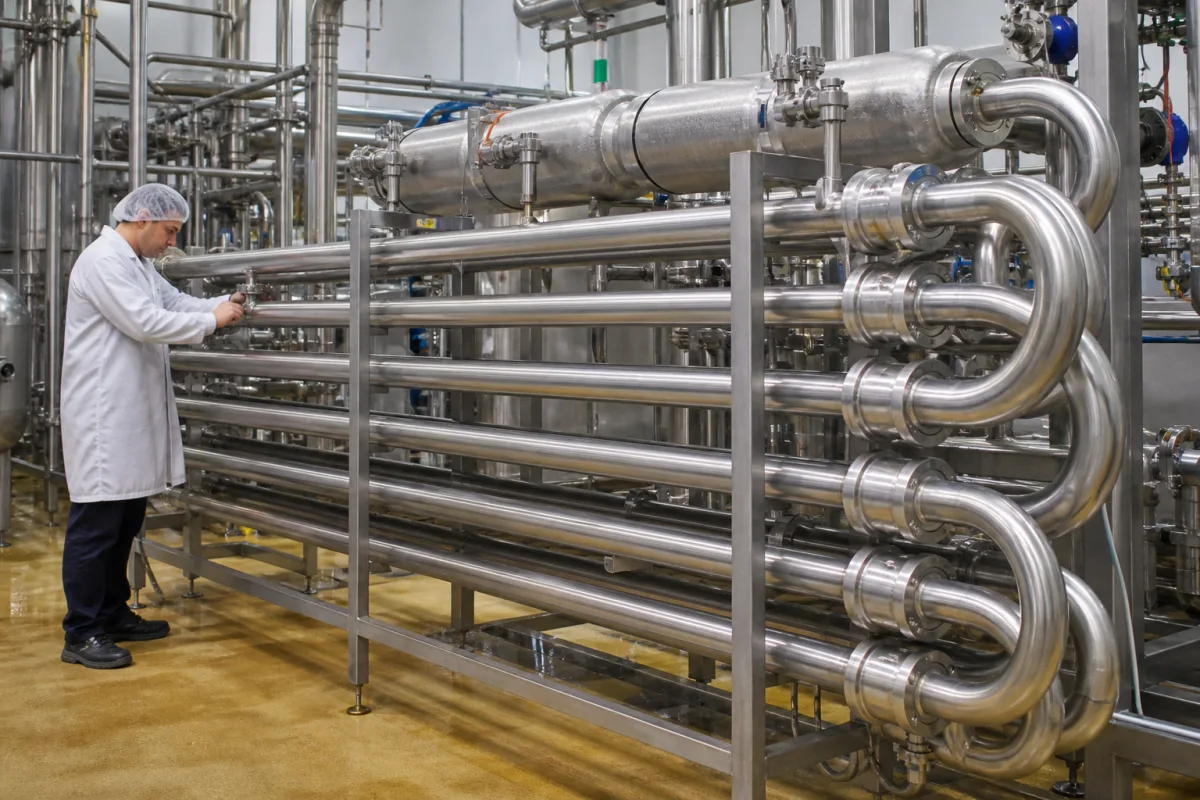
Product heating and holding tube for hot-fill beverages: sizing the hold for the fastest particle before the filler
The heating coil and holding tube ahead of a hot filler for juices and other acid beverages · tube length from flow, time and diameter for the fastest particle, 180–200 °F before filling, an upward slope of 2.1 cm per metre, and pressure above the boiling point
On a hot-fill line the beverage is heated in a coil of stainless tube, kept at temperature for a fixed time in a holding tube, and sent hot to the filler, where the heat also treats the container and closure. This page is about that heating-and-holding run: how long the holding tube must be for the particle that moves fastest through it, how the tube is laid and instrumented so the hold is real, and how the hold in the tube relates to the hold in the container afterwards.
Heating coils and holding tubes that bring juices, teas and other acid or acidified beverages to hot-fill temperature and hold them there before the filler: holding tube length and diameter for the fastest-moving particle, slope, pressure and temperature recording, and the link to the hot-fill-hold step in the container. Complete HTST and HHST pasteurisers for milk and dairy, with their regeneration, timing pump and flow-diversion device, are covered on the Continuous-flow (HTST) pasteurisation system page; regeneration sections of plate pasteurisers on the Regeneration section of a plate pasteuriser page; hygienic tube-in-tube and multi-tube heat exchangers as equipment on the Tubular heat exchanger for food and dairy processing page; aseptic fillers on the Aseptic filling machine page; the filling valves that receive the hot product on the Hot-fill valve for pulpy juices and drinks with fruit pieces page.
CNFX editorial research · Sources checked October 12, 2026 · 4 sources
Holding tube length for the fastest particle: L = 588.24 × Q × t ÷ D²
A holding tube does not hold every particle for the same time. A Dasi Industries patent on a UHT system states that the greatest variation in residence times occurs with laminar flow, that the residence time of the fastest-moving particle is taken as the holding tube time, and gives the length for that particle as L = 588.24·Q·t/D², with L and D in inches, Q in gallons per second and t in seconds. [1]
Editorial calculation: 3,500 gal/h is 0.972 gal/s. With D = 3.00 in the formula gives 588.24 × 0.972 × 2 ÷ 9 ≈ 127 in; the patent's 138.83 in corresponds to D² ≈ 8.24 in², an inside diameter of about 2.87 in, so the example uses the tube's bore rather than its nominal size. 138.83 in is 3.53 m. The mean velocity in that bore is about 0.88 m/s and the fastest particle, at twice the mean, travels about 1.76 m/s, covering 3.53 m in 2 s.
The patent also reasons that a larger tube diameter lowers the velocity gradients that cause flocculation in concentrated milk at UHT temperatures, so it calls for the largest diameter possible within the other constraints. [1] Editorial note: for a beverage tube, a larger diameter at the same flow makes the tube shorter but slower; the flow regime used in the length calculation has to match the regime the tube really runs in, and the patent's factor of two is for laminar flow.
Give the supplier the maximum product flow, the product's viscosity at holding temperature, the required holding temperature and time from the process authority, and the space available for the tube.
02
The tube is the first hold: 180–200 °F in the product, then 2–5 minutes in the inverted container
In hot-fill-hold, the heat treatment does not end at the holding tube. University of Georgia Extension describes heating the product to about 180–200 °F, filling, inverting and holding for 2–5 minutes to reach commercial sterility, with higher temperatures paired with shorter holds. [2]
UGA notes that products at pH 4.6 or above need a pressure process of 240–260 °F for minutes up to an hour or more, so hot-fill-hold is not for them; the heating also softens the closure's sealing compound so that a hermetic seal forms. [2]
Editorial calculation: 180–200 °F is 82.2–93.3 °C. Editorial note: the filler bowl, valves and pipework after the holding tube lose heat, and the container cools during its hold; the temperature the holding tube must deliver is set backwards from the minimum temperature the container must still have at the end of its hold, not only from the tube's own time-temperature target.
Hot-fill-hold point
Published guidance
Product temperature before filling
About 180–200 °F, set by a thermal process authority [2]
Hold after filling
2–5 min in UGA's summary; elsewhere it gives the hold as from a minute upward, including an inversion lasting seconds up to a couple of minutes [2]
Hold temperature
The last or lowest product temperature recorded during the hold [2]
Products suited
Acid or acidified foods with equilibrium pH 4.6 or below that can flow [2][3]
Heating threshold
Above 180 °F (82 °C), or a time and temperature set by a process authority [3]
Records
How long the container was inverted and held, and the temperature after inversion and holding [3]
03
Laying out the tube: 2.1 cm per metre upward slope, no heating along it, recorder at the outlet, pressure above boiling
US rules for aseptic processing of low-acid foods set out how a product holding tube has to be built; they are written for sterilisation, but they show what makes a holding time trustworthy in any tube. [4]
The Dasi patent explains the pressure rule: if product flashes to vapour in the tube, non-condensable gases can collect and reduce the holding time; its UHT design also avoids turbulence and agitation in the tube to prevent oiling-off and fat separation in milk. [1]
Editorial calculation: at 2.1 cm per metre, the 3.53 m tube of the worked example would rise at least 7.4 cm from inlet to outlet. Editorial note: for an acid beverage the scheduled process comes from the process authority rather than from the low-acid rules quoted here; use those rules as a layout checklist and confirm which ones the authority requires.
Requirement or design rule
Source value
Design
Every particle held at least the minimum holding time in the scheduled process [4]
Heating
No part of the tube between inlet and outlet may be heated [4]
Slope
Upward at least 1/4 inch per foot (2.1 cm per metre) [4]
Temperature recording
Recording sensor in the product at the tube outlet, before the cooler [4]
Flow control
Flow control device upstream of the holding tube [4]
Temperature drop
Product diverted away from the filler or surge tank [4]
Pressure
At least 9 psi above the product's saturated vapour pressure, so it cannot flash and shorten the hold [1]
Ask the supplier to show the tube's slope, the location of the outlet temperature sensor, the back-pressure arrangement and what happens to product when the outlet temperature falls below the set point.
04
What to send for a hot-fill heating and holding tube
Paste it into your enquiry below or into an email to a maker, then replace every bracket.
Product: [type; pH; viscosity at temperature; particles]
Flow: [maximum and minimum l/h]
Process: [holding temperature and time from process authority]
Filler: [distance; minimum fill temperature; container hold]
Tube: [bore; length; slope; insulation]
Controls: [outlet sensor and recorder; diversion; back pressure]
Heating: [steam or hot water; coil area]
Explore company information and manufacturing capabilities, then discuss the scope of your project with a relevant supplier.
Share this page
Compiled and source-reviewed by the CNFX editorial team.
Each manufacturer above links to the page on that company's own website where the product is listed, with the date we checked it. How we source and review
· Page last updated 13 October 2026
Buyer questions
How long should a holding tube be?
Long enough for the fastest particle to stay the required time; a Dasi patent uses L = 588.24·Q·t/D² for laminar flow and gives 138.83 in for 3,500 gal/h, 2 s and a 3-inch tube. [1]
What temperature is used for hot-fill beverages?
UGA Extension describes heating to about 180–200 °F before filling, then inverting and holding for 2–5 minutes; K-State gives above 180 °F (82 °C) or a process-authority time and temperature. [2][3]
Why must a holding tube slope upward?
US aseptic processing rules require at least 1/4 inch per foot (2.1 cm/m) upward slope and no heating along the tube, so every particle is held the scheduled time. [4]
Why keep pressure on a holding tube?
The Dasi patent keeps it at least 9 psi above saturation pressure so the product cannot flash and collect gases that shorten the holding time. [1]
Sources and what still needs a direct check
Sources checked 2026-10-12. The holding tube length formula, worked example and pressure rule come from a Dasi Industries patent; hot-fill-hold temperatures and times from University of Georgia and Kansas State University extension publications; holding tube construction rules from 21 CFR 113.40 (FDA) on aseptic processing.