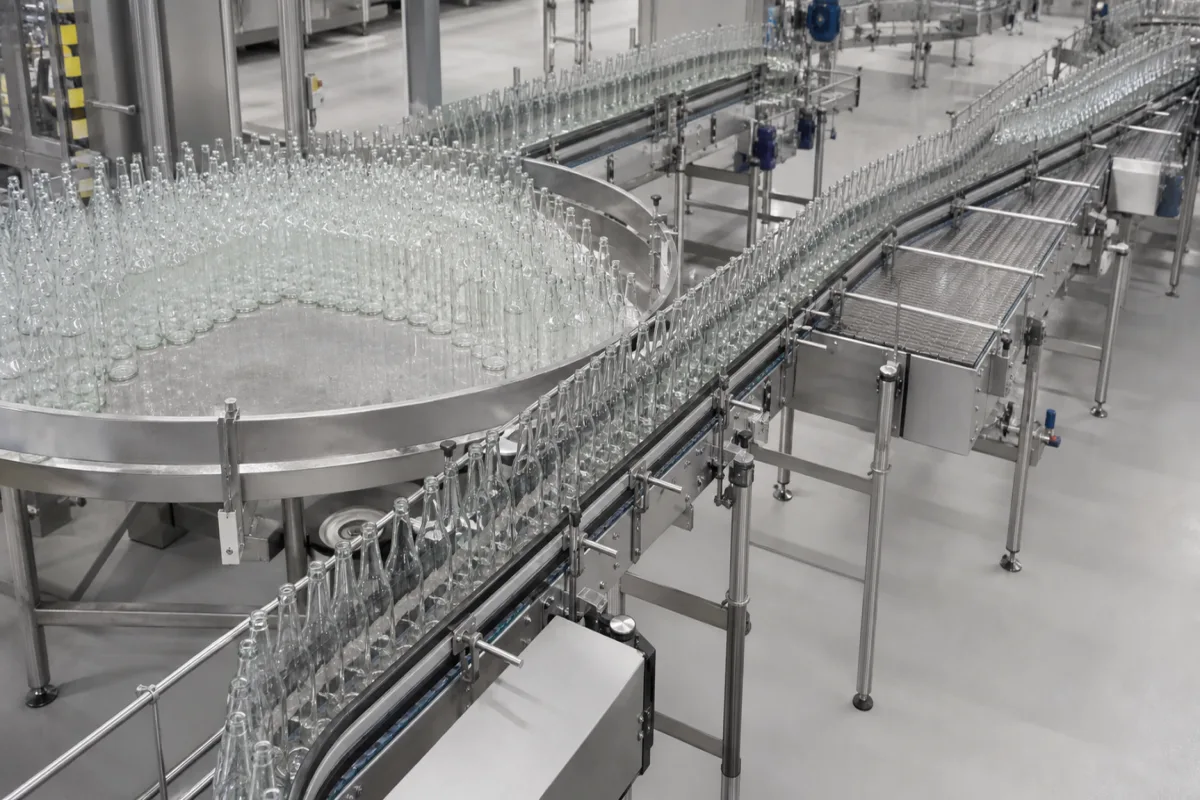
Glass-bottle conveyor system specified for low bottle-to-bottle impact: pressureless combining, speed-controlled chains and line enclosures that bring 96–101 dB down to the mid-80s
Glass-bottle lines · the conveyors, combining tables and laners between depalletiser, washer, filler and packer, specified for how loudly and how hard the bottles strike each other
On a glass-bottle line much of the noise comes from the bottles themselves: each time one strikes the next, glass rings, and the same contacts put the bottles under pressure and break some of them. A conveyor system for glass has to control the spacing and pressure between bottles from the depalletiser to the packer, and contain the noise where bottles have to close up. This page sets out what has been measured on such lines and which changes brought the levels down.
Conveyor systems that carry empty and filled glass bottles and jars between depalletiser, washer or rinser, filler, labeller and packer, specified for bottle-to-bottle impact: variable-speed chain conveyors, pressureless combiners and laners, accumulation tables, guide rails and line enclosures, and the noise levels and exposure values they are judged by. Single-file TableTop chain, wear strips and guide-rail mechanics are covered on the Conveyor module for beverage containers page; sizing filler outfeed and accumulation in minutes of output on the Outfeed conveyor of a beverage filler page; tunnel pasteurizers and their conveyor deck on the Beverage pasteurization and cooling tunnel page; rotary unscrambling and accumulating tables on the Rotary bottle turntable for filling lines page; track lubrication on the Lubricated bottle transport conveyor page; conveyor types across industries on the Conveyor systems page.
CNFX editorial research · Sources checked October 13, 2026 · 4 sources
Where glass bottles clash loudest: accumulation tables, laners and filler infeeds at 93 to 101 dB
HSE's food and drink noise case book records the levels on glass-bottle and jar conveyors before and after each change; read across, it shows which points on the line are worst.
The UK Control of Noise at Work Regulations 2005 set a lower exposure action value of 80 dB and an upper one of 85 dB daily or weekly personal exposure, A-weighted, and an exposure limit value of 87 dB; only the limit value may take account of hearing protectors worn. [3] The case-book figures are levels measured at the line, not personal exposures, so they do not translate directly into a worker's daily dose; Editorial comparison: a line level of 96 to 101 dB is 11 to 16 dB above the 85 dB figure. In the depalletiser-to-packer case operators had to wear hearing protection for the whole eight-hour shift until the conveyor was replaced. [1]
Editorial calculation from the table: replacing the conveyor and accumulation table took the first line from 101 dB to 84 dB, a fall of 17 dB, which ends 1 dB below the 85 dB upper action value and 4 dB above the 80 dB lower one. [1][3]
Point on the line
Level before
Change made
Level after
Conveyors and accumulation tables, depalletiser to packer (multi-lane squeezed to single line)
Ask the supplier for the A-weighted level the offered conveyors reach with your bottles at line speed, where along the line it was measured, and whether it was measured with or without enclosures.
02
Keeping bottles from touching: chains at different speeds, bottle-count sensors and pressureless combiners
HSE's bottling-line case study names the source of the noise and the only way to remove it at source: spacing the bottles so they do not collide.
HSE states that, if plastic bottles cannot be substituted for glass, spacing the bottles to prevent collisions is the only means of reducing the noise at source, and that this is possible along straight runs but not where bottles have to be marshalled at the entrances to and exits from washers, inspection tables or crating machines ("craters" in HSE's text). [2] The depalletiser-to-packer line in the case book shows what goes wrong at those points: its accumulation tables squeezed the bottles from multi-lane into a single line, putting them under considerable pressure and breaking some of them. [1]
The replacement conveyor used chains running at different speeds, with sensors counting the bottles through each machine so that the preceding section sped up or slowed down accordingly. HSE reports that bottles no longer travelled under pressure, breakages fell, and the line could accumulate bottles at its end. [1] A brewery fitted a pressureless combiner on a frequency inverter with variable-speed drives for each conveyor, plus high-density plastic guide rails and starwheels, after which bottles and cans no longer knocked together. [1]
Sidel describes its combiners as merging two or more container streams into single file without applying accumulation pressure, from mass conveying to single file for a machine infeed or, in a double-lane version, into 2 to 4 single files for a multi-lane infeed; it lists round and shaped glass bottles, full or empty, among the formats, evacuation of laid-down containers, and low noise level. It also offers pressure combiners for glass and metal containers at low and medium speeds. [4]
State where the line has to go from mass flow to single file or into lanes, the bottle shapes and whether they are full or empty, and ask whether the offered combiner works with or without back pressure at that point.
03
Enclosing the runs where bottles must close up: acrylic, perspex and PVC panels worth 2 to 10 dB
Where bottles cannot be kept apart, HSE's guidance is to contain the noise inside the line with an enclosure or screen that is hygienic and gives immediate access to any section.
In HSE's bottling-hall case, a reverberant hall about 20 m × 6 m × 5 m with some 30 m of conveyor ran above 85 dB. The enclosure had a polypropylene roof with an absorptive lining behind a cleanable membrane, and 13 mm transparent acrylic side panels hinged at the top for operator access; the area below the conveyor was left open so excess conveyor lubricant could drain. The result was about 5 dB, estimated to rise to 10 dB by extending the side panels to the floor with acoustic strip curtaining; the cost was £500 per metre of conveyor in 1988. [2]
On a soft-drinks conveyor carrying washed empty bottles from the washer to the filler, stainless-steel panels were considered and perspex chosen because it absorbed the bottle noise more effectively; the reduction was 2 to 8 dB, and the enclosure also cut contamination of the washed bottles and protected people from breaking glass. [1] The depalletiser-to-packer case shows the weakness of relying on doors: enclosure brought that machine to 85–89 dB, but operators did not reliably shut the doors after working on the machine, and levels stayed high. [1] Editorial comparison: the enclosures in these cases gave 2 to 10 dB, the speed-controlled conveyors 17 dB at source. [2][1]
For enclosed sections, specify panel material, access (hinged, sliding, curtain), drainage of lubricant and wash water, and how the panels are cleaned, and ask for the level with the panels in their normal working position.
04
Data for a glass-bottle conveyor system enquiry
Paste it into your enquiry below or into an email to a maker, then replace every bracket.
Bottles: [glass bottles or jars; shapes; diameters and heights; empty, full or both]
Line: [machines to be linked; rate in bottles per hour; lane counts]
Combining and laning: [where mass flow becomes single file or lanes; pressureless or with back pressure]
Speed control: [drives per section; bottle-count or backlog sensors]
Noise: [current measured levels; target level and where it is to be measured]
Enclosures: [sections to be enclosed; panel material; access; cleaning and drainage]
Breakage: [current breakage rate; glass containment requirements]
Explore company information and manufacturing capabilities, then discuss the scope of your project with a relevant supplier.
Share this page
Compiled and source-reviewed by the CNFX editorial team.
Each manufacturer above links to the page on that company's own website where the product is listed, with the date we checked it. How we source and review
· Page last updated 13 October 2026
Buyer questions
Why are glass-bottle conveyors so loud?
HSE states that the noise is generated as glass bottles strike one another along the conveyors; levels of 93 to 101 dB were recorded at accumulation tables, laners and filler infeeds in its case book. [2][1]
How far can a new conveyor design bring the noise down?
In HSE's case book, chains running at different speeds under bottle-count sensors took a depalletiser-to-packer line from 101 dB to 84 dB without enclosures, and also reduced breakage. [1]
What does an enclosure over a bottle conveyor achieve?
HSE reports about 5 dB for a hinged acrylic enclosure (an estimated 10 dB with side panels to the floor) and 2 to 8 dB for perspex panels on a washer-to-filler conveyor. [2][1]
What noise values apply to people working along the line?
The UK Control of Noise at Work Regulations 2005 set action values of 80 and 85 dB(A) daily or weekly personal exposure and a limit value of 87 dB(A). [3]
Sources and what still needs a direct check
Sources checked 2026-10-13. HSE's HSG232 case book and its bottling-line case study give measured levels on glass-bottle and jar conveyors before and after each change; the Control of Noise at Work Regulations 2005 give the exposure values; Sidel's combiner page describes pressureless combining of glass bottles.