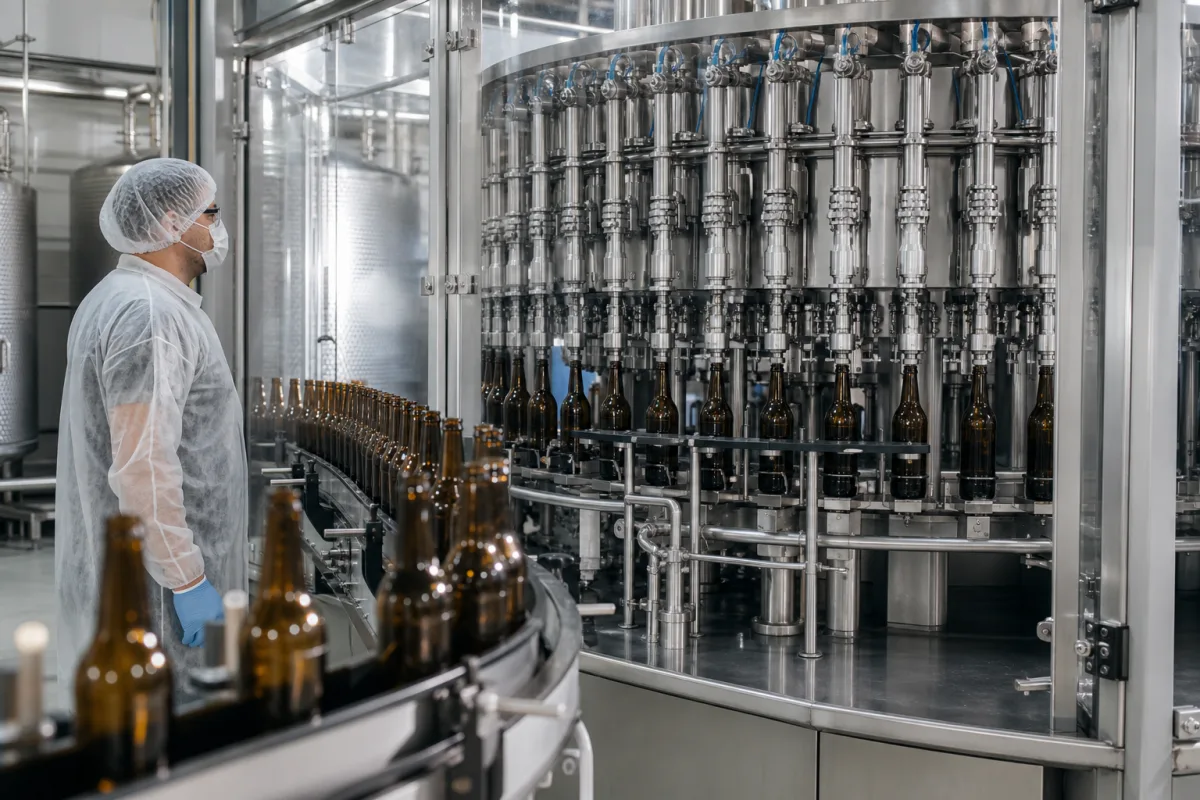
Sanitary rotary bottle filler for beer in glass bottles: low-oxygen filling with evacuation and CO₂ purging
Rotary glass-bottle fillers for beer · Pre-evacuation and CO₂ purging, oxygen pickup in ppb against CO₂ use in g/hl, high-pressure injection before crowning, fill-level probes and hygienic design
This page covers rotary fillers that fill beer and other carbonated drinks into glass bottles, with vacuum and CO₂ purging steps that keep oxygen out of the product. Ask three things first: what oxygen pickup the filler reaches and at what CO₂ consumption, how fill level is set and held, and what the hygienic design and cleaning-in-place arrangement look like.
Rotary fillers for beer, beer-mix drinks and carbonated soft drinks in glass bottles, with pre-evacuation, CO₂ purging, filling and crowning. Rotary rinse-fill-cap monoblocks for PET bottles are covered on the High-speed rotary bottle filling machine page. Can fillers, keg fillers, linear piston fillers and still-wine fillers are outside this page.
CNFX editorial research · Sources checked October 12, 2026 · 3 sources
Control oxygen pickup with evacuation, CO₂ purging and foaming
KHS describes the sequence on its Innofill Glass DRS ECO: during pre-evacuation, air and its oxygen are removed from each bottle by vacuum, the bottle is purged with a precisely dosed amount of CO₂, and filling takes place in an almost pure CO₂ atmosphere; just before capping, high-pressure injection makes the beer foam and displace the remaining air from the neck and under the crown. KHS's filling technology lead states that if much oxygen enters at filling, the foaming result is poor. [1]
KHS gives the trade-off between oxygen and CO₂: in some brands 1,600 g of CO₂ per hectolitre has been used to reach an oxygen pickup of 40 ppb, while in Germany values of 80–200 ppb are considered normal. It reports that the Innofill Glass DRS ECO needs 110 g of CO₂ per hectolitre for 40 ppb and that at 160 g the pickup drops to 20 ppb, with CO₂ savings of up to 60%; the first unit has run at OeTTINGER Brewery in Mönchengladbach since mid-2021. [1]
Editorial calculation: 110 g/hl against 1,600 g/hl for the same 40 ppb is about 93% less CO₂; for 1,000 hl of beer that is 110 kg against 1,600 kg of CO₂. 1 ppb is 1 µg per kg, as KHS notes, so 40 ppb is 0.04 mg per kg of beer. [1]
Give the supplier your products (beer, beer-mix, soft drinks), CO₂ content, fill temperature, bottle formats and crowns, target bottles per hour, target oxygen pickup in ppb and your CO₂ price, and ask for the oxygen and CO₂ figures measured on a comparable installation.
02
Check fill-level control, crowning and hygienic design
KHS's data sheet describes the Innofill Glass DRS as a computer-controlled glass bottle filler with a short-tube filling system for beer, beer-mix drinks and soft drinks, reaching up to 80,000 bottles per hour, with the fill level set by a probe integrated in the filling valve, servo-synchronised modular filler, capper and transfer stars, bottles raised by lifting elements and sealed by a centring tulip that is included in the CIP process, and filling valves with an aseptic sealing system. [2]
The same data sheet lists multiple evacuation and CO₂ purging for low oxygen pickup, low-foam filling even at 20 °C filling temperature, standard crown corks and twist crowns, a crowner with ±2 mm bottle-height compensation, motorised height adjustment for different bottle heights, a fill-level probe with two switching points, manually fitted CIP caps, a closed CIP circuit and quick-change format parts. [2] KHS's article adds an optional diagnostic system monitoring all filling stations, a camera-assisted foaming control and automatic height adjustment of the fill-level probes, letting operators set product loss to one millimetre per bottle instead of two. [1]
MIC lists smaller beer bottling machines from the 12-12-1 to the 32-32-8 with fill volumes of 0.1–1 L; its page headings give 800–1,500 BPH for the 12-12-1 and 8,000–10,000 BPH for the 32-32-8, while the table on the same page gives 300–1,500 and 4,800–7,500 BPH, so confirm the rate in writing. [3]
03
Innofill Glass DRS fill data against earlier brewery practice
Compare oxygen figures with the CO₂ use and conditions behind them.
Machine or basis
Published figure
Note
Innofill Glass DRS ECO
40 ppb at 110 g CO₂/hl; 20 ppb at 160 g CO₂/hl. [1]
Explore company information and manufacturing capabilities, then discuss the scope of your project with a relevant supplier.
Share this page
Compiled and source-reviewed by the CNFX editorial team.
Each manufacturer above links to the page on that company's own website where the product is listed, with the date we checked it. How we source and review
· Page last updated 13 October 2026
Buyer questions
How low can oxygen pickup be on a glass beer filler?
KHS reports 40 ppb at 110 g CO₂ per hectolitre and 20 ppb at 160 g on its Innofill Glass DRS ECO, against 80–200 ppb considered normal in Germany. [1]
Why does a beer filler use high-pressure injection?
Injection just before capping foams the beer so it displaces the remaining air from the neck and under the crown. [1]
How fast are rotary glass bottle fillers?
KHS lists the Innofill Glass DRS at up to 80,000 bottles per hour; MIC's page headings give 800–10,000 BPH for its smaller beer bottling machines. [2][3]
Sources and what still needs a direct check
Sources checked 2026-10-12. KHS describes its own filler and reports figures from a brewery installation; MIC describes its own machines.