Industry-Verified Manufacturing Data (2026)

Liquid Reservoir

Based on aggregated insights from multiple verified factory profiles within the CNFX directory, the standard Liquid Reservoir used in the Beverage Manufacturing sector typically supports operational capacities ranging from standard industrial configurations to heavy-duty production requirements.

Technical Definition & Core Assembly

A canonical Liquid Reservoir is characterized by the integration of Level Sensor and Drain Valve. In industrial production environments, manufacturers listed on CNFX commonly emphasize 304 Stainless Steel construction to support stable, high-cycle operation across diverse manufacturing scenarios.

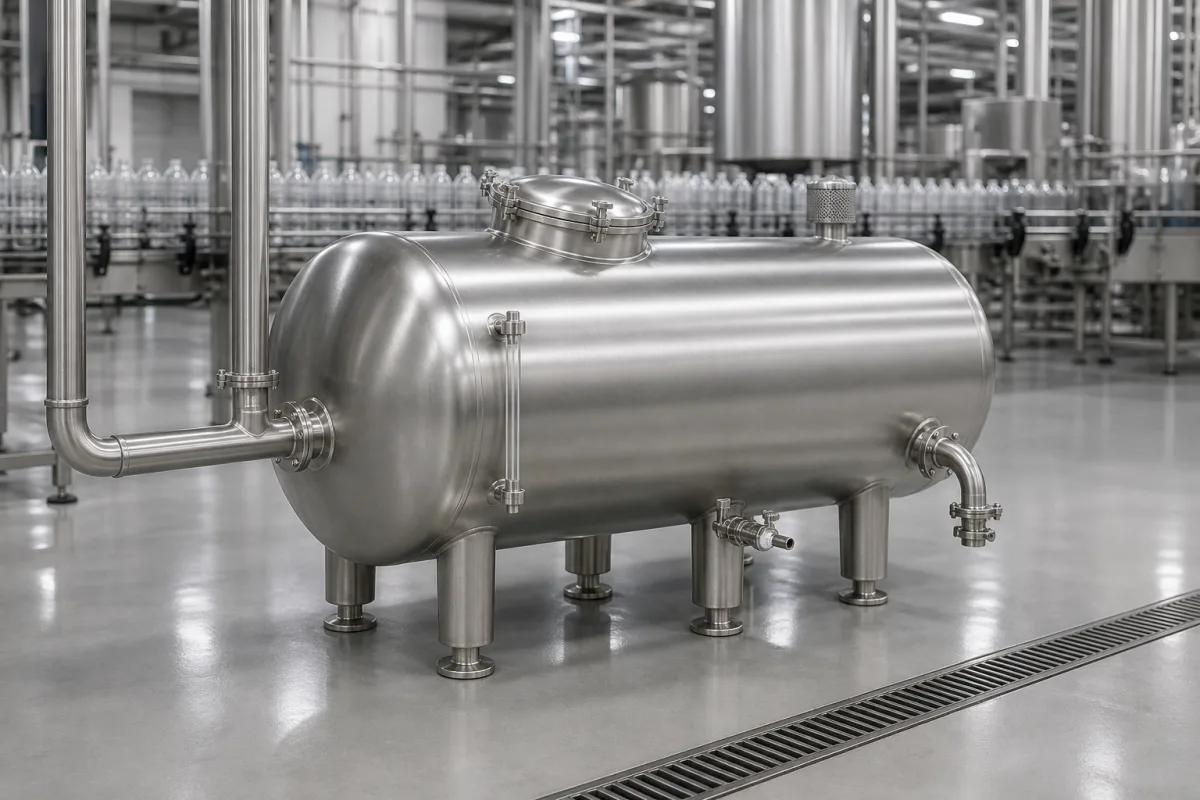
A sanitary container that temporarily stores liquid product before filling into bottles in a rotary bottle filling system.

Product Specifications

Technical details and manufacturing context for Liquid Reservoir

Definition
The liquid reservoir is a critical component of sanitary rotary bottle fillers that serves as an intermediate storage vessel between the product supply system and the filling nozzles. It maintains a consistent liquid level and pressure to ensure uniform filling volumes across all stations. Designed with sanitary construction (typically 304 or 316L stainless steel), it features smooth interior surfaces, proper drainage, and often includes level sensors, temperature control elements, and agitation systems for products requiring mixing.
Working Principle
The reservoir receives liquid from the main supply line and maintains a predetermined level through float valves or level sensors. As bottles rotate through the filling station, the reservoir supplies liquid to the filling nozzles via gravity or pressure-assisted systems. The consistent head pressure in the reservoir ensures each bottle receives the precise volume specified, while sanitary design prevents contamination and facilitates cleaning between production runs.
Common Materials
304 Stainless Steel, 316L Stainless Steel
Technical Parameters
  • Capacity of the liquid reservoir, typically ranging from 50L to 500L depending on filler size and production requirements (L) Standard Spec
Components / BOM
  • Level Sensor
    Monitors liquid level and controls inlet valve to maintain consistent volume
    Material: Stainless Steel
  • Drain Valve
    Allows complete drainage for cleaning and product changeover
    Material: Stainless Steel
  • Sight Glass
    Visual inspection of liquid level and condition
    Material: Glass/Stainless Steel
  • Agitator
    Mixes products that require homogeneity (optional for certain applications)
    Material: Stainless Steel
Engineering Reasoning
0.1-0.8 bar gauge pressure, 4-60°C liquid temperature, 0.5-3.0 m³ volume capacity
Material yield stress at 240 MPa for 316L stainless steel, 0.95 bar vacuum collapse pressure, 80°C thermal deformation threshold
Design Rationale: Von Mises stress exceeding 240 MPa yield strength causes permanent deformation; Bernoulli's principle creates cavitation at vapor pressure (0.023 bar at 20°C); differential thermal expansion (17.3 μm/m·°C for 316L) exceeds weld tolerance at ΔT>60°C
Risk Mitigation (FMEA)
Trigger Pressure differential exceeding 0.95 bar during CIP suction cycle
Mode: Tank wall implosion with permanent plastic deformation
Strategy: Install vacuum breaker valve with 0.8 bar cracking pressure and redundant pressure transmitter interlock
Trigger Electrochemical corrosion at chloride concentration >25 ppm in 60°C product
Mode: Pitting corrosion penetration rate exceeding 0.5 mm/year at weld HAZ
Strategy: Apply electropolishing to Ra<0.4 μm surface finish and install 316L coupon corrosion monitoring system

Industry Taxonomies & Aliases

Commonly used trade names and technical identifiers for Liquid Reservoir.

Industrial Ecosystem & Supply Chain DNA

Complementary Systems
Downstream Applications
Specialized Tooling

Application Fit & Sizing Matrix

Operational Limits
pressure: 0 to 2 bar (gauge)
flow rate: Up to 500 L/min
temperature: 5°C to 80°C
slurry concentration: Up to 20% solids by weight
Media Compatibility
✓ Pharmaceutical solutions ✓ Food-grade beverages ✓ Cosmetic emulsions
Unsuitable: Highly corrosive acids (e.g., concentrated sulfuric acid)
Sizing Data Required
  • Required liquid hold-up volume (L)
  • Maximum fill rate (L/min)
  • Required residence time (minutes)

Reliability & Engineering Risk Analysis

Failure Mode & Root Cause
Corrosion
Cause: Chemical attack from stored liquid, atmospheric exposure, or galvanic corrosion due to dissimilar metals in contact with the reservoir or its components.
Structural fatigue cracking
Cause: Cyclic stresses from pressure fluctuations, thermal expansion/contraction, or vibration from connected piping/pumps, leading to crack initiation and propagation, often at weld seams or stress concentrators.
Maintenance Indicators
  • Visible leaks, weeping, or damp areas around seams, welds, or connections, indicating loss of containment.
  • Unusual audible noises such as knocking, creaking, or high-frequency vibration sounds, suggesting structural movement, loose internal components, or resonance issues.
Engineering Tips
  • Implement a regular internal and external inspection program using non-destructive testing (NDT) methods like ultrasonic thickness testing to monitor wall thickness and detect corrosion or thinning before failure.
  • Install and maintain proper venting and pressure relief devices to prevent over-pressurization or vacuum conditions, and ensure the reservoir is adequately supported to minimize stress from misalignment or foundation settlement.

Compliance & Manufacturing Standards

Reference Standards
ISO 11439:2013 (Gas cylinders - High pressure cylinders for the on-board storage of natural gas as a fuel for automotive vehicles) ASME BPVC Section VIII Division 1 (Rules for Construction of Pressure Vessels) DIN 28018 (Vertical cylindrical steel tanks for the storage of liquids above ground - Nominal capacities, main dimensions)
Manufacturing Precision
  • Wall thickness: +/-5% of nominal thickness
  • Out-of-roundness: Maximum 1% of nominal diameter
Quality Inspection
  • Hydrostatic pressure test (to 1.5 times design pressure)
  • Visual and dimensional inspection per ASME B46.1 (Surface Texture)

Factories Producing Liquid Reservoir

Verified manufacturers with capability to produce this product in China

✓ 94% Supplier Capability Match Found

P Project Engineer from United Arab Emirates Jan 05, 2026
★★★★★
"Great transparency on the Liquid Reservoir components. Essential for our Beverage Manufacturing supply chain."
Technical Specifications Verified
S Sourcing Manager from Australia Jan 02, 2026
★★★★★
"The Liquid Reservoir we sourced perfectly fits our Beverage Manufacturing production line requirements."
Technical Specifications Verified
P Procurement Specialist from Singapore Dec 30, 2025
★★★★★
"Found 15+ suppliers for Liquid Reservoir on CNFX, but this spec remains the most cost-effective."
Technical Specifications Verified
Verification Protocol

“Feedback is collected from verified sourcing managers during RFQ (Request for Quote) and factory evaluation processes on CNFX. These reports represent historical performance data and technical audit summaries from our B2B manufacturing network.”

19 sourcing managers are analyzing this specification now. Last inquiry for Liquid Reservoir from Brazil (10m ago).

Supply Chain Compatible Machinery & Devices

Automated Beverage Batch Blending System

Automated system for precise multi-ingredient beverage batch preparation.

Explore Specs →
Automated Beverage Container Sterilization System

Automated system for sterilizing beverage containers before filling.

Explore Specs →
Automated Beverage Labeling and Coding System

Integrated system for applying labels and printing codes on beverage containers.

Explore Specs →
Automated Beverage Ingredient Dispensing System

Automated system for precise dispensing of beverage ingredients into production lines.

Explore Specs →

Frequently Asked Questions

What are the key differences between 304 and 316L stainless steel for liquid reservoirs?

304 stainless steel offers excellent corrosion resistance for most beverage applications, while 316L provides superior resistance to chlorides and acidic liquids, making it ideal for beverages with higher acidity or salt content.

How does the agitator improve beverage quality in the reservoir?

The agitator maintains consistent liquid homogeneity by preventing ingredient separation or settling, ensuring uniform product quality and preventing stratification during temporary storage before bottling.

What maintenance is required for sanitary liquid reservoirs in beverage production?

Regular cleaning-in-place (CIP) procedures, inspection of seals and gaskets, verification of level sensor calibration, and periodic validation of drain valve operation are essential for maintaining sanitary conditions and optimal performance.

Can I contact factories directly on CNFX?

CNFX is an open directory, not a transaction platform. Each factory profile provides direct contact information and production details to help you initiate direct inquiries with Chinese suppliers.

Get Quote for Liquid Reservoir

Request technical pricing, lead times, or customized specifications for Liquid Reservoir directly from verified manufacturing units.

Your business information is encrypted and only shared with verified Liquid Reservoir suppliers.

Thank you! Your message has been sent. We'll respond within 1–3 business days.

Need to Manufacture Liquid Reservoir?

Connect with verified factories specializing in this product category

Add Your Factory Contact Us
Previous Product
Intelligent Beverage Pasteurization System
Next Product
Liquid Storage Tank