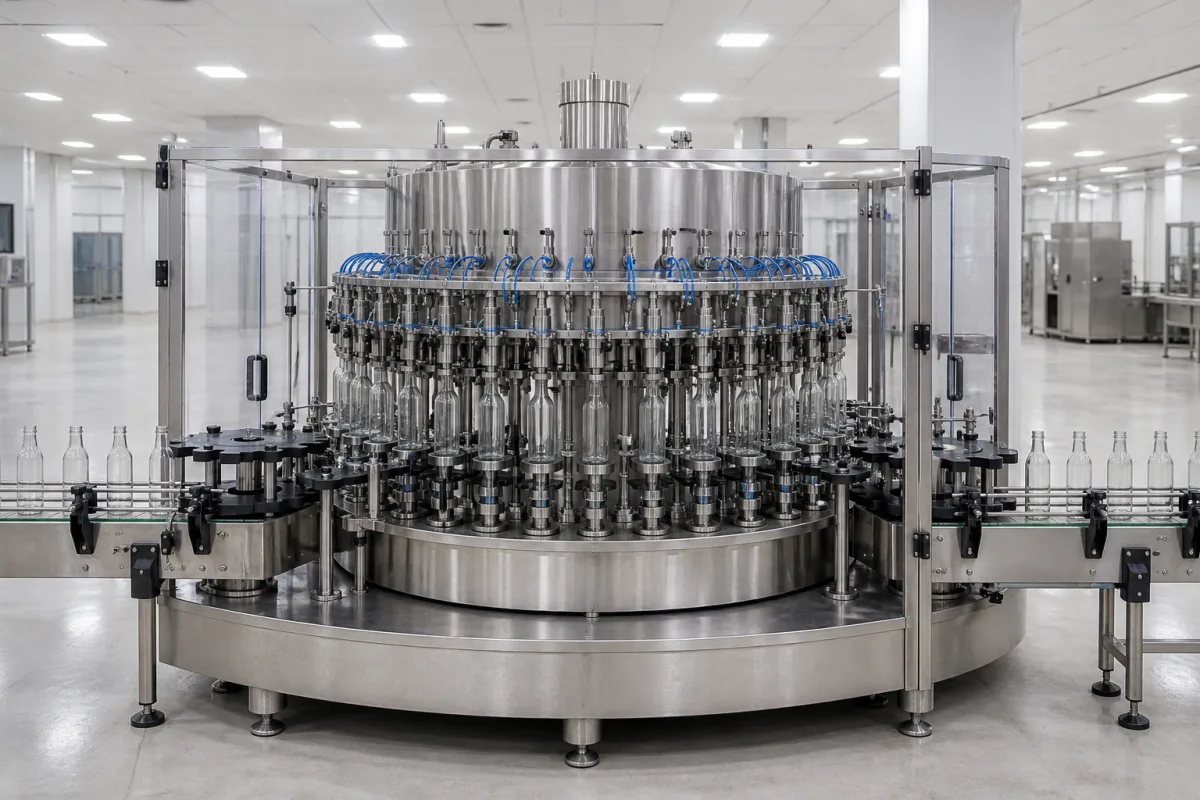
Rotating carousel of a rotary bottle filler: the turret bearing, its drive, and keeping it true through washdown and heat
The rotor that carries the filling stations round a rotary filler · slewing rings up to 4 m and 50 rpm, toothed-ring drives with backlash adjustment, washdown corrosion of the turret bearing, and roller mountings that hold the star-wheel transfer within 1 mm when the rotor heats up
In a rotary filler the bottles do not move past the filling valves; the valves ride round with the bottles on a rotating carousel — the rotor or turret — that carries the filling stations, the ring tank and the bottle supports, and hands bottles to and from star wheels at fixed points. This page is about that rotating structure as a machine element: what bearing carries it, how it is driven, what washdown does to the bearing, and how the rotor's growth with heat is kept from upsetting the transfer.
Rotating carousels (rotors, turrets) of rotary bottle fillers, rinsers and cappers: the slewing ring or roller mounting that carries them, the toothed-ring drive, sealing and corrosion protection against washdown, and the alignment of the rotor with infeed and discharge star wheels under heat. Complete rotary rinse-fill-cap monoblocks are covered on the Rotary bottle filling machine page; star wheels themselves on the Star wheel in UHMW-PE for bottle transfer and Infeed starwheel (container change part) pages; slewing rings for cranes and general turntables on the Slewing bearing and Rotating platform for carousels pages; blow-fill-cap blocks on the Blow-fill-cap combiblock page; low-oxygen glass beer fillers on the Sanitary rotary bottle filler for beer in glass bottles page.
CNFX editorial research · Sources checked October 12, 2026 · 4 sources
The turret bearing: slewing rings from 100 mm to 4 m, up to 50 rpm on a 3 m ring
Rollix (Defontaine Group), a slewing ring maker that has supplied more than 20,000 rings for bottling machines over 30 years, lists rings of 100 mm to 4,000 mm in diameter for blowing, rinsing, filling, capping and labelling machines. It cites speeds of up to 50 rpm for a 3-metre ring, control of axial and radial run-out, and low, constant torque to avoid hard points and overheating, with a service life of 15 to 20 years. [1]
Editorial calculation: at 50 rpm a 3 m ring's circumference (π × 3 m ≈ 9.42 m) passes at about 7.9 m/s. A filler carousel turns at a speed set by its station count and output — stations × rpm × 60 = containers per hour — so a turret with, for example, 80 stations would need 12.5 rpm for 60,000 containers per hour; the bearing's speed limit is then not the constraint, but its run-out is, because every station must meet the star-wheel pocket at the same point. [1]
US patent 3,658,100 (A-T-O Inc., filed 1970) shows the elements of a filler-head bearing that also drives it: a large ring under the filler head, toothed on its outer edge and turned by gearing in the base, running on radial bearing units on posts round the base, which engage a V-groove inside the ring. The posts are eccentric, so each bearing unit can be turned to set preload, and the ring of posts can be shifted sideways to set the backlash between the toothed ring and the drive gear. [3]
Give the bearing or filler maker the rotor mass with full ring tank, the station count and maximum rpm, the diameter available, and the run-out the transfer to the star wheels can tolerate.
02
Washdown and the turret bearing: corrosion, plating and a double-lip seal
SKF reports a bottling company whose bottle-filling machine kept stopping because its slewing ring bearing was corroding under high-pressure washdowns. Its Kaydon engineers designed a custom slewing ring with Kaydon's corrosion-resistant Endurakote plating and a double-lip external seal, which SKF says eliminated the corrosion and saved the bottler approximately $100,000 a year. [2]
SKF frames the cause in the hygiene regime itself: to keep the filling environment clean, the area is wet from the washdown schedule. [2] Editorial note: on a carousel the slewing ring sits under the ring tank and filling stations, where cleaning water and product run down; ask for the bearing's sealing arrangement, its raceway and gear protection, how it is relubricated, and whether the grease is acceptable for incidental food contact.
Ask which surfaces of the turret bearing are plated or stainless, the seal type on each side, the relubrication points and interval, and the washdown pressure the seal is designed for.
03
When the rotor grows with heat: keeping the star-wheel transfer point within 1 mm
US patent 9,139,410 (KHS, priority 2008) replaces the ball-bearing slewing rim under a filler rotor — which it calls expensive — with rollers arranged round the machine axis, while still supporting the rotor on a large diameter for stability. It addresses the change in rotor diameter from thermal expansion during hot filling and during cleaning or sterilising with hot media. [4]
The patent places rollers fixed to the machine frame at or near the tangential points where the rotor meets the infeed and discharge star wheels, with other rollers movable, and absorbs the change in rotor diameter by a radial displacement of the machine axis. It states that the displacement of the tangential points from thermal expansion is advantageously less than 1 mm, because the spatial allocation between star wheels and filling stations is highly important for fault-free operation. [4]
Editorial note: for a hot-fill or hot-CIP carousel, ask how the bearing arrangement handles the rotor's growth between cold set-up and hot running, and for the measured shift at the transfer points; a mounting that keeps the rotor centre fixed lets the transfer points move outward instead.
04
Data for a rotary filler carousel
Paste it into your enquiry below or into an email to a maker, then replace every bracket.
Machine: [filler, rinser or capper; station count; pitch diameter]
Output: [containers per hour; maximum rpm]
Loads: [rotor mass with full ring tank; tilting moment]
Bearing: [slewing ring or roller mounting; diameter; run-out]
Drive: [toothed ring and pinion; backlash setting]
Hygiene: [washdown pressure; plating or stainless; seals; lubricant]
Temperature: [hot fill or hot CIP; allowed shift at the transfer point]
Explore company information and manufacturing capabilities, then discuss the scope of your project with a relevant supplier.
Share this page
Compiled and source-reviewed by the CNFX editorial team.
Each manufacturer above links to the page on that company's own website where the product is listed, with the date we checked it. How we source and review
· Page last updated 13 October 2026
Buyer questions
What bearing carries the carousel of a rotary filler?
Slewing rings: Rollix lists 100–4,000 mm rings for filling, rinsing and capping machines, up to 50 rpm on a 3 m ring; a KHS patent instead mounts the rotor on rollers. [1][4]
How is a filler carousel driven?
In US patent 3,658,100 a toothed ring under the filler head is turned by gearing in the base, with eccentric posts to set bearing preload and backlash. [3]
Why do turret bearings on fillers fail?
SKF describes a slewing ring corroding under high-pressure washdowns; a plated ring with a double-lip seal stopped it and saved about $100,000 a year. [2]
Does heat affect the carousel?
Yes; a KHS patent notes rotor growth in hot filling and hot cleaning and keeps the star-wheel transfer points shifting less than 1 mm. [4]
Sources and what still needs a direct check
Sources checked 2026-10-12. Slewing ring sizes, speed and life come from Rollix (Defontaine Group); the washdown corrosion case from SKF; the toothed-ring bearing and drive from an A-T-O patent; the roller mounting and thermal shift at the transfer points from a KHS patent.