Automated visual inspection of injectables · Qualification against human inspection, defect test sets, throughput, camera stations, container range and leak-test options
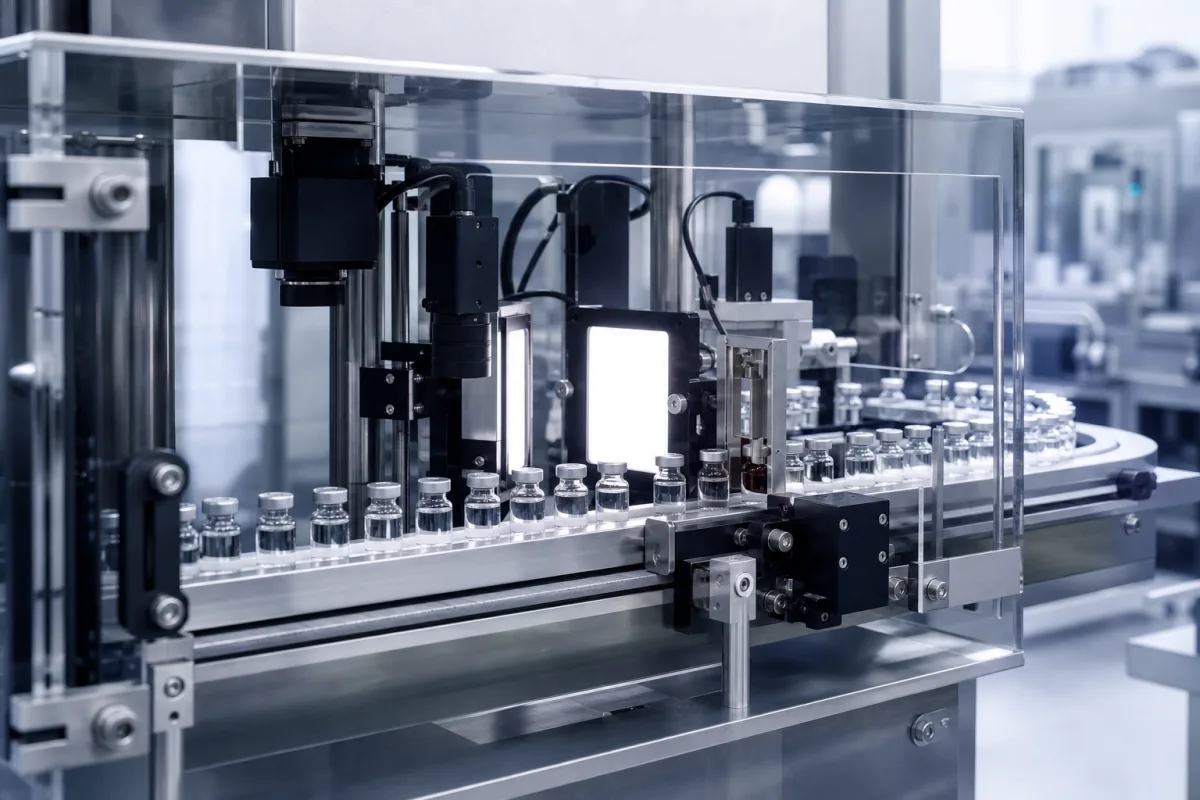
An automated pharmaceutical vial inspection system spins and stops filled vials, ampoules or cartridges in front of cameras and lights, judges each image for particles, cosmetic defects and fill problems, and ejects non-conforming units. Settle three things before comparing machines: how the machine will be validated against manual inspection with your own defect library, which products and containers it must handle (liquid, lyophilized, tinted, sizes), and the throughput, camera stations and add-ons such as leak testing your line needs.
Semi-automatic and fully automatic visual inspection machines for filled parenteral containers — vials, ampoules and cartridges — including camera, light and reject systems. Syringe-only machines, empty-glass inspection, tablet and capsule inspection and stand-alone leak testers are outside this page.
CNFX editorial research · Sources checked October 11, 2026 · 4 sources
FDA's December 2021 draft guidance on visible particulates in injectable products — nonbinding and issued for comment — says each final container must be inspected using a qualified method and all units found to contain visible particulates must be rejected, and that trained personnel, automated technology or both should be used for this 100% inspection, followed by AQL sampling by the quality unit. [1]
It says automated inspection machines should be validated to meet or surpass human inspection capabilities and can be qualified using training standards or artificial intelligence technology. Test sets should mix good units and defective units with visible particulates, include examples from the lower limit of visual detection found in threshold studies, and keep defective units to no more than 10–20 percent of the set. [1]
The guidance notes that visual detection is probabilistic and depends on the product and the size and shape of the particle, that automated technology may detect particles at the lower end of the visual range with greater statistical reliability than manual inspection, and that manufacturers may need to adjust in-process alert and action limits when they change from manual to automated inspection. For opaque products and containers such as lyophilized powders, suspensions and tinted vials, it points to technologies such as X-ray and to supplemental destructive testing. [1]
Editorial calculation: a 300-unit qualification set at the 10–20% ceiling would hold no more than 30–60 defective units. Agree the set size, defect types and acceptance criteria with your quality unit before the factory acceptance test.
Give the supplier your products (liquid, lyophilized, suspension; tinted or clear), container types and dimensions, required throughput, defect list with priorities, defect library and test-set plan, required reject and false-reject targets, leak-test needs, data and audit-trail requirements, line integration and site utilities.
02
Set throughput, camera stations and container range
Körber's specification table for its basic automated platforms for vials, ampoules and cartridges lists throughput of up to 600 containers per minute for the VI, MS and CS series, container diameters up to 52 mm, and up to 13, 9 and 6 camera stations respectively (8, 6 and 4 inside the carousel), with up to 10, 10 and 5 outfeed channels and footprints of 1,500 × 1,800, 1,400 × 1,500 and 1,475 × 1,350 mm. [2]
The table lists HVLD leak-test integration for all three and headspace analysis (HSA) integration into the carousel as an option, with Bubble-X and 3D inspection integrable on VI and MS only. [2] Körber's overview adds outputs of up to 1,000 per minute for nested formats, deep-learning tools for particle and cosmetic inspection, and leak testing by high-voltage leak detection or headspace analysis for liquid and lyophilized products. [3]
Editorial calculation: at 600 containers per minute a machine inspects up to 36,000 units an hour, so a 100,000-unit batch needs at least about 2.8 hours of running time before changeovers, re-inspection or stoppages. The inspection rate itself should be qualified, as FDA's draft guidance says for all techniques. [2][1]
A linked supplier describes rotary machines that spin the container at high speed, brake it and image it, using reflected, diffraction and transmitted light for different particle types, with ejection by a dial wheel and compressed air; it lists rotary models at 400 and 600 bpm. [4]
03
Rotary inspection machines at 400 and 600 bpm with HVLD in the linked listing
The listing reviewed offers rotary visual inspection machines for vials, ampoules and lyophilized products together with HVLD units; ask for the validation package, the particle detection data on your own defect set and the false-reject rate on good units.
04
Spin-and-brake handling, camera stations, algorithms, outfeeds and leak test in a vial inspection machine
Speed, particle size, container range, reject rates and interfaces for a vial inspection quotation
Published values in this table come from FDA's draft guidance, Körber's platform tables and MIC Machinery's listing; where none states a value, the row says what to obtain from the supplier.
1 company lists this product among what they make. Company figures are quoted from each
company's own website; every card states where the relationship came from.
Zhangjiagang Mic Machinery
Manufacturing site to be confirmed for the order
Lists rotary automatic visual inspection machines (400 and 600 bpm) for vials and ampoules, lyophilized-product inspection and HVLD leak detection.
Explore company information and manufacturing capabilities, then discuss the scope of your project with a relevant supplier.
Share this page
Compiled and source-reviewed by the CNFX editorial team.
Each manufacturer above links to the page on that company's own website where the product is listed, with the date we checked it. How we source and review
· Page last updated 13 October 2026
Buyer questions
Must an automated vial inspection machine match manual inspection?
FDA's 2021 draft guidance says automated machines should be validated to meet or surpass human inspection capabilities. [1]
How many defective units go in a qualification test set?
FDA's draft guidance puts the ceiling for defective units at 10–20 percent of the set. [1]
How fast are automated vial inspection machines?
Körber lists its VI, MS and CS platforms at up to 600 containers per minute. [2]
Can leak testing be combined with visual inspection?
Körber lists HVLD integration and a headspace analysis option on its inspection platforms. [2]
Sources and what still needs a direct check
Sources checked 2026-10-11. FDA's draft guidance sets out expectations for visible-particulate inspection; Körber is an inspection machine maker publishing a platform specification table; MIC Machinery is a linked supplier.