Industry-Verified Manufacturing Data (2026)

Rejection Mechanism

Based on aggregated insights from multiple verified factory profiles within the CNFX directory, the standard Rejection Mechanism used in the Machinery and Equipment Manufacturing sector typically supports operational capacities ranging from standard industrial configurations to heavy-duty production requirements.

Technical Definition & Core Assembly

A canonical Rejection Mechanism is characterized by the integration of Actuator Assembly and Control Interface. In industrial production environments, manufacturers listed on CNFX commonly emphasize Stainless Steel construction to support stable, high-cycle operation across diverse manufacturing scenarios.

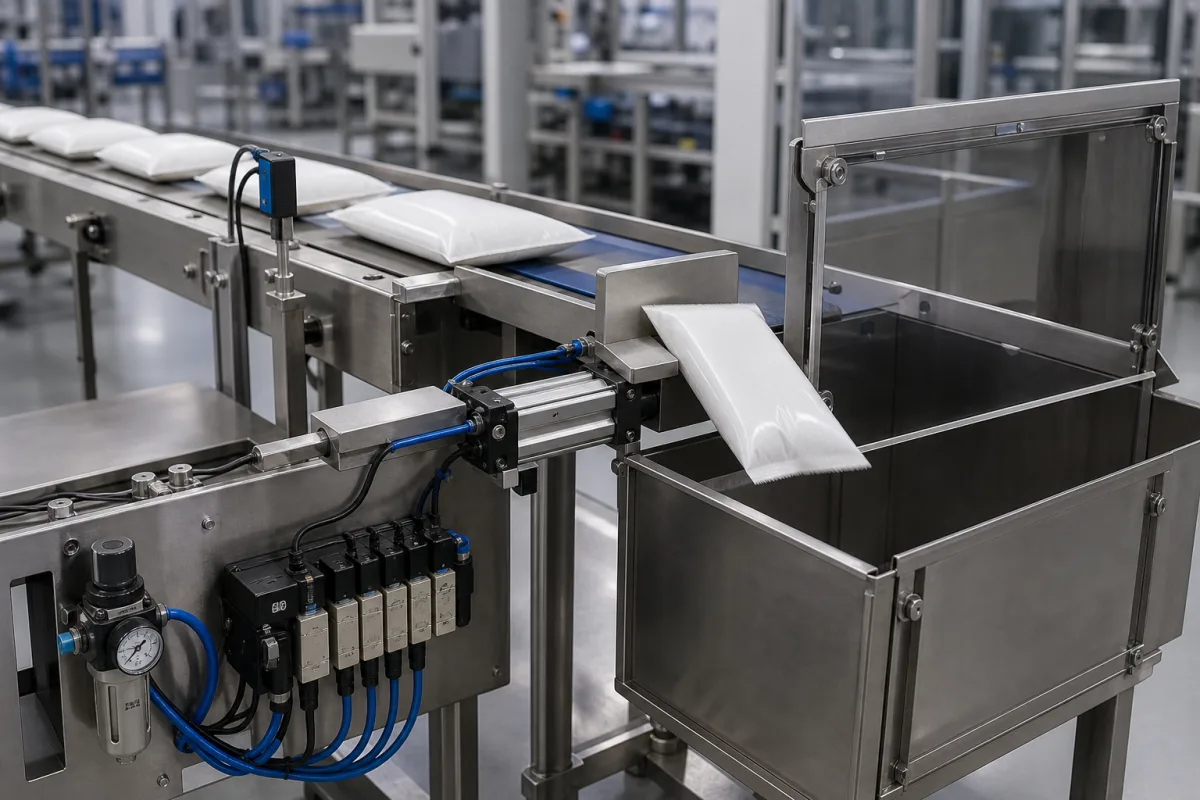
A mechanical component within an industrial system designed to identify and remove defective or non-conforming items from the production line.
Product Specifications

Technical details and manufacturing context for Rejection Mechanism

Definition
The Rejection Mechanism is a critical component integrated into industrial systems that performs quality control by detecting substandard products based on predefined criteria (e.g., size, weight, shape, or visual defects) and physically ejecting them from the main production flow. It ensures only acceptable items proceed to subsequent stages, maintaining product quality and reducing waste in automated manufacturing processes.
Working Principle
The Rejection Mechanism operates by receiving signals from upstream sensors or inspection systems that identify defective items. Upon detection, it activates a mechanical actuator (such as a pneumatic pusher, diverter arm, or trapdoor) to physically displace the rejected item from the conveyor or processing path into a rejection bin or alternate route, while allowing conforming items to continue uninterrupted.
Common Materials
Stainless Steel, Aluminum Alloy
Technical Parameters
  • Maximum rejection rate indicating how many defective items the mechanism can remove per minute (items/minute) Standard Spec
Components / BOM
  • Actuator Assembly
    Provides the physical motion to push, divert, or drop rejected items from the production line
    Material: Stainless steel with polymer seals
  • Control Interface
    Receives and processes signals from inspection systems to trigger rejection actions
    Material: PCB with electronic components
  • Rejection Chute/Bin Optional
    Collects and channels rejected items away from the main production flow
    Material: Stainless steel or food-grade polymer
Engineering Reasoning
0.5-2.5 m/s linear actuator velocity, 15-85°C ambient temperature, 0.1-1.0 mm sensor resolution
Actuator velocity exceeds 3.0 m/s causing inertial overshoot, temperature surpasses 95°C degrading polymer seals, sensor resolution deteriorates beyond 1.5 mm positional tolerance
Design Rationale: Inertial momentum exceeding actuator braking capacity (F=ma), thermal expansion coefficient mismatch (ΔL=αL₀ΔT) between steel guides (11.7×10⁻⁶/°C) and polyurethane seals (180×10⁻⁶/°C), Hall-effect sensor magnetic flux density dropping below 50 mT threshold
Risk Mitigation (FMEA)
Trigger Pneumatic pressure surge to 8.5 bar exceeding 6.0 bar design limit
Mode: Diaphragm rupture in pneumatic actuator causing 100% rejection failure
Strategy: Install 5.5 bar pressure relief valve with 0.05 bar hysteresis
Trigger Electromagnetic interference at 150 MHz inducing 12 V noise on 5 VDC sensor lines
Mode: False-positive defect detection triggering 23% over-rejection rate
Strategy: Implement π-section LC filter with 100 MHz cutoff frequency and 40 dB attenuation

Industry Taxonomies & Aliases

Commonly used trade names and technical identifiers for Rejection Mechanism.

Applied To / Applications

This component is essential for the following industrial systems and equipment:

Industrial Ecosystem & Supply Chain DNA

Complementary Systems
Downstream Applications
Specialized Tooling

Application Fit & Sizing Matrix

Operational Limits
pressure: 0 to 10 bar
flow rate: Up to 100 m³/h
temperature: -20°C to 120°C
slurry concentration: Up to 40% solids by weight
Media Compatibility
✓ Plastic pellets ✓ Food products ✓ Metal components
Unsuitable: Highly corrosive chemical slurries
Sizing Data Required
  • Production line speed (items/min)
  • Maximum item dimensions (LxWxH)
  • Defect detection method sensitivity

Reliability & Engineering Risk Analysis

Failure Mode & Root Cause
Mechanical binding or jamming
Cause: Accumulation of contaminants, misalignment, or inadequate lubrication leading to increased friction and seizure.
Fatigue fracture of critical components
Cause: Cyclic overloading, material defects, or stress concentrations from poor design or manufacturing flaws.
Maintenance Indicators
  • Unusual grinding, screeching, or knocking noises during operation
  • Visible misalignment, deformation, or excessive wear on moving parts or housing
Engineering Tips
  • Implement a strict, condition-based lubrication schedule using manufacturer-specified lubricants and monitor for contamination.
  • Conduct regular alignment checks and torque verifications on all fasteners and linkages to prevent stress-induced failures.

Compliance & Manufacturing Standards

Reference Standards
ISO 9001:2015 Quality Management Systems ANSI B46.1 Surface Texture DIN 8580 Manufacturing Processes
Manufacturing Precision
  • Bore Diameter: +/-0.02mm
  • Surface Flatness: 0.1mm
Quality Inspection
  • Dye Penetrant Test for Surface Defects
  • Dimensional Verification with CMM

Factories Producing Rejection Mechanism

Verified manufacturers with capability to produce this product in China

✓ 92% Supplier Capability Match Found

S Sourcing Manager from United States Feb 13, 2026
★★★★★
"The technical documentation for this Rejection Mechanism is very thorough, especially regarding technical reliability."
Technical Specifications Verified
P Procurement Specialist from United Arab Emirates Feb 10, 2026
★★★★☆
"Reliable performance in harsh Machinery and Equipment Manufacturing environments. No issues with the Rejection Mechanism so far. (Delivery took slightly longer than expected, but technical support was excellent.)"
Technical Specifications Verified
T Technical Director from Australia Feb 07, 2026
★★★★★
"Testing the Rejection Mechanism now; the technical reliability results are within 1% of the laboratory datasheet."
Technical Specifications Verified
Verification Protocol

“Feedback is collected from verified sourcing managers during RFQ (Request for Quote) and factory evaluation processes on CNFX. These reports represent historical performance data and technical audit summaries from our B2B manufacturing network.”

12 sourcing managers are analyzing this specification now. Last inquiry for Rejection Mechanism from Vietnam (19m ago).

Supply Chain Commonly Integrated Components

Drive Motor

Electric motor that provides rotational power to drive the blending mechanism in pharmaceutical powder blending equipment

Explore Specs →
Vision System

An optical inspection subsystem that uses cameras, lighting, and image processing to detect defects in pharmaceutical vials.

Explore Specs →
Coating Pan

A rotating vessel used to apply uniform coating layers to pharmaceutical tablets through controlled spraying and drying processes.

Explore Specs →
Spray System

A precision fluid delivery subsystem that atomizes and applies coating solutions onto pharmaceutical tablets within an automated coating system.

Explore Specs →

Frequently Asked Questions

What materials are used in this rejection mechanism?

This rejection mechanism is constructed from durable stainless steel and lightweight aluminum alloy components for optimal performance and corrosion resistance in industrial environments.

How does the rejection mechanism identify defective items?

The mechanism integrates with quality control systems through its control interface to receive signals identifying non-conforming items, then activates the actuator assembly to remove them via the rejection chute or bin.

What are the main components of this rejection mechanism?

The key components include the actuator assembly for physical removal, control interface for system integration, and rejection chute/bin for collecting defective items from the production line.

Can I contact factories directly on CNFX?

CNFX is an open directory, not a transaction platform. Each factory profile provides direct contact information and production details to help you initiate direct inquiries with Chinese suppliers.

Get Quote for Rejection Mechanism

Request technical pricing, lead times, or customized specifications for Rejection Mechanism directly from verified manufacturing units.

Your business information is encrypted and only shared with verified Rejection Mechanism suppliers.

Thank you! Your message has been sent. We'll respond within 1–3 business days.

Need to Manufacture Rejection Mechanism?

Connect with verified factories specializing in this product category

Add Your Factory Contact Us
Previous Product
Rejection Gate/Mechanism
Next Product
Rejection Mechanism Interface