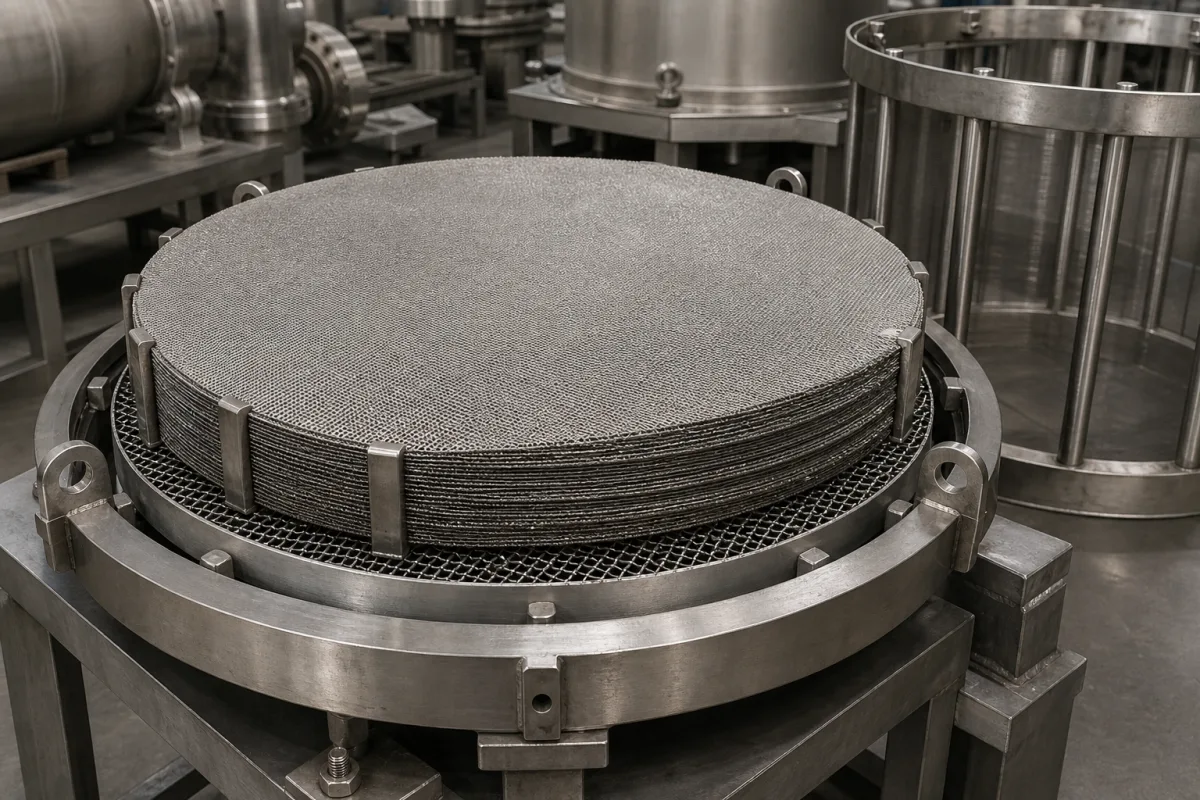
Platinum–rhodium gauze packs for ammonia oxidation · Alloy and palladium, temperature and pressure of the burner, NO yield and campaign life, N₂O formation and secondary catalysts
A catalyst gauze pack is a stack of precious-metal wire gauzes laid across the ammonia burner of a nitric acid plant, where ammonia and air react on the hot metal to form nitric oxide. Settle three things before ordering: the alloy and pack design for your burner diameter, pressure and temperature, the NO yield and campaign length you expect, and how N₂O formation will be controlled, including any secondary catalyst under the pack.
Platinum–rhodium (and palladium-containing) catalyst gauzes and gauze packs for ammonia oxidation in nitric acid plants. Secondary N₂O decomposition catalyst pellets, tail-gas abatement catalysts, base-metal oxidation catalysts and the burner vessel are outside this page.
CNFX editorial research · Sources checked October 12, 2026 · 4 sources
The US EPA report Available and Emerging Technologies for Reducing Greenhouse Gas Emissions from the Nitric Acid Production Industry (December 2010) describes weak nitric acid production in three steps: catalytic oxidation of ammonia with heated air to nitric oxide (4 NH₃ + 5 O₂ → 4 NO + 6 H₂O), oxidation of NO to NO₂, and absorption in water. It describes the catalyst as a 90% platinum, 10% rhodium gauze made from squares of fine wire, with up to 5% palladium also used, giving a 93 to 98% yield of NO at oxidation temperatures of 750 to 900 °C. [1]
The report says higher temperatures and lower pressures raise NO yield, while lower temperatures and higher pressures produce more nitrogen and N₂O. It describes single-pressure plants at medium (4–8 atm) or high (8–14 atm) pressure, and dual-pressure plants that oxidise ammonia from slightly below atmospheric to about 4 atm and absorb at 8–14 atm; dual-pressure plants have better ammonia conversion, longer catalyst life and less frequent catalyst replacement, at higher capital cost. [1]
Editorial note: give the gauze supplier your burner diameter, operating pressure, gauze temperature, ammonia load and campaign target, so that the alloy and pack can be designed for them. [1]
Give the supplier the plant type (single or dual pressure), burner diameter, operating pressure and gauze temperature, ammonia throughput and loading per area, target campaign length, required NO yield, N₂O target and any secondary catalyst, pack design preferences (layers, wire diameter, mesh), precious-metal accounting and recovery terms, and delivery schedule.
02
Plan N₂O control and the campaign
The EPA report identifies ammonia oxidation as the source of N₂O at nitric acid plants and cites a default uncontrolled factor of 9 kg N₂O per tonne of nitric acid used in the US inventory. Among primary controls it notes that improved platinum gauzes have shown 30–40% N₂O reduction at a few plants, that non-platinum oxidation catalysts can reach 80–90% but produce less NO, and that 14 European units with improved oxidation catalysts reported 3.6–9.7 kg N₂O/t, averaging 6.2. [1]
For secondary control, the report describes selective catalysts placed in the ammonia burner immediately downstream of the gauze that decompose N₂O to nitrogen and oxygen, with up to 90% reduction, 130–400 ppm achievable, an average pellet life of four years and no reported effect on ammonia conversion. [1]
Editorial calculation: at the 9 kg/t default factor, a plant making 1,000 t/day of nitric acid emits about 9 t of N₂O a day uncontrolled; a 30–40% reduction from improved gauzes would cut that by about 2.7–3.6 t/day. [1]
03
Use the IPCC default factors to size the N₂O at stake
The 2006 IPCC Guidelines for National Greenhouse Gas Inventories (Volume 3, Chapter 3) state that N₂O is generated as an unintended by-product of the high-temperature catalytic oxidation of ammonia in nitric acid production, and that the amount formed depends, among other things, on combustion conditions (pressure, temperature), "catalyst composition and age" and burner design. They name a process-gas option involving direct catalytic decomposition right after the platinum gauzes among the mitigation routes, and give default N₂O emission factors in Table 3.3, relating to 100 percent pure acid. [4]
The EPA report this page cites uses 9 kg N₂O per tonne of nitric acid as its default uncontrolled factor and reports 30–40% N₂O reduction with improved platinum gauzes at a few plants [1]. The IPCC table shows why the plant type matters for that comparison: the default runs from 5 kg/t for atmospheric-pressure plants to 9 kg/t for high-pressure plants, for plants without the NSCR or N₂O destruction listed in its first two rows [4]. When a gauze supplier offers an N₂O reduction, ask for the baseline factor at your plant's pressure, the measurement method and how the reduction changes over the campaign as the gauze ages.
The IPCC text also distinguishes single-pressure plants, where oxidation and absorption take place at essentially the same pressure, from dual-pressure plants, where absorption takes place at a higher pressure [4]; AP-42 gives the gauze temperature window and NO yield [2]. Give the supplier the burner pressure, gauze temperature and campaign length so the pack design and guarantee match the plant.
Editorial calculation: a plant producing 1,000 tonnes of 100 percent nitric acid a day would emit about 9 t of N₂O a day at the high-pressure default and about 5 t at the atmospheric-pressure default; a 30–40% reduction on 9 t is about 2.7–3.6 t a day. [4][1]
Production process (IPCC Table 3.3)
Default N₂O emission factor
Uncertainty
Plants with NSCR (all processes)
2 kg N₂O/tonne nitric acid
±10%
Plants with process-integrated or tailgas N₂O destruction
2.5 kg N₂O/tonne nitric acid
±10%
Atmospheric pressure plants (low pressure)
5 kg N₂O/tonne nitric acid
±10%
Medium pressure combustion plants
7 kg N₂O/tonne nitric acid
±20%
High pressure plants
9 kg N₂O/tonne nitric acid
±40%
Values are from the IPCC 2006 Guidelines, Volume 3, Chapter 3 (text extracted from the PDF); the defaults are inventory factors, not plant guarantees.
04
Check the operating window and the NOx limit downstream
EPA's AP-42 section 8.8 (Nitric Acid Production) describes the catalyst in widest use as 90% platinum and 10% rhodium gauze made from squares of fine wire. A 1:9 ammonia–air mixture passes through it at 1,380–1,470 °F, oxidising ammonia to nitric oxide with 93–98% yield, and oxidation temperatures can range from 1,380 to 1,650 °F. Higher catalyst temperatures favour NO, while lower temperatures favour nitrogen and nitrous oxide; the gas later passes a waste heat boiler and a platinum filter. [2]
For new and modified US nitric acid plants, 40 CFR 60.72 limits tail-gas nitrogen oxides, expressed as NO₂, to 1.5 kg per metric ton of acid produced (3.0 lb per ton, as 100% nitric acid), and opacity to below 10%. The gauze's NO yield sets how much NOx and N₂O the absorption and abatement steps must handle. [3][2]
Editorial calculation: 1,380–1,470 °F is about 749–799 °C and 1,650 °F about 899 °C; at the 1.5 kg/t limit, a plant making 1,000 t/day of 100% acid may emit up to 1.5 t of NOx (as NO₂) a day from the tail gas. [2][3]
05
Alloy, pack design, NO yield guarantee and metal recovery terms to ask a gauze maker for
Ask any supplier for the alloy, pack design, guaranteed NO yield and campaign life for your burner conditions, and its precious-metal recovery terms. [1]
06
Gauze alloy, palladium content, temperature, plant pressure, secondary catalyst and support grid
Two of the rows are operating conditions rather than hardware, because the EPA report ties NO yield, N₂O formation and catalyst life to gauze temperature and plant pressure. [1]
Burner diameter, pack layers, wire and mesh, loading, temperature and NO yield for a gauze quotation
Only temperature, NO yield, alloy and the fine-wire description carry published values, all from the EPA report; diameter, layers, mesh and loading are pack-design figures for the supplier. [1]
Explore company information and manufacturing capabilities, then discuss the scope of your project with a relevant supplier.
Share this page
Compiled and source-reviewed by the CNFX editorial team.
Each manufacturer above links to the page on that company's own website where the product is listed, with the date we checked it. How we source and review
· Page last updated 13 October 2026
Buyer questions
What are nitric acid catalyst gauzes made of?
EPA describes 90% platinum, 10% rhodium gauze of fine wire, with up to 5% palladium also used. [1]
What temperature do ammonia oxidation gauzes run at?
EPA reports 30–40% reduction with improved platinum gauzes at a few plants, and up to 90% with secondary catalysts below the gauze. [1]
What alloy are ammonia oxidation gauzes made of?
EPA's AP-42 describes the catalyst in widest use as 90% platinum and 10% rhodium gauze woven from fine wire, giving 93–98% NO yield. [2]
How much N₂O does a nitric acid plant emit per tonne of acid?
The IPCC 2006 Guidelines give default factors from 2 kg N₂O/tonne for plants with NSCR and 2.5 kg/tonne with N₂O destruction, to 5, 7 and 9 kg/tonne for atmospheric, medium and high pressure plants without such abatement. [4]
Sources and what still needs a direct check
Sources checked 2026-10-12. The US EPA's December 2010 report on nitric acid production describes ammonia oxidation catalysts and N₂O control; EPA's AP-42 section 8.8 gives the gauze operating window, 40 CFR 60.72 the US tail-gas NOx limit, and the 2006 IPCC Guidelines the default N₂O factors.