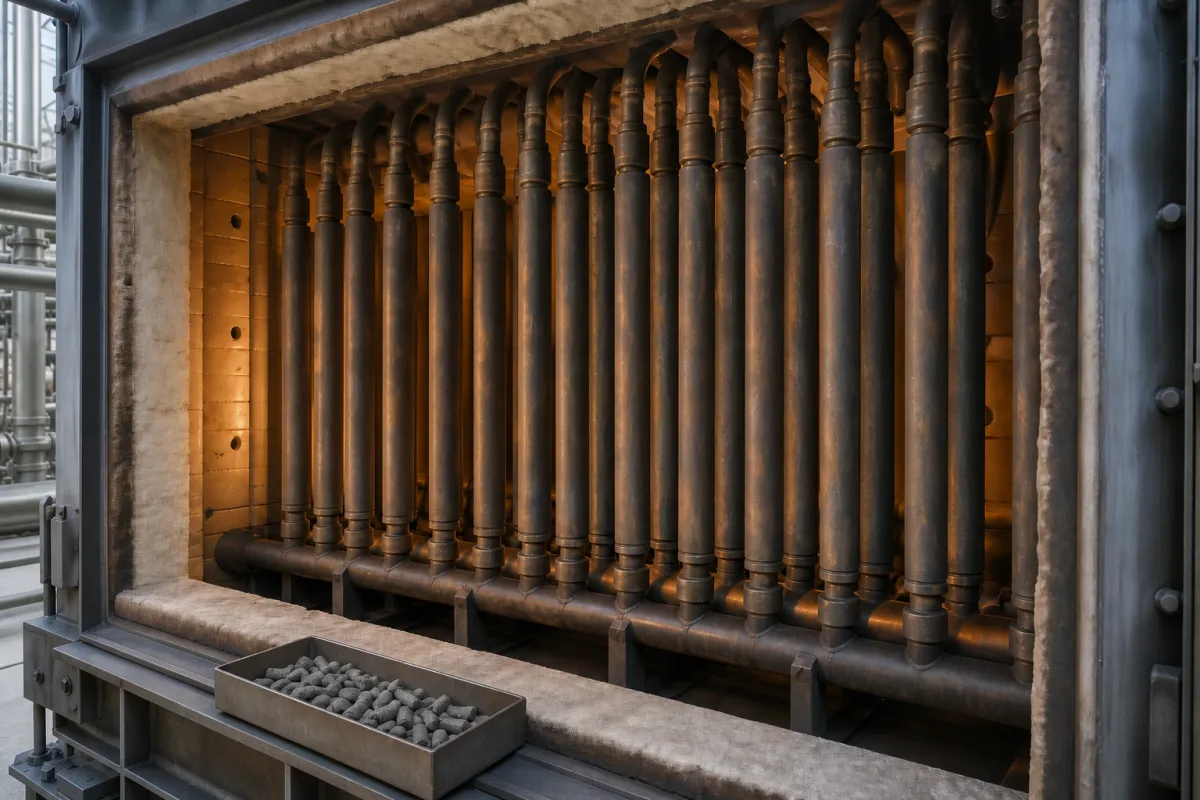
Catalyst (reformer) tubes for primary reformers in hydrogen and fertiliser plants · centrifugally cast HP-Nb and micro-alloyed 35Ni25Cr grades, design creep life, titanium micro-alloying, carbide coarsening, overheating, remaining-life assessment
Catalyst tubes are the catalyst-filled heater tubes of a primary reformer furnace, used in hydrogen production and in fertiliser (ammonia) plants. Their service life is limited by creep, and failures in the studies reviewed trace back to alloy structure and overheating. Ask three things first: the alloy and casting route and how the supplier proves creep strength; the tube dimensions and design life your furnace is rated for; and the inspection and remaining-life assessment you will use in service.
Catalyst-filled reformer tubes for steam reformers — centrifugally cast HP-type heat-resistant alloys such as HP-Nb and micro-alloyed 35Ni25Cr-Nb-Ti — with welds, flanges and outlet connections. The reforming catalyst itself, complete reformer furnaces, outlet headers and pigtails supplied separately, and tubes for ethylene cracking furnaces are outside this page except where compared.
CNFX editorial research · Sources checked October 12, 2026 · 4 sources
A 2023 study in the journal Metals, listed by TU Delft, analysed two reformer tubes from hydrogen production in a petrochemical plant, both made by centrifugal casting of HP-Nb alloy, one containing titanium as a micro-element and one without. Although both saw similar creep conditions, the titanium-free tube failed after only 46,000 hours against a design life of 100,000 hours. Microscopy showed creep pores starting and growing next to chromium carbide particles and microcracks in Cr23C6 carbides, with pore initiation driven by grain-boundary sliding and strongly dependent on structural morphology. The titanium-bearing tube showed higher thermal stability and creep resistance, attributed to finer and more discrete carbide particles. [1]
Doncasters' European patent EP0980729B1 gives the alloy family for reformer and cracker furnace tubes as iron-based with 0.1–0.5% carbon, 20–35% chromium, 20–45% nickel, 0–2% niobium, 0–2% silicon, 0–5% tungsten and 0–1% other additions by weight, and alternatively defines a creep resistant alloy by a mean 100,000-hour stress-rupture value of more than 6 MPa at 1000 °C, preferably more than 10 MPa. The patent says these alloys cannot be readily forged, so the tubes are centrifugally cast and then bored along their length, which removes impurities that float to the inside of the casting. [3]
Editorial note: ask suppliers for the chemical analysis of each heat, including micro-alloying elements such as niobium and titanium, and for stress-rupture data on the cast material, since the study links creep resistance to composition and carbide structure. [1]
Give the supplier the furnace and duty (hydrogen, ammonia, other), alloy grade and micro-alloying, outside diameter, minimum wall thickness and length, design pressure, design metal temperature and design life, casting method and machining of the bore, weld procedures and filler, inspection (dimensional, radiographic, dye-penetrant), stress-rupture test data, certificates, and quantity including spares.
02
Plan for creep life, overheating and remaining-life assessment
A study by India's National Metallurgical Laboratory examined catalyst-filled heater tubes of cast HP-microalloyed 35Ni25Cr1NbTi alloy that failed after 8 years in the primary reformer of a fertiliser complex. Failed portions showed coarsened primary chromium and niobium carbides at inter-dendritic boundaries, degradation of niobium carbide into a Ni–Nb–Si phase and partial conversion back, almost no secondary carbides and lower tensile strength, while cooler regions of the same tube showed less carbide coarsening and higher strength. The failure was attributed to localized overheating causing premature creep failure, and remaining life was assessed by accelerated stress-rupture tests with Larson–Miller parameter prediction. [2]
The same patent describes primary steam reformer tubes as filled with catalyst, with feed passing through them at pressures between 28 and 43 kg/cm² and tubes heated to 875–1000 °C; it names creep as the primary damage mechanism for reformer tubes, and as an example cites an expected life of 12 years for a steam reforming furnace with tube temperatures of 900–1000 °C. [3]
Editorial calculation: a 100,000-hour design life is about 11.4 years of continuous running; the HP-Nb tube that failed at 46,000 hours reached about 5.3 years, 46% of design life, and the 35Ni25Cr1NbTi tubes failing after 8 years had run roughly 70,000 hours if in continuous service. [1][2]
Editorial calculation: 28–43 kg/cm² is about 2.7–4.2 MPa (× 0.0981), and 12 years of continuous running is about 105,000 hours, close to the 100,000-hour design basis in the 2023 study. [3][1]
03
Reference the cast tubing specification and its supplementary tests
ASTM A608/A608M-20 "covers iron-chromium-nickel, high-alloy tubes made by the centrifugal casting process intended for use under pressure at high temperatures". The grades in its Table 1 are intended for applications needing strength and resistance to corrosion and scaling at high temperatures. ASTM's summary says the tubing is supplied as cast or as cast with machining on the outside or inside surfaces, and that it must meet chemical composition limits, an elevated-temperature tension test, and pressure, flattening and mechanical tests. Optional Supplementary Requirements S1 to S11 call for additional tests if the buyer wants them. [4]
The supply condition line connects to the boring step the Doncasters patent describes, in which the bore of a centrifugally cast tube is machined to remove inner-surface impurities [3]. Ask the foundry whether tubes are supplied bored, and to what minimum sound wall. The TU Delft study's HP-Nb tubes and the NML study's 35Ni25Cr1NbTi tubes are micro-alloyed grades [1][2]; ask whether the grade offered is one of the A608 Table 1 grades or the foundry's own, and which of the S1 to S11 supplementary tests will be applied.
Both failure studies cited on this page found carbide changes after service [1][2], and A608 names an elevated-temperature tension test [4]. The summary names a tension test but no stress-rupture test, so ask the foundry for stress-rupture data for the grade at your design metal temperature as well as the A608 test results.
Editorial calculation: the A608 scope page lists 11 optional supplementary requirements (S1 to S11) and 8 elements in the required chemistry. [4]
Item
ASTM A608/A608M-20 (scope page)
Product
Centrifugally cast iron-chromium-nickel high-alloy tubing for pressure use at high temperatures
Supply condition
As cast, or as cast with outside or inside surfaces machined
Elevated-temperature tension test (tensile strength, elongation); pressure, flattening and mechanical tests
Optional tests
Supplementary Requirements S1 to S11
Units
SI or inch-pound, each used independently
Page data
6 pages; last updated Jun 02, 2020; DOI 10.1520/A0608_A0608M-20
Values are from ASTM's scope page for A608/A608M-20; Table 1 grade compositions were not reviewed.
04
Compare what suppliers offer
No manufacturer record has been reviewed for this product yet.
When requesting quotations, ask each foundry for alloy analysis, stress-rupture data, wall-thickness tolerance, inspection scope and references from reformers of similar design.
05
Trace what limits tube life
This is a functional reference built from the sources cited; it is not one maker's design.
Factor
Effect
Fix in the order
Casting and boring
Centrifugal casting, then boring removes inner-surface impurities. [3]
Casting route; bore machining.
Alloy and micro-alloying
Ti gave finer carbides, more creep resistance. [1]
Patent threshold: > 6 MPa at 1000 °C for 100,000 h. [3]
Rupture data for the grade.
06
Fill the specification fields with values for your project
A catalyst tube quotation needs values for your project. The table explains each field, gives published values where a reviewed source states them, and says what to obtain from the supplier.
Explore company information and manufacturing capabilities, then discuss the scope of your project with a relevant supplier.
Share this page
Compiled and source-reviewed by the CNFX editorial team.
Published product pages show what a company offers, not tested performance. Confirm the legal seller, factory and scope for your order. How we source and review
· Page last updated 13 October 2026
Buyer questions
What design life do reformer tubes have?
The tubes in a 2023 failure study had a design life of 100,000 hours. [1]
Does titanium micro-alloying help reformer tubes?
In that study the titanium-bearing HP-Nb tube showed higher thermal stability and creep resistance, attributed to finer, more discrete carbides. [1]
Why do reformer tubes fail early?
An NML study attributed failures after 8 years to localized overheating leading to premature creep failure. [2]
At what pressure and temperature do reformer tubes run?
A Doncasters patent gives primary reformer feed pressures between 28 and 43 kg/cm² and tube temperatures of 875–1000 °C, with creep as the primary damage mechanism. [3]
Which ASTM specification covers centrifugally cast reformer tubing?
ASTM A608/A608M covers iron-chromium-nickel high-alloy tubes made by centrifugal casting for use under pressure at high temperatures, supplied as cast or machined, with optional supplementary tests S1 to S11. [4]
Sources and what still needs a direct check
Sources checked 2026-10-12. Two sources are research abstracts: a 2023 Metals article listed by TU Delft and a 2008 study from India's CSIR-National Metallurgical Laboratory. The third is a European patent held by Doncasters PLC on centrifugally cast furnace tubes; its alloy ranges and furnace conditions are the patent's own statements.