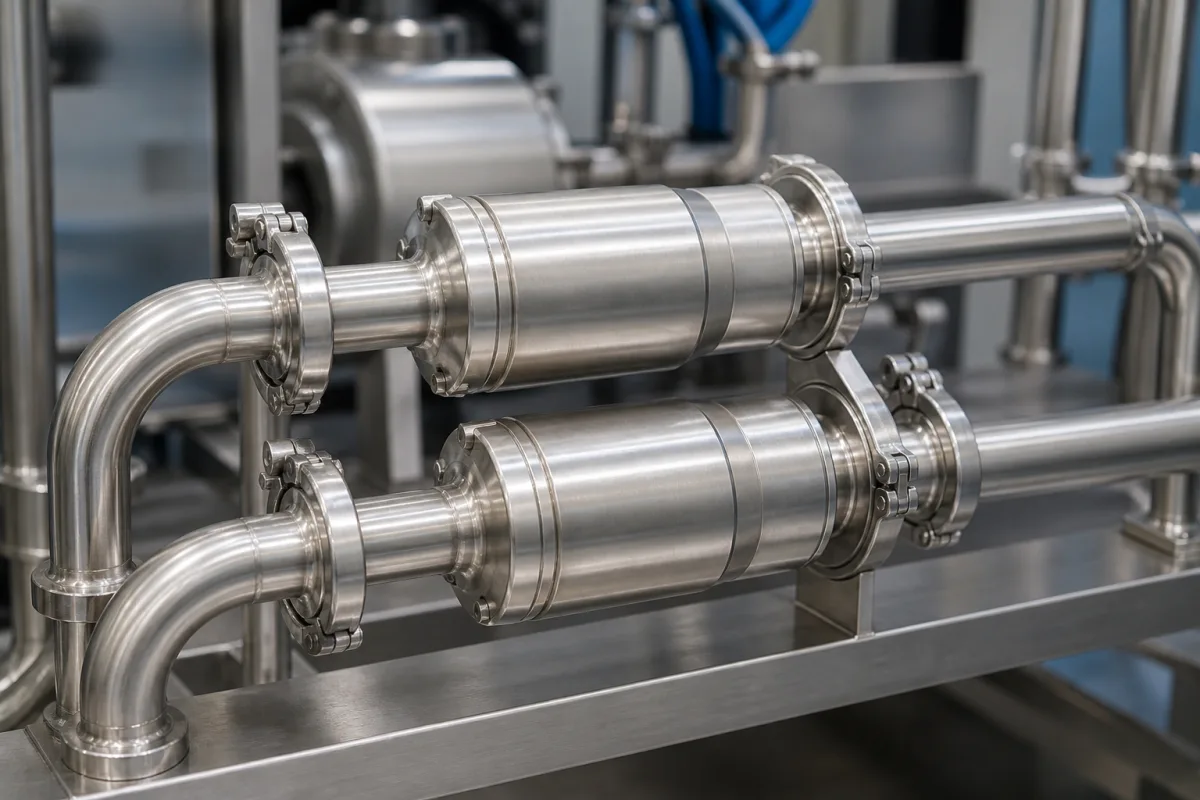
In-line spring check valves for hygienic process and CIP lines
The illustrated pair are in-line check valves on a stainless process skid: cylindrical bodies held together by clamps, with clamp ferrules to the pipework on each side. Inside, a spring holds a plug or piston on its seat until line pressure pushes it open. Two hygienic valve makers, Alfa Laval and Pentair Südmo, publish enough on their versions to set out how such a valve opens, what it costs in pressure drop and where its limits are.
Covers spring-loaded in-line check (non-return) valves for hygienic liquid service in food, beverage, dairy, brewery and pharmaceutical process lines, with clamp or weld ends to DIN, ISO or inch OD tube. The original catalogue entry described check valves on precision dosing pumps; the pump-head and injection-point valves of dosing systems are covered on 4267 (injection valve and quill), 4303 (metering pump) and 822 (dosing skid). Swing, wafer, dual-plate, API and oilfield check valves, fire-protection alarm check valves and rubber duckbill valves are outside this page; the general check valve page is 10250, sanitary pressure relief valves are on 282. Other hygienic line components share vocabulary but not function: regulating valves 4560, gaskets 390, flow meters 944, temperature points 3121, homogenizer valves 3306, tubular heat exchangers 3046.
CNFX editorial research · Sources checked October 13, 2026 · 3 sources
Alfa Laval describes the LKC non-return valve as a two-part body, a valve plug and a spring held together by a clamp ring, with a four-legged guide disc keeping the spring-loaded plug aligned. The spring keeps the valve closed until the force from inlet pressure exceeds it; on reverse flow the spring and the outlet pressure hold it shut.
Alfa Laval's 0.06 bar figure applies to the vertical installation in its figure 2; the leaflet gives no value for horizontal mounting, which is why the LKC-H exists as a separate version.
Pentair names in-line cleanability as a feature and lists CIP fluids among the media the F264J handles. A valve that only opens when flow pushes against the spring is cleaned in place by the CIP flow itself, so the CIP supply has to come from the inlet side (editorial reading).
Point
Alfa Laval LKC
Pentair Südmo F264J
Closing element
Spring-loaded plug with O-ring seal, guided by a four-legged disc
Piston held closed by a light stainless steel spring
Opening
About 6 kPa (0.06 bar) differential when fitted in a vertical pipe
Light spring for a low cracking pressure; piston compresses the spring until it reaches its travel stop
Mounting
Two versions: LKC-2 for vertical flow, LKC-H for horizontal flow
Can be installed in any position; vertical with upward flow recommended for optimum performance
Ends
Weld and clamp ends for ISO and DIN tube
Butt weld or clamp as standard, others on request; flow direction indicator
Neither maker publishes a spring rate. Where an exact opening pressure matters, for example on a gravity-fed line, ask for it in the installed orientation.
02
Pressure drop: Kv by size, and what a valve costs at your flow
Pentair's F264J brochure gives a flow coefficient for each size alongside its pressure-drop graph; Alfa Laval's leaflet gives a pressure-drop curve per size measured with water at 20 °C to VDI 2173.
With Δp = (Q/Kv)² for water, Δp in bar and Q in m³/h, a DN 50 F264J passing 20 m³/h loses about 0.05 bar and a DN 25 passing 5 m³/h about 0.06 bar (Editorial calculation). Both are close to the 0.06 bar Alfa Laval quotes just to open its LKC, so on a short low-pressure line the spring can account for as much pressure as the flow does (editorial reading).
The brochure's selection guide also lists FEP among the O-ring options and a body drain (DRN) as an extended option, alongside NBR, FKM and EPDM with a 316L body.
F264J size
Kv
Cv
DN 25 (1")
20
23
DN 40 (1½")
40
46
DN 50 (2")
87
101
DN 65 (2½")
109
126
DN 80 (3")
163
189
DN 100 (4")
210
244
DN 150 (6")
280
325
Kv and Cv are read from the labels on Pentair's pressure-drop graph for the F264J; other makes differ and should be read from their own curves.
03
Steel, seals and temperature: what decides the cleaning regime
Both makers build the wetted body in austenitic stainless steel and offer a choice of elastomers; the temperature ceilings differ.
The 95 °C ceiling on the F264J and the 140 °C rating for EPDM in the LKC are the figures to hold against the hottest step of the line's cleaning or sterilising cycle before choosing a valve (editorial comparison of the two documents).
Pentair states that the one-piece machined body with heavy-duty clamps withstands pressure spikes well beyond the 10 bar rating; that is a robustness statement, not a higher working pressure.
Item
Alfa Laval LKC (leaflet)
Pentair Südmo F264J (brochure)
Wetted steel
1.4301 (304) or 1.4404 (316L)
Body, plug, guide plate and cover 316 SS (ASTM A276)
Spring
Not specified in the leaflet
302 SS (ASTM A313)
Seals
EPDM standard; NBR or FPM options
NBR, EPDM or FKM, FDA (commercial)
Surface finish
Internal Ra < 0.8 µm; external machined Ra 1.6
Not stated
Temperature
−10 °C to 140 °C (EPDM)
−10 °C to 95 °C
Pressure
Max. 1,000 kPa (10 bar)
Max. 10 bar at 20 °C; full vacuum
Sizes
DN 25–100; ISO 25–101.6
DN 25–150; 1"–6" OD; DIN 11850 / DIN 32676, ISO 2037 / BS 4825-1 / ISO 2852
04
What to give a hygienic check valve supplier
Paste it into your enquiry below or into an email to a maker, then replace every bracket.
Give the tube standard and size (DIN 11850, ISO or inch OD), end connection (clamp or weld), product and CIP media, the highest temperature in production and cleaning, maximum and minimum line pressure including vacuum, flow rate, and whether the valve will sit in a vertical or horizontal run. Ask for the opening pressure in that orientation, Kv or pressure-drop curve for the size, wetted steel grade, seal material with its food-contact statement, internal surface finish, and spare seal and spring kits.
12 companies list this product among what they make. Company figures are quoted from each
company's own website; every card states where the relationship came from.
China Sanitary Valve
card
Lists hygienic (sanitary) check valves on its own product page. Location TBC.
Explore company information and manufacturing capabilities, then discuss the scope of your project with a relevant supplier.
Share this page
Compiled and source-reviewed by the CNFX editorial team.
Each manufacturer above links to the page on that company's own website where the product is listed, with the date we checked it. How we source and review
· Page last updated 13 October 2026
Buyer questions
How much pressure does a hygienic check valve need to open?
Alfa Laval gives about 6 kPa (0.06 bar) for its LKC non-return valve fitted in a vertical pipe. [1]
Can a hygienic check valve be mounted horizontally?
Alfa Laval makes a separate LKC-H version for horizontal flow; Pentair says its F264J can be installed in any position but recommends vertical with upward flow. [1][2]
What is the Kv of a DN 50 hygienic check valve?
Pentair's brochure gives Kv 87 (Cv 101) for the DN 50 Südmo F264J. [3]
Sources and what still needs a direct check
Sources checked 2026-10-13. Product leaflets and a brochure from two hygienic valve makers, Alfa Laval and Pentair Südmo.