Industry-Verified Manufacturing Data (2026)

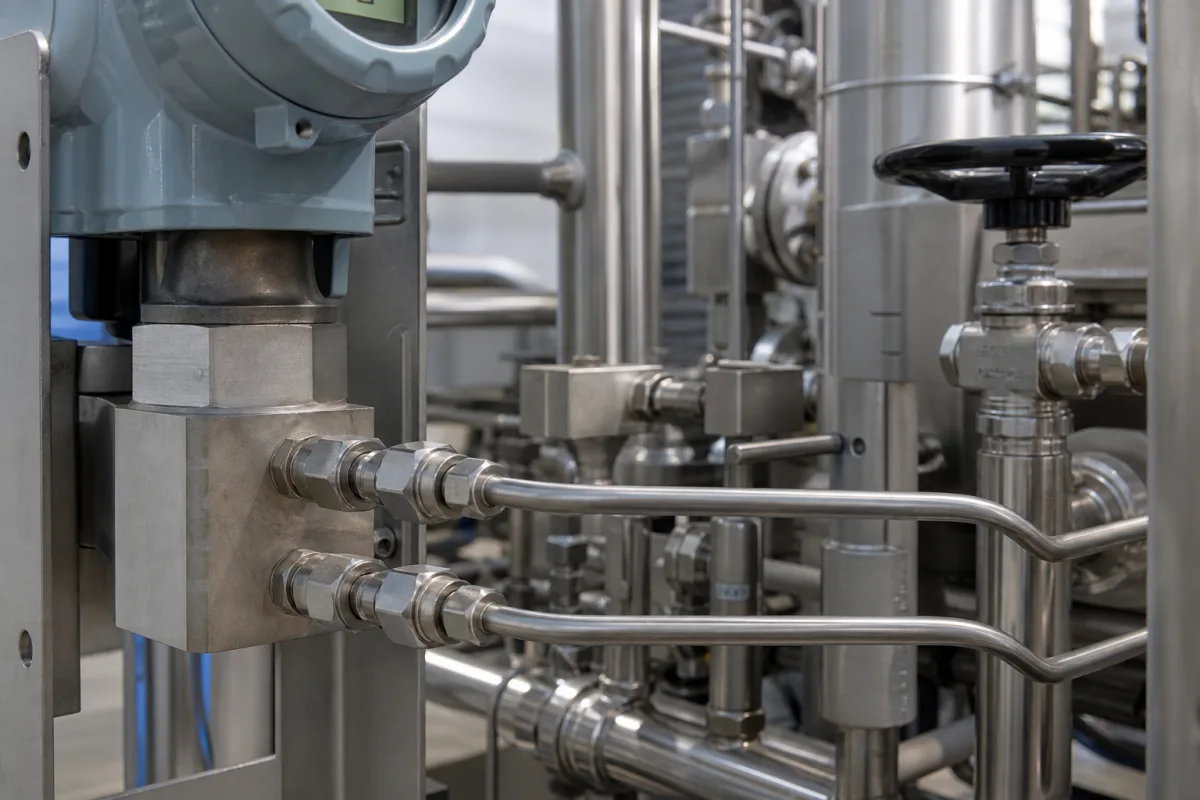
Compression Fitting

Based on aggregated insights from multiple verified factory profiles within the CNFX directory, the standard Compression Fitting used in the Chemical Manufacturing sector typically supports operational capacities ranging from standard industrial configurations to heavy-duty production requirements.

Technical Definition & Core Assembly

A canonical Compression Fitting is characterized by the integration of Fitting Body and Compression Nut. In industrial production environments, manufacturers listed on CNFX commonly emphasize Stainless Steel (e.g., 316/316L) construction to support stable, high-cycle operation across diverse manufacturing scenarios.

A mechanical fitting that creates a leak-tight seal by compressing a ferrule or sleeve onto a tube or pipe when tightened.
Product Specifications

Technical details and manufacturing context for Compression Fitting

Definition
In the context of a Chemical Reactor Temperature Sensor Probe, the compression fitting serves as the critical connection point that securely attaches the temperature sensor's probe or thermowell to the reactor piping or vessel wall, ensuring a pressure-tight and leak-proof seal to prevent process fluid escape and maintain measurement integrity in harsh chemical environments.
Working Principle
The fitting consists of a body, a nut, and one or two ferrules (sleeves). When the nut is tightened onto the fitting body, it forces the ferrule(s) to compress radially onto the inserted tube or probe stem. This compression creates both a mechanical grip (preventing pull-out) and a metal-to-metal seal (preventing leaks) by deforming the ferrule against both the tube and the fitting body.
Common Materials
Stainless Steel (e.g., 316/316L)
Technical Parameters
  • Tube or probe stem outer diameter (OD) that the fitting is designed to connect. (mm) Per Request
Components / BOM
  • Fitting Body
    Main structural component with internal taper that receives the tube and ferrule, forming one side of the seal.
  • Compression Nut
    Threads onto the body to apply axial force, driving the ferrule forward to create compression and seal.
  • Front Ferrule
    Primary sealing element. Compresses onto the tube and bites slightly into it, creating the main leak-tight seal.
  • Back Ferrule (if dual ferrule design)
    Provides a gripping action on the tube to prevent vibration-induced loosening and supports the front ferrule.
Engineering Reasoning
0-689 bar (0-10000 psi) for standard brass fittings, 0-1379 bar (0-20000 psi) for high-pressure stainless steel variants
Seal failure occurs at 1.5x rated pressure (1034 bar for 689 bar rated fittings), mechanical failure at 2.0x rated pressure (1379 bar for 689 bar rated fittings)
Design Rationale: Plastic deformation of ferrule material (typically 316 stainless steel with yield strength 290 MPa) exceeding elastic limit, causing permanent set and loss of spring-back force required for sealing
Risk Mitigation (FMEA)
Trigger Insufficient tube insertion depth (less than 2x tube OD per SAE J514 standard)
Mode: Ferrule seats on tube shoulder instead of full circumference, creating 0.1-0.3 mm radial gap
Strategy: Positive-stop design with visual insertion indicator marks and torque-limiting assembly tools
Trigger Over-torque during assembly exceeding 150% of specified value (e.g., 45 N·m instead of 30 N·m)
Mode: Ferrule material work-hardening beyond Rockwell C45, reducing ductility by 60%
Strategy: Torque-to-yield assembly procedure with angle-controlled tightening (90° ±5° rotation after hand-tight)

Industry Taxonomies & Aliases

Commonly used trade names and technical identifiers for Compression Fitting.

Industrial Ecosystem & Supply Chain DNA

Complementary Systems
Downstream Applications
Specialized Tooling

Application Fit & Sizing Matrix

Operational Limits
pressure: Up to 10,000 psi (690 bar) depending on size and material
other spec: Flow rate: Varies with tube ID and system design; Slurry concentration: Limited to low-particulate applications (<5% solids by volume)
temperature: -65°F to 400°F (-54°C to 204°C) typical for standard materials
Media Compatibility
✓ Hydraulic fluids (petroleum-based) ✓ Instrumentation air/gas ✓ Potable water systems
Unsuitable: Highly corrosive chemicals (e.g., concentrated acids, strong oxidizers)
Sizing Data Required
  • Tube outer diameter (OD) and wall thickness
  • System operating pressure and temperature
  • Tube material and hardness

Reliability & Engineering Risk Analysis

Failure Mode & Root Cause
Leakage due to improper ferrule seating
Cause: Insufficient tube insertion depth, incorrect ferrule orientation, or inadequate tightening torque during installation, preventing proper compression seal formation.
Stress corrosion cracking
Cause: Exposure to corrosive media (e.g., chlorides, acids) combined with residual tensile stresses from over-tightening or vibration-induced cyclic loading in susceptible materials like stainless steel.
Maintenance Indicators
  • Visible fluid weeping or dripping at the fitting body-ferrule interface
  • Audible hissing or high-frequency vibration noise indicating gas or high-pressure fluid escape
Engineering Tips
  • Use a calibrated torque wrench and manufacturer-specified installation procedures to ensure correct ferrule compression without over-tightening, which can deform components and reduce fatigue life.
  • Select fitting materials compatible with the fluid service (considering temperature, pressure, and chemical compatibility) and install vibration dampeners or supports near fittings in high-vibration systems to reduce cyclic stress.

Compliance & Manufacturing Standards

Reference Standards
ISO 8434-1: Hydraulic fluid power - Connections - Part 1: 24° cone connectors ANSI/ASME B16.11: Forged Fittings, Socket-Welding and Threaded DIN 2353: Tube fittings with 24° cone for hydraulic applications
Manufacturing Precision
  • Bore diameter: +/-0.02mm
  • Surface finish: Ra 0.8μm maximum
Quality Inspection
  • Pressure test: 1.5x working pressure for 2 minutes
  • Dimensional verification with calibrated gauges

Factories Producing Compression Fitting

Verified manufacturers with capability to produce this product in China

✓ 93% Supplier Capability Match Found

T Technical Director from Germany Feb 15, 2026
★★★★★
"Testing the Compression Fitting now; the technical reliability results are within 1% of the laboratory datasheet."
Technical Specifications Verified
P Project Engineer from Brazil Feb 12, 2026
★★★★☆
"Impressive build quality. Especially the technical reliability is very stable during long-term operation. (Delivery took slightly longer than expected, but technical support was excellent.)"
Technical Specifications Verified
S Sourcing Manager from Canada Feb 09, 2026
★★★★★
"As a professional in the Chemical Manufacturing sector, I confirm this Compression Fitting meets all ISO standards."
Technical Specifications Verified
Verification Protocol

“Feedback is collected from verified sourcing managers during RFQ (Request for Quote) and factory evaluation processes on CNFX. These reports represent historical performance data and technical audit summaries from our B2B manufacturing network.”

8 sourcing managers are analyzing this specification now. Last inquiry for Compression Fitting from India (23m ago).

Supply Chain Compatible Machinery & Devices

Automated Batch Crystallization System

Automated system for controlled crystallization of chemical compounds in batch processes.

Explore Specs →
Automated pH Monitoring and Dosing System

Automated system for continuous pH monitoring and chemical dosing in process streams.

Explore Specs →
Automated Powder Dispensing and Blending System

Automated system for precise dispensing and homogeneous blending of powdered chemicals.

Explore Specs →
Automated Solvent Recovery and Purification System

Automated system for recovering and purifying industrial solvents.

Explore Specs →

Frequently Asked Questions

Why are 316/316L stainless steel compression fittings preferred in chemical manufacturing?

316/316L stainless steel offers superior corrosion resistance against chemicals, acids, and chlorides, ensuring long-term reliability and preventing contamination in chemical processing applications.

How does the dual ferrule design create a leak-tight seal in compression fittings?

The dual ferrule design uses a front ferrule that grips the tube and a back ferrule that provides spring action, creating a mechanical seal that maintains integrity even under vibration and thermal cycling in chemical systems.

What maintenance considerations are important for compression fittings in chemical plants?

Regular inspection for corrosion, proper torque during installation, and using compatible tube materials are crucial. Avoid overtightening and ensure fittings match the chemical compatibility requirements of your specific process fluids.

Can I contact factories directly on CNFX?

CNFX is an open directory, not a transaction platform. Each factory profile provides direct contact information and production details to help you initiate direct inquiries with Chinese suppliers.

Get Quote for Compression Fitting

Request technical pricing, lead times, or customized specifications for Compression Fitting directly from verified manufacturing units.

Your business information is encrypted and only shared with verified Compression Fitting suppliers.

Thank you! Your message has been sent. We'll respond within 1–3 business days.

Need to Manufacture Compression Fitting?

Connect with verified factories specializing in this product category

Add Your Factory Contact Us
Previous Product
Column Shell
Next Product
Concentration Column